

Stakeholders (SPICE)
A healthy company delivers value to 5 groups — Society, Partners, Investors, Customers, and Employees — not just to the cash register. This panel shows all 5 with real data.
The screen
The real screen, in the theme you picked above.
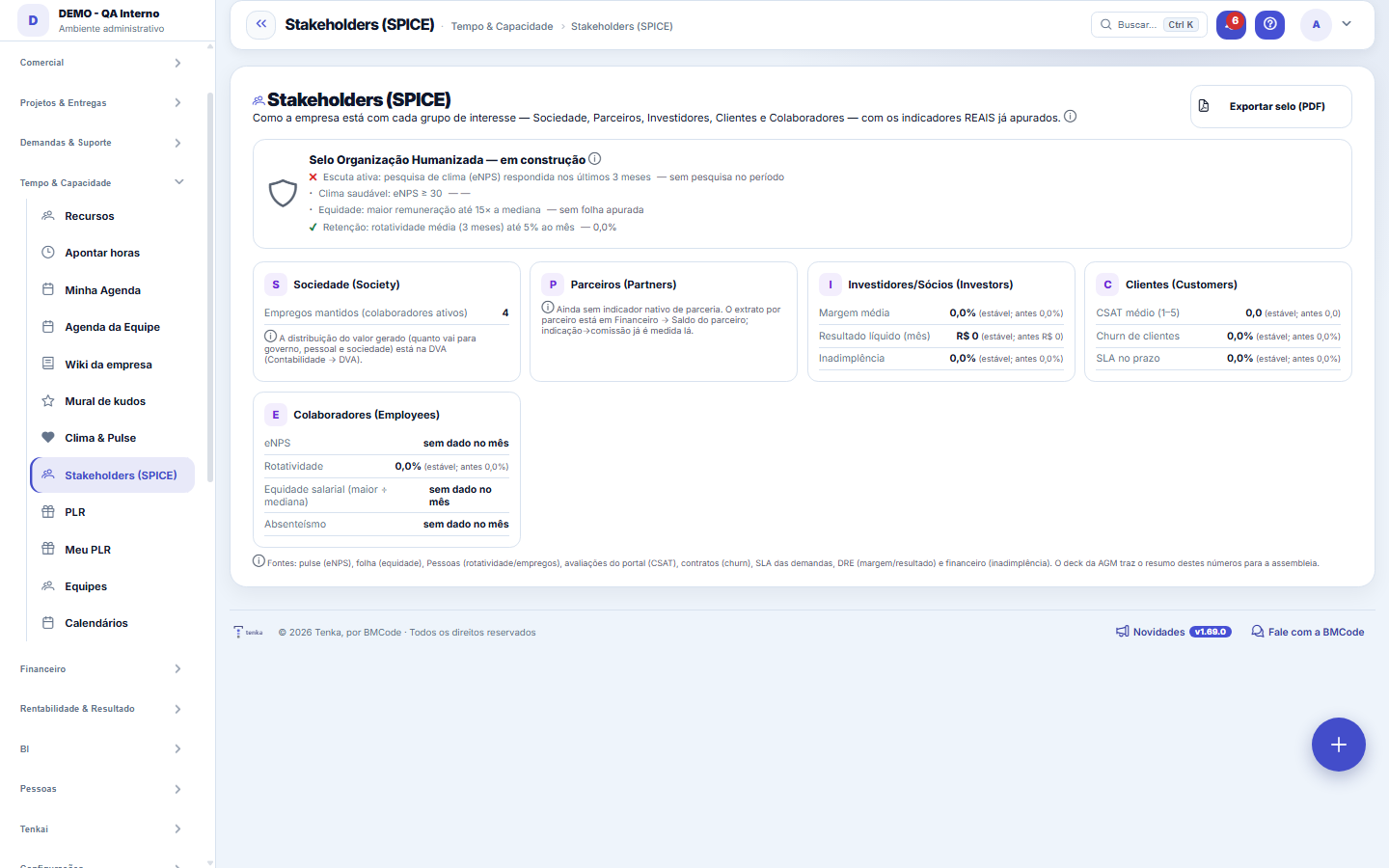
What you find on this screen
A portrait of the screen, read from the screen itself — it changes when the screen changes.
Available actions
Export seal (PDF)
Form fields
Selo Organização HumanizadaSe a empresa atende os critérios mínimos do selo ou ainda está em construção.
eNPSÍndice de recomendação da empresa pelos próprios colaboradores.
RotatividadePercentual de saídas de pessoal no período, o turnover.
Equidade salarialRazão entre o maior salário e o salário mediano da empresa.
AbsenteísmoPercentual de ausências do time no período.
CSAT médioNota média de satisfação declarada pelos clientes, de 1 a 5.
Churn de clientesPercentual de clientes perdidos no período.
SLA no prazoPercentual de atendimentos entregues dentro do prazo acordado.
Margem médiaMargem média da operação no período.
Resultado líquido do mêsResultado gerencial do mês, receitas menos custos e despesas.
InadimplênciaPercentual da carteira a receber em atraso.
Empregos mantidosQuantidade de vínculos ativos que a empresa sustenta.
Start here
What it's for
Brings together in one screen the native indicators for each stakeholder group (eNPS, turnover, pay equity, CSAT, churn, SLA, margin, delinquency, jobs) with the current month and the trend — the Humanized Organizations view.
Rules
Where the numbers come from
Pulse (eNPS), payroll (pay equity), People (turnover/jobs), portal ratings (CSAT), contracts (churn), demand SLA, DRE and finance. "No data for the month" = there was no record — we never make up a number.
The seal and its criteria
The Humanized Organization seal is INTERNAL and transparent: active climate survey (3 months), eNPS ≥ 30, pay equity up to 15× and average turnover up to 5%/month. All met = seal earned, exportable as a PDF with the values.
It's not an external certification
The seal is your humanized-management thermometer, calculated from your own data — it doesn't replace market certifications. The PDF states this explicitly (credibility comes from transparency).
How absenteeism is calculated
UNSCHEDULED absence hours divided by the expected hours for the month, times 100. Vacation is not included: rest agreed on in advance is not an absence, and adding it in would turn good vacation management into an attendance problem. Refused or cancelled absences are also left out — what didn't happen doesn't count. The expected hours come from the weekly schedule registered for whoever was active in that period; without a registered schedule, the indicator shows as not calculable, not as zero.
Frequently asked questions
Groups still without an indicator
Partners and part of Society don't yet have a native indicator — the panel points to where to see what already exists (partner balance, DVA) instead of making up a metric.
Was this article helpful?
In the same module: People and development24
9-box and calibrationThe matrix that crosses performance with potential, and the room where managers compare their standards with …Performance reviewThe reading of a work PERIOD, not of the person: how they delivered (competencies, with evidence), how much t…Peer reviewWhere whoever works alongside the person answers — on the same scale as the cycle, with evidence, anonymously…Climate & PulseAnonymous climate and eNPS surveys to listen to the team.New HiresThe people-inflow pipeline: from accepted offer to ACTIVE employee with a start date — feeding payroll, cost,…Company cultureThe honest portrait of how the company actually works — derived from an anonymous 16-statement diagnostic, on…TerminationsThe organized exit: final settlement, dates, and contract closure — with immediate effect on payroll, cost, a…FeedbackRecord, in half a minute, what happened, what the person did, and the effect of it — to become a ready-made a…
Tenka Academy
Explore the AcademyStep-by-step learning paths for your industry, inside the platform.