

Peer review
Where whoever works alongside the person answers — on the same scale as the cycle, with evidence, anonymously and all at once. And where the leader builds the list of who evaluates whom.
The screen
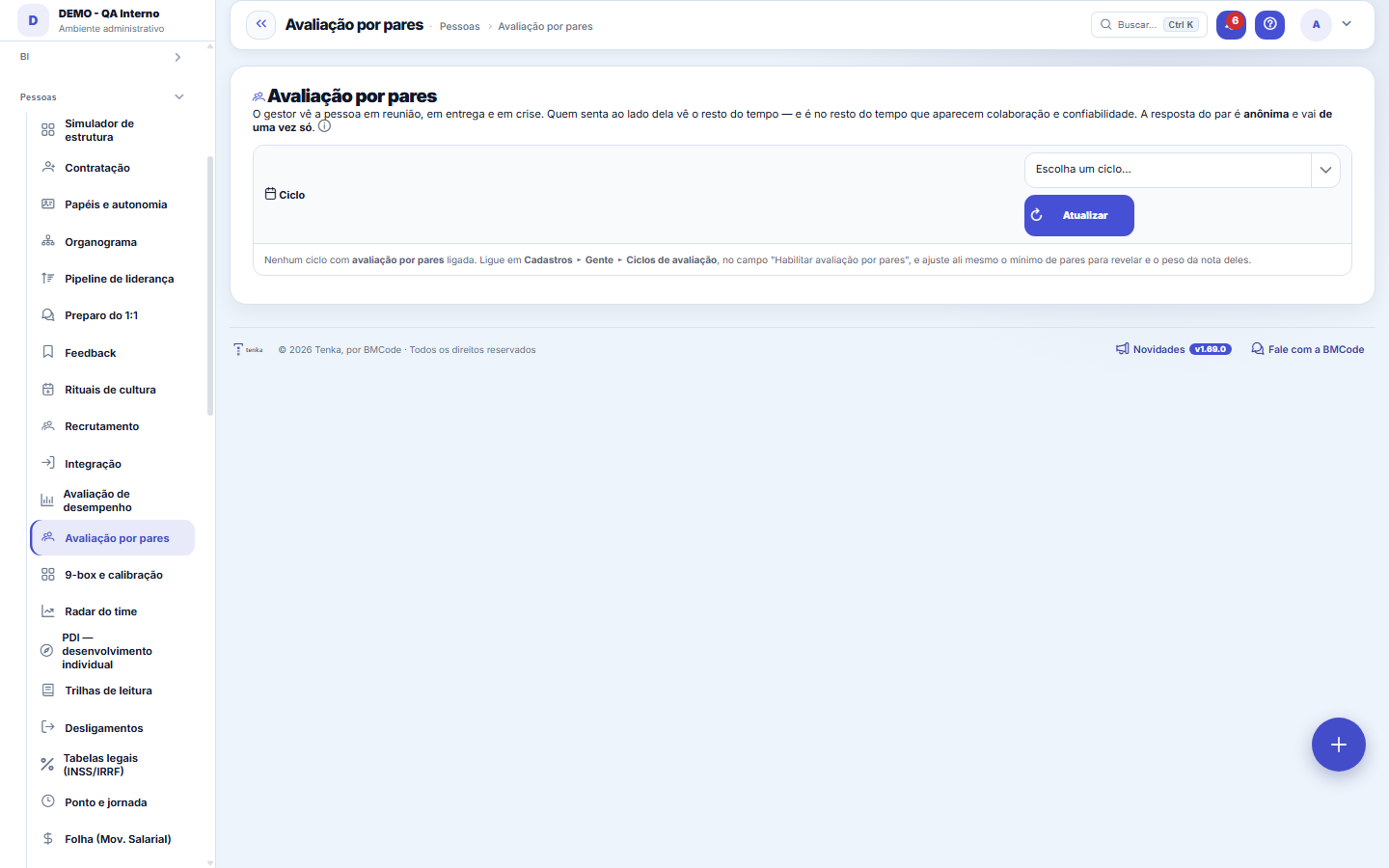
The real screen, in the theme you picked above.
What you find on this screen
A portrait of the screen, read from the screen itself — it changes when the screen changes.
Available actions
RefreshSubmit (final)Close without sendingDecline this invitationRespondPeersInvite
Form fields
Par convidadoColega chamado para opinar sobre o avaliado.
AvaliaçãoFicha de avaliação que este convite alimenta.
OrigemSe o par foi indicado pelo gestor, pelo próprio avaliado ou sorteado pelo sistema.
SituaçãoSe o convite está pendente, respondido ou recusado.
Convidado emQuando o convite saiu. Serve para medir quanto tempo a resposta está demorando.
Respondido emQuando o par respondeu. Vazio no fim do ciclo é resposta que não veio.
Motivo da recusaPor que o colega não quis ou não pôde avaliar.
Start here
What it is for
The manager sees the person in meetings, in deliveries and in crises. Whoever sits next to them sees the rest of the time — and it is in the rest of the time that collaboration, reliability and the effect the person has on those who depend on them show up. Peer review exists to bring that part into the conversation. It does not replace the manager's reading: it complements it, and the cycle decides whether it complements only by informing or also by weighing on the score.
O que esta tela responde
How those who work alongside see the person — the reading the manager doesn't have. Here you set up who evaluates whom, send the invitations, answer your queue and read the consolidated result.
Rules
O QUE O AVALIADO VÊ e o que ele NUNCA vê
They see: how many peers answered, the average per competency and the evidence texts. They NEVER see: who was invited, who answered, who didn't answer, or which score came from whom. And they see NOTHING until the cycle's minimum number of answers is reached — the system never reveals with fewer than 3, even if someone configures 1. It is the same floor as the climate pulse, for the same reason: with one or two answers, "anonymous" is just a word on the screen.
A nota entra SEM avaliador, e isso é definitivo
The system records that you took part, but it does not record that the score is yours. This is neither a setting nor an internal policy: the person↔score link does not exist in the database. Nobody can reconnect it later — not HR, not whoever has database access, not at the board's request.
A resposta vai de UMA VEZ SÓ — e isso é o anonimato funcionando
There is no saving a draft and coming back later. To come back later, the system would need to know that that answer is yours — and that is exactly the link it refuses to keep. The peer's score goes in with no evaluator recorded; the invitation only records that you took part, never what you wrote. Read the whole scale before starting and send it when you finish.
Por que não dá para salvar rascunho
For the same reason. To give you back a half-finished draft, the system would need to know that that answer is yours — and that is precisely the link that doesn't exist. That is why the answer is all at once: set aside the minutes before starting.
Escreva o fato, não a pessoa
The person being evaluated will READ your evidence, without your name on top. Text that describes a situation ("during customer X's turnaround, reorganized the queue and flagged the risk before it blew up") helps and doesn't expose anyone. Text that describes someone ("he is disorganized") doesn't help, and it is the kind of sentence the team can identify by its style. A score without evidence is not accepted, here as in the rest of the cycle.
Nada é revelado abaixo de 3 respostas
With one or two answers, the reader deduces who wrote them — and then anonymity is over. That is why the result only opens from three answers onwards, for the person evaluated, for the manager and for HR alike. The cycle can require more than three; never fewer.
Frequently asked questions
How many peers to invite, and whom
From 3 to 5 people who actually worked with the person being evaluated during the period. Fewer than 3 and the reading cannot be revealed. Many more than 5 and the average turns lukewarm: everyone becomes "good". Invite those who depend on the person's delivery and those who deliver to them — not just those who like them. Whoever leads sees how many invitations were sent and how many came back, but never WHICH came back: if answers are missing, remind the whole group.
What this screen answers
You see HOW MANY invitations came back, never WHICH ones. Knowing who is missing is knowing who answered — and from there to "who wrote what" is one step. To chase answers, chase the whole team.
Was this article helpful?
In the same module: People and development24
9-box and calibrationThe matrix that crosses performance with potential, and the room where managers compare their standards with …Performance reviewThe reading of a work PERIOD, not of the person: how they delivered (competencies, with evidence), how much t…Climate & PulseAnonymous climate and eNPS surveys to listen to the team.New HiresThe people-inflow pipeline: from accepted offer to ACTIVE employee with a start date — feeding payroll, cost,…Company cultureThe honest portrait of how the company actually works — derived from an anonymous 16-statement diagnostic, on…TerminationsThe organized exit: final settlement, dates, and contract closure — with immediate effect on payroll, cost, a…FeedbackRecord, in half a minute, what happened, what the person did, and the effect of it — to become a ready-made a…Integration — onboarding and offboardingThe company's checklist becomes a task with a date and an owner for each person. That is the difference betwe…
Tenka Academy
Explore the AcademyStep-by-step learning paths for your industry, inside the platform.