

9-box and calibration
The matrix that crosses performance with potential, and the room where managers compare their standards with one another. Every movement between quadrants is recorded with a reason, forever.
The screen
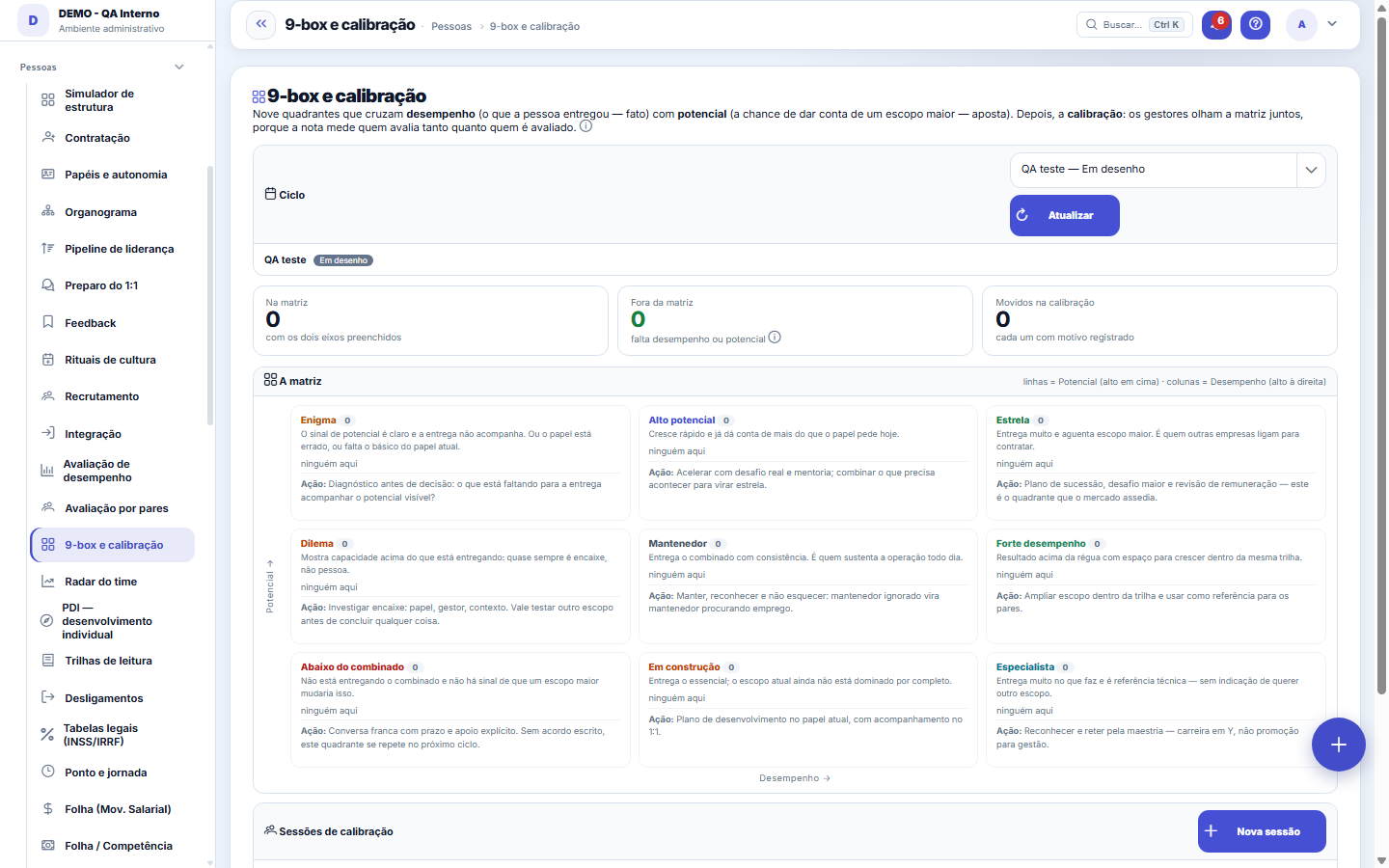
The real screen, in the theme you picked above.
What you find on this screen
A portrait of the screen, read from the screen itself — it changes when the screen changes.
Available actions
RefreshConfirm transactionCancelNew sessionSave sessionComplete session
Form fields
Nome da sessãoComo esta rodada de calibração é chamada pelo comitê.
CicloRodada de avaliação que está sendo calibrada.
Data da sessãoQuando o comitê se reuniu para comparar as notas.
ParticipantesQuem estava na mesa. É o que dá legitimidade à mudança de quadrante.
PautaQuais casos entraram na discussão da sessão.
ConclusõesO que ficou decidido, incluindo os movimentos de quadrante e o motivo de cada um.
SituaçãoSe a sessão está agendada, em andamento ou concluída.
Concluída emQuando a calibração foi encerrada e as notas passaram a valer.
Start here
O que a matriz é — e o que ela não é
Nine boxes formed by two three-level axes: performance (low/medium/high, horizontal) and potential (vertical). It reads like a chart: high potential at the top, high performance on the right.
The matrix is not a ranking. There is no good box and bad box — there are boxes with different actions. It exists so the company stops treating different situations with the same conversation: someone who delivers a lot without wanting another scope needs recognition, not promotion; someone with visible potential who does not deliver needs a diagnosis, not a warning.
The matrix is not a ranking. There is no good box and bad box — there are boxes with different actions. It exists so the company stops treating different situations with the same conversation: someone who delivers a lot without wanting another scope needs recognition, not promotion; someone with visible potential who does not deliver needs a diagnosis, not a warning.
What this screen answers
Where each person on the team falls at the intersection of PERFORMANCE (what they delivered) and POTENTIAL (what they can take on going forward) — and what the company does about each quadrant. Nine boxes, and a recommended action in each one.
How to
Potencial não é desempenho bom
It is the most common mistake with the tool. High performance in today's role does not imply potential for tomorrow's role — they are independent axes, and it is precisely because they are independent that the matrix has nine boxes instead of an ordered list. Each quadrant shows on screen what it means and what to do.
Rules
The nine quadrants and what to do in each
1 · Below expectations — a frank conversation, with a deadline and explicit support. Without a written agreement, this quadrant repeats in the next cycle.
2 · Developing — development plan in the current role, followed up in the 1:1.
3 · Specialist — recognize and retain through mastery: a dual career track, not promotion to management.
4 · Dilemma — investigate fit (role, manager, context). It is worth testing another scope before concluding anything.
5 · Maintainer — the one who sustains operations every day. An ignored maintainer becomes a maintainer looking for a job.
6 · Strong performer — broaden scope within the track and use as a reference for peers.
7 · Enigma — diagnosis before decision: what is missing for delivery to match the visible potential?
8 · High potential — accelerate with a real challenge and mentoring; agree on what needs to happen to become a star.
9 · Star — succession, a bigger challenge and compensation review. It is the quadrant the market courts.
The screen repeats the recommended action at the bottom of each cell, so the matrix does not end in contemplation.
Calibrar é o ponto, não preencher
The matrix exists for managers to discuss TOGETHER. Alone, each manager scores by their own yardstick — and a "4" in area A becomes a "3" in area B without anyone noticing. The calibration session is where the yardsticks are aligned, and each person's movement between quadrants is recorded along with who proposed it.
How the score becomes a quadrant
Each axis is normalized to the cycle's scale and cut into thirds: the bottom third is low, the middle is medium, the top is high. On the default 1 to 5 scale that means below 2.33 = low, 2.33 to 3.67 = medium and 3.67 or more = high. Changing the cycle's scale moves the cuts along with it, automatically.
If a score is missing on either axis, the person appears in the "Outside the matrix" card and does not enter any box. It is on purpose: guessing a quadrant so as not to leave a gap is how every matrix nobody believes in begins. Those outside are also left out of calibration.
If a score is missing on either axis, the person appears in the "Outside the matrix" card and does not enter any box. It is on purpose: guessing a quadrant so as not to leave a gap is how every matrix nobody believes in begins. Those outside are also left out of calibration.
What calibrating is for
Because the score measures the evaluator as much as the evaluated. A strict manager and a generous one produce numbers that cannot be compared — and whoever pays the difference is the one who had the bad luck of reporting to the strict one.
The calibration session is the room where managers put the quadrants side by side and defend each position with evidence. The screen requires who is in the room before opening the session: calibration with just one manager is not calibration, it is the same yardstick looking at itself.
Nobody can be moved outside an open session. A move without a room has no participants and cannot be audited.
What comes out of here changes people’s lives
Promotion, succession and termination rely on this matrix. A quadrant chosen on autopilot, without evidence from the cycle, becomes a career decision based on an impression. Bring the cycle's score and the facts — the screen keeps the trail precisely so the decision can be re-examined later.
Every move is recorded, with a reason, and cannot be erased
When you move someone, the system records the whole line: from which box to which, the scores before and after, who moved, when and the reason — mandatory, and the question is always the same: what evidence did the room bring that the direct manager did not have?
This trail cannot be deleted, not even logically. It is what separates calibrating from using a polite verb to change a score without saying why. The evaluation also keeps the original quadrant forever, the one from before the room — it is what allows you to answer, months later, whether the yardstick changed or who was defending changed.
This trail cannot be deleted, not even logically. It is what separates calibrating from using a polite verb to change a score without saying why. The evaluation also keeps the original quadrant forever, the one from before the room — it is what allows you to answer, months later, whether the yardstick changed or who was defending changed.
Mover na matriz também reescreve a nota
The axis score becomes the midpoint of the destination level — on the 1 to 5 scale, 1.67 for low, 3.00 for medium and 4.33 for high. In other words: a potential of 4.80 moved to "medium" becomes 3.00, and a 4.80 kept in "high" would become 4.33.
It is intentional. Leaving the quadrant in one place and the score in another would make the matrix and the person's record tell different stories — and the feedback would be given with the wrong version.
It is intentional. Leaving the quadrant in one place and the score in another would make the matrix and the person's record tell different stories — and the feedback would be given with the wrong version.
O alerta de concentração é sobre a régua, não sobre o time
When 60% or more of the positioned people fall in the same quadrant (and there are at least four positioned), the screen warns. The right reading is not "the whole team is the same": it is that what the matrix is measuring there is the yardstick of whoever evaluated.
Below these thresholds the warning does not appear — and its absence is not a certificate of healthy distribution. Look at the matrix anyway.
Below these thresholds the warning does not appear — and its absence is not a certificate of healthy distribution. Look at the matrix anyway.
Frequently asked questions
Preciso distribuir as pessoas numa curva forçada?
No, and the product does not impose quotas. "Only 10% can be stars" turns the evaluation into a zero-sum game between managers and destroys the evidence you have just collected. A forced curve is a management choice — if the company wants to adopt it, let it be a declared decision, not a side effect of the system.
Quem pode mover alguém de quadrante?
Only those with change permission on this screen — by default, administration and management profiles. The evaluation screen is open to everyone (each person needs to do their own self-assessment); the calibration screen is not.
Completing the session only closes the record and saves the conclusions: nothing is locked retroactively, and the movements report stays in the cycle's history.
Completing the session only closes the record and saves the conclusions: nothing is locked retroactively, and the movements report stays in the cycle's history.
Connected screens
Lê as notas deAvaliação de desempenhoOs dois eixos nascem na avaliação de cada pessoa.Compara dentro deCiclos de avaliaçãoA matriz é sempre de um ciclo — comparar períodos diferentes na mesma tela seria comparar réguas diferentes.Continua emPDI — desenvolvimento individualA ação recomendada do quadrante só vira desenvolvimento quando alguém a escreve como PDI.
Was this article helpful?
In the same module: People and development24
Performance reviewThe reading of a work PERIOD, not of the person: how they delivered (competencies, with evidence), how much t…Peer reviewWhere whoever works alongside the person answers — on the same scale as the cycle, with evidence, anonymously…Climate & PulseAnonymous climate and eNPS surveys to listen to the team.New HiresThe people-inflow pipeline: from accepted offer to ACTIVE employee with a start date — feeding payroll, cost,…Company cultureThe honest portrait of how the company actually works — derived from an anonymous 16-statement diagnostic, on…TerminationsThe organized exit: final settlement, dates, and contract closure — with immediate effect on payroll, cost, a…FeedbackRecord, in half a minute, what happened, what the person did, and the effect of it — to become a ready-made a…Integration — onboarding and offboardingThe company's checklist becomes a task with a date and an owner for each person. That is the difference betwe…
Tenka Academy
Explore the AcademyStep-by-step learning paths for your industry, inside the platform.