

Feedback
Record, in half a minute, what happened, what the person did, and the effect of it — to become a ready-made agenda item for the next 1:1 instead of turning into forgetfulness.
The screen
The real screen, in the theme you picked above.
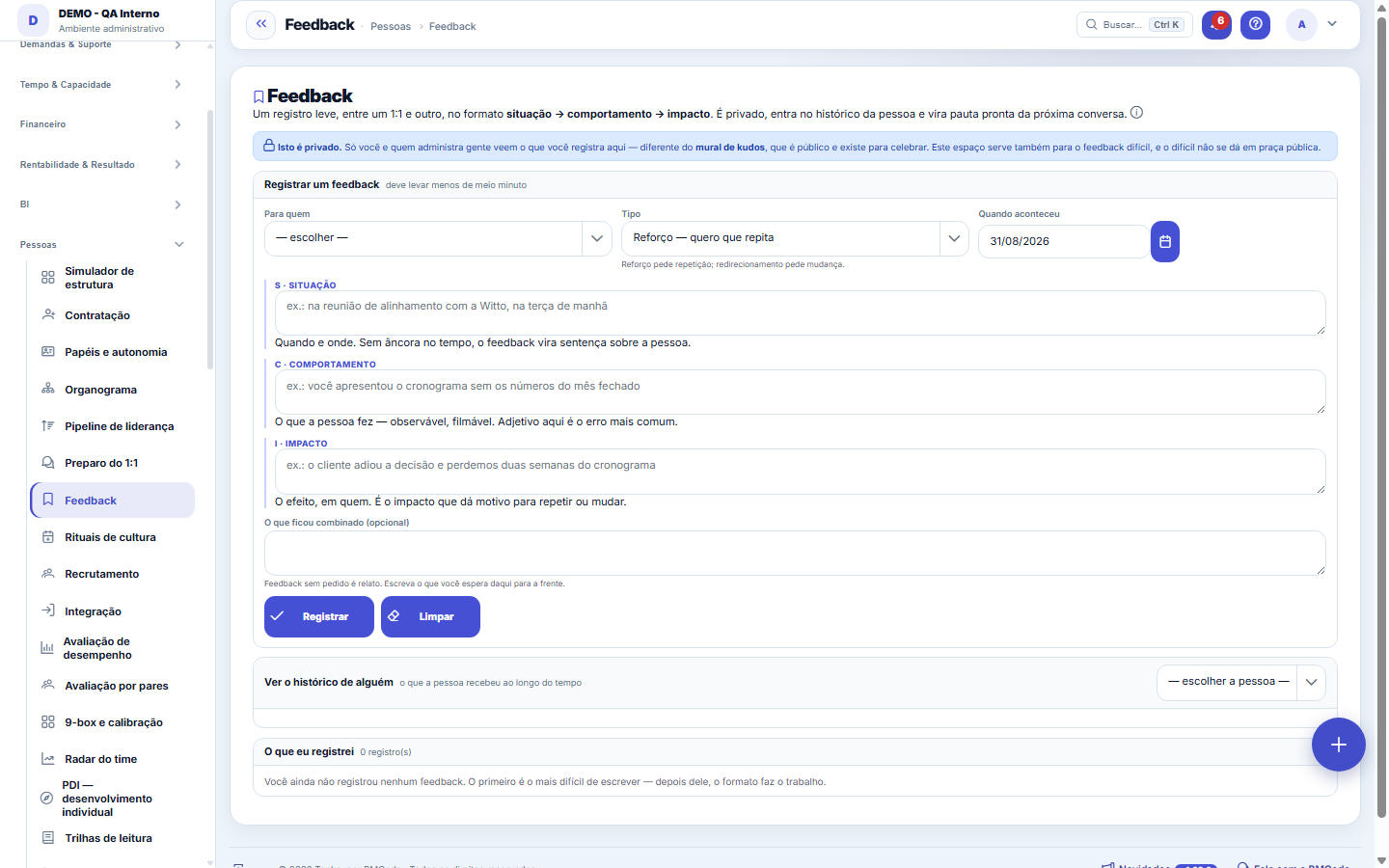
What you find on this screen
A portrait of the screen, read from the screen itself — it changes when the screen changes.
Available actions
RecordClear
Form fields
PessoaQuem recebeu o feedback.
Dado porQuem deu o feedback. Feedback sem autor não se conversa depois.
TipoReforço, para o que deve continuar, ou desenvolvimento, para o que precisa mudar.
SituaçãoQuando e onde aconteceu. Sem isso o feedback vira impressão genérica.
ComportamentoO que a pessoa fez, de forma observável, sem interpretação de intenção.
ImpactoO efeito daquilo: em quem, e de que jeito.
CombinadoO que ficou acordado. Feedback sem pedido é só relato.
Data do fatoQuando aconteceu. Pode ser bem anterior ao dia do registro.
ConversadoMarcado quando o feedback já foi levado a um 1:1. O que não está marcado continua esperando conversa.
Start here
S-B-I: por que os três campos são separados
S — Situation: when and where. B — Behavior: what the person did, observable, filmable. I — Impact: the effect of it, and on whom.
Separating the three is what keeps feedback from turning into an adjective. Notice that "you are disorganized" doesn't fit in any of the three fields — and that's precisely why the sentence is indefensible and the conversation ends in a fight.
Whereas "in Tuesday's meeting (S) you presented without the month's numbers (B), and the customer postponed the decision (I)" fits in all three, is verifiable, and the person can do something with it on Monday.
The three fields are mandatory on purpose. The form is the method.
Rules
Escreva o combinado, senão é só relato
The fourth field — what was agreed — is optional in the system and almost mandatory in practice. Feedback without a request is narration: the person listens, agrees, and nothing changes.
Also choose the type: reinforcement ("I want you to repeat it") or redirection ("I want you to change it"). It's not decoration — it's what lets you read your own ratio later.
Also choose the type: reinforcement ("I want you to repeat it") or redirection ("I want you to change it"). It's not decoration — it's what lets you read your own ratio later.
A proporção reforço ÷ redirecionamento é sobre VOCÊ
The screen reads the last six months and returns one sentence. The three readings that matter:
• No records — silence is also a message, and it's rarely the one the leader intended.
• Only reinforcement — praise without correction is pleasant and develops nobody.
• Only redirection — correction without recognition takes the person apart before improving them.
Note that the data is not about the team member: it's about your behavior as a leader. It's the cheapest mirror there is.
Isto não é o mural de kudos — e a diferença é proposital
The kudos wall is public, reinforcement-only and immutable: it is celebration, and celebration isn't edited. Feedback is a development record and also covers the hard stuff — which isn't given in the public square.
That's why feedback has a cycle: it is born, goes into the 1:1 agenda, is discussed and becomes history. And that's why it belongs to the person (the employee), not to the user.
The record cannot be edited — only removed, and only by whoever wrote it. Feedback rewritten after the conversation wouldn't be a record, it would be a version.
Treat it as visible to anyone with access to the screen
Feedback doesn't appear in any general company listing and isn't published anywhere — but whoever has access to this screen can pick a person and read their history. In practice, that means HR and management.
Write with that in mind: observable fact and impact, no adjectives about the person and no private information. It's the same rule that applies to any record about people — and it's also what makes the record survive a difficult conversation.
Write with that in mind: observable fact and impact, no adjectives about the person and no private information. It's the same rule that applies to any record about people — and it's also what makes the record survive a difficult conversation.
Frequently asked questions
When does feedback leave the agenda?
When you mark Discussed in the 1:1 preparation. At that moment it leaves the pending list and goes to the person's history, tied to the most recent recorded conversation.
If there has never been a 1:1 recorded with that person, it is marked as discussed but without saying in which conversation — one more reason to record the 1:1s.
If there has never been a 1:1 recorded with that person, it is marked as discussed but without saying in which conversation — one more reason to record the 1:1s.
Connected screens
Vira pauta emPreparo do 1:1O que ainda não foi conversado aparece no preparo do próximo 1:1.Não confundir comMural de kudosKudos é público, imutável e só celebra; o feedback é registro de desenvolvimento.Dá lastro aAvaliação de desempenhoFeedback registrado ao longo do período é a matéria-prima da evidência na avaliação.
Was this article helpful?
In the same module: People and development24
9-box and calibrationThe matrix that crosses performance with potential, and the room where managers compare their standards with …Performance reviewThe reading of a work PERIOD, not of the person: how they delivered (competencies, with evidence), how much t…Peer reviewWhere whoever works alongside the person answers — on the same scale as the cycle, with evidence, anonymously…Climate & PulseAnonymous climate and eNPS surveys to listen to the team.New HiresThe people-inflow pipeline: from accepted offer to ACTIVE employee with a start date — feeding payroll, cost,…Company cultureThe honest portrait of how the company actually works — derived from an anonymous 16-statement diagnostic, on…TerminationsThe organized exit: final settlement, dates, and contract closure — with immediate effect on payroll, cost, a…Integration — onboarding and offboardingThe company's checklist becomes a task with a date and an owner for each person. That is the difference betwe…
Tenka Academy
Explore the AcademyStep-by-step learning paths for your industry, inside the platform.