

1:1 preparation
The sheet the leader opens BEFORE the conversation: what style to use with this person (and based on what data), where the last conversation left off, and what still hasn't been said.
The screen
The real screen, in the theme you picked above.
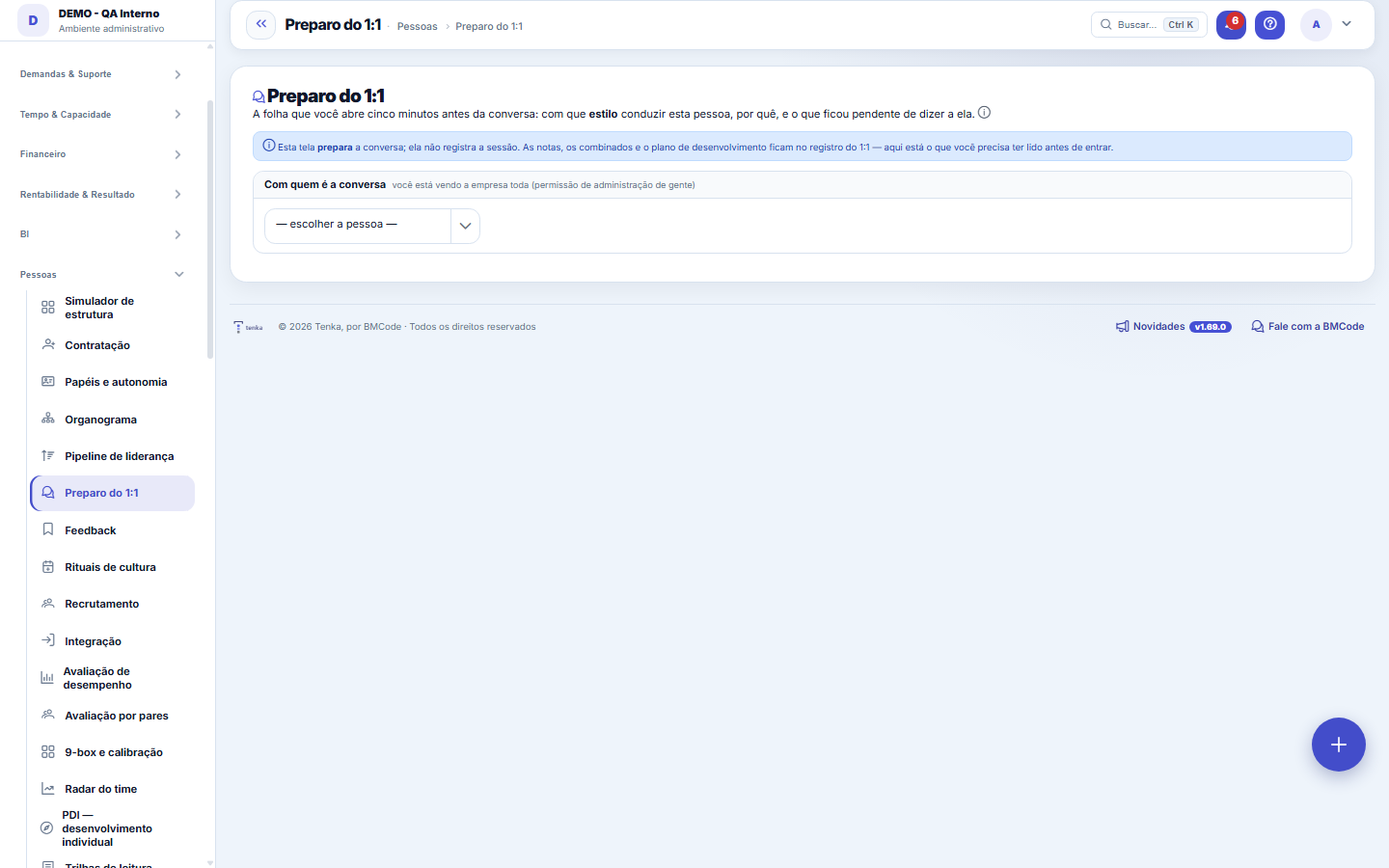
What you find on this screen
A portrait of the screen, read from the screen itself — it changes when the screen changes.
Available actions
Confirm styleDiscussed
Form fields
PessoaPessoa para quem o 1:1 está sendo preparado.
LíderQuem conduz o 1:1 desta pessoa.
Estilo sugeridoEstilo que a maturidade medida indica: dirigir, orientar, apoiar ou delegar.
Estilo escolhidoEstilo que o líder decidiu usar. Pode divergir da sugestão, desde que ele diga por quê.
MaturidadeMaturidade de 0 a 100 apurada nos sinais da pessoa. É ela que produz a sugestão.
JustificativaQuais sinais, com que número, levaram àquela sugestão de estilo.
Motivo da escolhaPor que o líder escolheu diferente da sugestão. Obrigatório quando os dois divergem.
Calculado emQuando a sugestão foi calculada. Sinal novo muda o estilo indicado.
Start here
Liderança situacional em três minutos
The model starts from a simple observation: the same leader needs to behave in different ways with different people — and with the same person on different subjects. What defines the right behavior is not the leader's profile, it's how much that person already masters that work.
Directing — little demonstrated competence: say what, how and by when; check closely. Here autonomy isn't a gift, it's abandonment.
Coaching — they already understand how big the hole is and don't yet have all the competence. It's the phase of greatest discouragement, and the one that loses the most good people. Explain the why, decide together, stay close.
Supporting — knows how to do it, wavers in confidence. Ask more than you answer; a ready-made answer here holds the person back.
Delegating — agree on the result and a checkpoint, and get out of the way. Too much follow-up at this stage reads as distrust and drives away exactly the people you want to keep.
Rules
Os quatro sinais que compõem a sugestão
Maturity is a sum from 0 to 100 points, with the source declared for each part:
Length of service — up to 25 points, from the hiring date in the employee record (less than 3 months: 0; up to 1 year: 10; up to 3 years: 18; above: 25).
On-time delivery — up to 40 points, from the requests completed in the last 180 days (90% or more on time: 40; 75%: 30; 50%: 18; below: 6). A request that never had a forecast counts as on time — nobody is penalized for never having been given a deadline.
Dragging requests — up to 15 points: open for more than 30 days (none: 15; up to 2: 9; up to 5: 4; more: 0).
Decisions made on their own — up to 20 points, from the autonomy declared in Roles and autonomy (none: 0; one: 8; up to three: 14; more: 20).
The ranges: below 25 suggests directing; up to 50, coaching; up to 75, supporting; above, delegating.
Maturidade NÃO é nota da pessoa — e tem pontos cegos conhecidos
It measures how much the system can see of competence already demonstrated in the data. Someone excellent can score low for being new at the company, for working on something that doesn't turn into a recorded request, or for not having a user linked to the employee record.
Two blind spots worth knowing: whoever has no requests at all gets the 15 points for "no dragging requests" for free — zero stalled requests and zero completed requests score the same on that item; and the "little data" warning only appears when both things are missing (fewer than three closed requests and a blank hiring date).
Treat the suggestion as a question for the conversation: "the data says I should be directing you here — does that make sense?". It's a much better question than most of those asked in a 1:1.
A sugestão não grava nada — quem decide é você
Calculating doesn't record anything. The record is only created when you choose the style you're going to use. If your choice is different from the suggested one, the system asks for the reason — not to judge, but because it's what keeps the decision explainable three months from now ("she knows how to do it, but has been insecure since last week's incident").
Together with the choice, the whole calculation breakdown is recorded: the four signals, each one's points and the source. You can reread, months later, the picture on which that decision was made.
A subtlety of matrix structures: there is one current style per person, not per leader–report pair. If two leaders prepare the same person's 1:1, the second overwrites the first one's record.
Esta tela PREPARA; ela não registra a conversa
What stays here is the preparation: the style, the agreements from last time and the agenda that already exists. The notes, new agreements and development plan stay in the 1:1 record and in the IDP.
The "where the conversation left off" block exists for a specific reason: picking up the previous agreement is what separates a 1:1 from a sequence of disconnected conversations. Without it, each meeting starts from scratch and nothing is followed up — and the person learns that what's agreed there doesn't count.
The "where the conversation left off" block exists for a specific reason: picking up the previous agreement is what separates a 1:1 from a sequence of disconnected conversations. Without it, each meeting starts from scratch and nothing is followed up — and the person learns that what's agreed there doesn't count.
Frequently asked questions
Por que só aparecem os meus liderados?
Because the screen is driven by the org chart: it includes the people who point to you as their direct manager. If you lead someone and that person doesn't appear, the fix is in the employee records.
Whoever has people-administration permission and has no direct reports gets to see the whole company — the screen warns about this in the header when it happens. It's the exception designed for HR, not the rule.
Whoever has people-administration permission and has no direct reports gets to see the whole company — the screen warns about this in the header when it happens. It's the exception designed for HR, not the rule.
Connected screens
Recebe a pauta deFeedbackFeedback registrado e ainda não conversado aparece aqui como pauta pronta.Continua emPDI — desenvolvimento individualO acompanhamento do desenvolvimento acontece dentro do 1:1, no PDI.Lê a autonomia dePapéis e autonomiaAs decisões que a pessoa toma sozinha entram como sinal na sugestão de estilo.Mostra o degrau dePipeline de liderançaSe o liderado também lidera, o degrau dele aparece no preparo.
Was this article helpful?
In the same module: People and development24
9-box and calibrationThe matrix that crosses performance with potential, and the room where managers compare their standards with …Performance reviewThe reading of a work PERIOD, not of the person: how they delivered (competencies, with evidence), how much t…Peer reviewWhere whoever works alongside the person answers — on the same scale as the cycle, with evidence, anonymously…Climate & PulseAnonymous climate and eNPS surveys to listen to the team.New HiresThe people-inflow pipeline: from accepted offer to ACTIVE employee with a start date — feeding payroll, cost,…Company cultureThe honest portrait of how the company actually works — derived from an anonymous 16-statement diagnostic, on…TerminationsThe organized exit: final settlement, dates, and contract closure — with immediate effect on payroll, cost, a…FeedbackRecord, in half a minute, what happened, what the person did, and the effect of it — to become a ready-made a…
Tenka Academy
Explore the AcademyStep-by-step learning paths for your industry, inside the platform.