

Performance review
The reading of a work PERIOD, not of the person: how they delivered (competencies, with evidence), how much they delivered (quarterly goals), and the feedback that closes the cycle.
The screen
The real screen, in the theme you picked above.
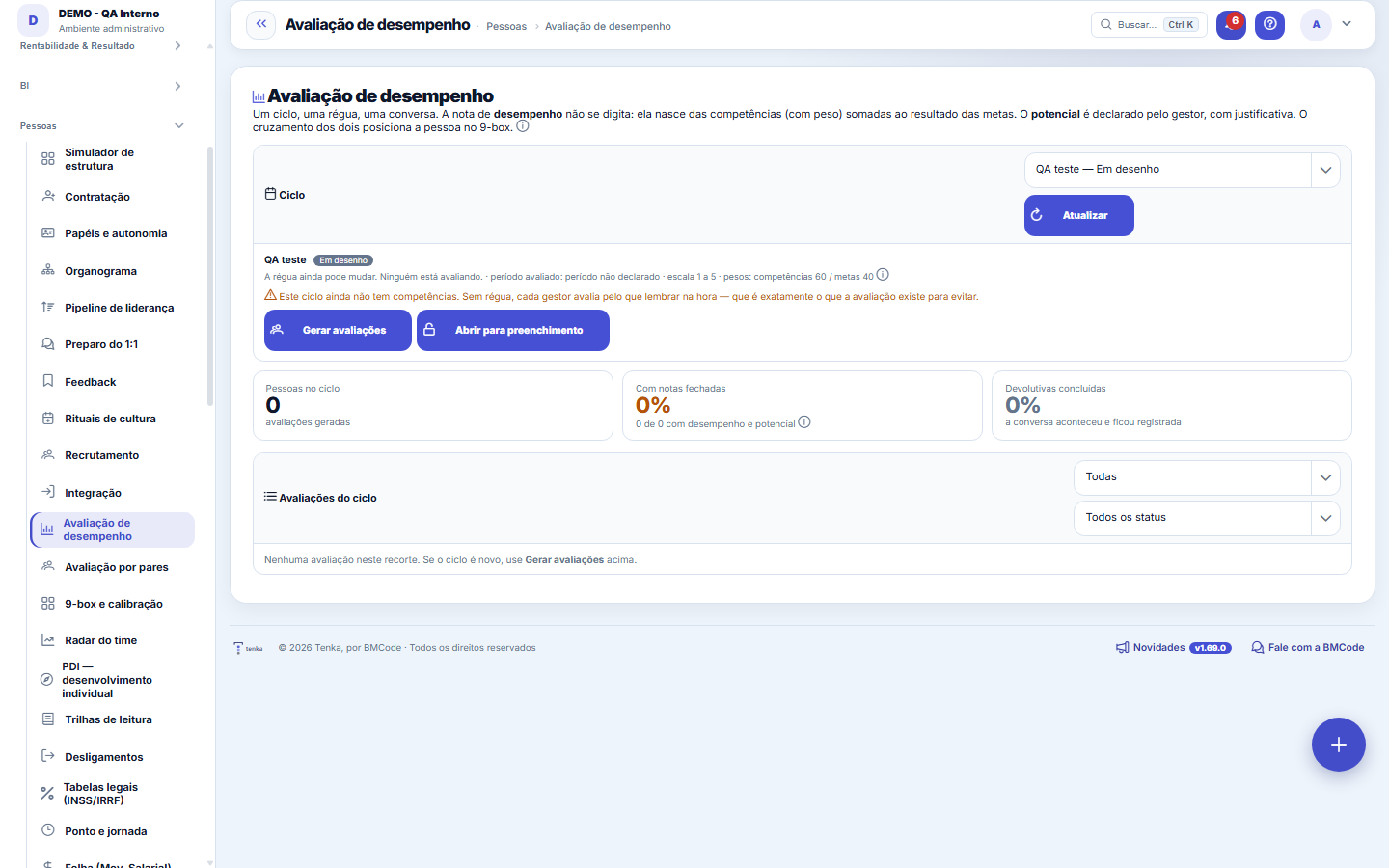
What you find on this screen
A portrait of the screen, read from the screen itself — it changes when the screen changes.
Available actions
RefreshGenerate reviewsOpen for filling inStart calibrationClose cycleOpen my recordManager evaluationSelf-assessmentFeedbackSave ratingSave self-assessmentRecord the feedback+4
Form fields
NºNúmero sequencial por empresa da avaliação. É o número que o RH cita.
CicloRodada de avaliação a que esta ficha pertence.
AvaliadoQuem está sendo avaliado nesta ficha.
GestorQuem responde pela avaliação e conduz o feedback.
CargoCargo ocupado no momento da avaliação, que define as competências cobradas.
SituaçãoEm que etapa a ficha está: aberta, respondida, calibrada ou encerrada.
Nota de competênciasResultado da parte comportamental, vinda das competências do cargo.
Nota de metasResultado da parte de entrega, vinda das metas do período.
DesempenhoNota final de desempenho. É o eixo horizontal do 9-box.
PotencialLeitura de potencial atribuída pelo gestor. É o eixo vertical do 9-box.
Quadrante (9-box)Em qual dos nove quadrantes a pessoa caiu depois da calibração.
AcordadoSem o acordo da pessoa a avaliação não fecha: o feedback ainda não foi dado.
Feedback emQuando a conversa de feedback aconteceu. Vazio é ciclo que ficou pela metade.
Pontos a desenvolverO que a pessoa precisa melhorar. É o que alimenta o plano de desenvolvimento.
Start here
The order matters — and this is it
1) open a cycle (evaluated period, scale and weights) · 2) write the competency scale BEFORE the first score · 3) click Generate evaluations · 4) Open for filling in · 5) the person does the self-assessment and the manager evaluates, with evidence for each score · 6) the manager declares the potential with justification · 7) Start calibration, and the managers compare scales in the 9-box room · 8) the feedback conversation happens, the person records their own version and the cycle is closed.
If you skip step 2 and start with the scores, you'll find out at the end that each manager measured a different thing — and calibration turns into negotiation, not correction.
If you skip step 2 and start with the scores, you'll find out at the end that each manager measured a different thing — and calibration turns into negotiation, not correction.
Rules
The performance score is NOT typed in
That's why there's no "final score" field. It is composed: first the weighted average of competencies assessed by the manager (each competency has its own weight in the scale); then that average is combined with the goals score using the cycle's weights — by default 60 for competencies ("the how") and 40 for goals ("the how much").
Two common-sense rules are built in. A competency left blank is ignored, never counted as zero: the opposite would punish the person for a score the manager forgot to give. And if only one of the two sides has a score, it answers alone — inventing zero for the missing side would fail someone due to a data-entry gap.
The screen shows the entire calculation trail on the record, in the format competencies X (weight 60) + goals Y (weight 40) = performance Z.
A score without evidence does not save
Every score requires the evidence field — what the person did or said that supports that number — and the entire tab is refused while any is missing. A score without evidence is an impression with a number in front of it, and it disappears exactly when someone asks "why 3 and not 4?".
A competency left with no score at all does not require evidence: it simply falls out of the calculation. In other words, the system demands justification from those who gave an opinion, not from those who abstained.
A competency left with no score at all does not require evidence: it simply falls out of the calculation. In other words, the system demands justification from those who gave an opinion, not from those who abstained.
The self-assessment does not change the score — it opens the conversation
The person's own score and the manager's score are stored separately, one never overwrites the other, and only the manager's score enters the performance calculation. The self-assessment exists to produce just one thing: the gap between the two readings.
When that gap exceeds one point, the screen highlights it in text ("the person sees themselves X points above the manager", or the opposite). It's the best feedback script there is: the conversation starts with the competency where you disagree, not the whole list.
Only the person themselves fills out the self-assessment — whoever opens someone else's record sees this tab in read-only mode.
Performance is a FACT; potential is a BET
They are two different axes and the system keeps them separate on purpose. Performance looks backward — what was delivered in the period — and that's why it's calculated. Potential looks forward — the chance that the person can handle a bigger scope — and that's why it's typed in by the manager, with mandatory justification, never calculated.
Confusing the two is the classic company mistake: promoting the best technician to manager and losing both. Delivering a lot without wanting a bigger scope isn't a flaw — it's a specialist, and they have their own quadrant in the matrix.
Justification is mandatory because this is the axis that decides promotion, and the one most easily turned into favoritism with a number in front of it.
Position and scale are FROZEN within the evaluation
The person's position is recorded inside the evaluation, and the competency's name is copied into each score. A promotion after the cycle, or a scale rewritten in the next cycle, does not rewrite history: the evaluation remains readable years later, stating which position and against which scale that score was given.
The frozen position is also what filters the scale: the person answers the general competencies (those without a position) plus those of their position.
There is a single evaluation per person per cycle, guaranteed by the database. Running "Generate evaluations" again after a hire is safe: it only adds whoever is missing, it does not duplicate, and it does not erase what has already been filled in.
After calibration, the quadrant belongs to the ROOM — and resaving doesn't undo it
As long as no one has calibrated, saving the manager's record recalculates performance and repositions the person in the quadrant the calculation indicates. Once the room moves someone, this stops happening: the position becomes the calibration's decision, and saving the record again does not rewrite it. Calibration exists precisely because the calculation is not the final word — letting the calculation erase it would undo the decision with the very argument it was created to contradict.
So correcting a score after the session is safe. The competency average keeps being recalculated, and the record starts showing both readings: "calculated X · calibrated Y", with a note saying which one counts (the calibrated one) and since when.
To change the quadrant after the room, there's only one path: move the person in a new calibration session, with a reason. That is what keeps the trail telling the right story — who moved them, when, and why.
The feedback conversation only closes with the person's own version
The cycle doesn't end with the score, it ends with the conversation. The manager records strengths, areas to develop, and agreed-upon actions — the screen refuses an empty feedback, because feedback with only a score doesn't tell the person what to do on Monday.
Then there is a field that belongs to the person being evaluated, and a button that only they can click: "The conversation happened". A manager confirming on the person's behalf is exactly what makes the record useless.
Confirming is not agreeing with the score. A recorded disagreement is a sign of health — what erodes trust is not disagreeing, it's the person finding out their score from someone else.
A leitura dos pares aparece agregada, ou não aparece
When the cycle asks for peer review, the record gains a block with the peers' average per competency and the evidence they wrote, with no names at all. The block only exists from the minimum number of answers configured in the cycle (never fewer than 3). Below that, the screen says how many answers are missing and shows no number — not to the manager, not to HR. If the peers' weight in the cycle is greater than zero, that average goes into the competency score and the calculation breakdown starts showing both parts; with zero weight, the peers' reading informs the conversation and doesn't touch any score.
A devolutiva termina virando PDI — com você no comando
At the end of the Feedback tab there is "Turn into a development plan". It reads what the evaluation RECORDED — competencies scored below expectations, with the evidence you wrote, plus each line of "to develop" and "agreed actions" — and proposes a list of candidate actions. Each candidate comes with its justification and source in view: such score, in such competency, in this cycle. Nothing is created until you uncheck what isn't worth it, edit the text and confirm. If the person already has an active plan, the actions go into it instead of opening a second plan competing with the first.
A sugestão não inventa competência nem meta
Everything that appears in the candidate list came from something someone wrote in the evaluation. If the scale didn't have "how to evaluate" filled in, the candidate action is born without an expected result and you need to write it — because the machine has nowhere to get it from. And the plan's EVIDENCE (how the two of you will know the person got there) is left blank on purpose: it is an agreement between two people, not a deduction from a score. The plan still refuses to be activated without it.
Frequently asked questions
Where does the goals score come from?
It is typed in by the manager, on the same scale as the cycle — the system does not convert OKRs into a score on its own, because each company weighs goals differently, and an automatic conversion would hide that choice.
What the system does is provide backing: if the cycle has a quarter filled in (format YYYY-Qn), the record lists the OKR check-ins for that quarter — declared confidence and comment — and there is a mandatory, common-sense field called "where did this number come from". A goals score with no written origin is the fastest way to turn an evaluation into an argument about a spreadsheet.
Two warnings: those check-ins are the company's for the quarter, context and not the person's score; and a cycle without a filled-in quarter simply shows none.
Who can see whose record?
Each person sees their own and that of whoever they lead — trying to open a third party's is refused. Whoever administers the cycle (edit permission in Evaluation Cycles) sees all of them, because they are the one accountable for the process.
The "Your evaluation" block at the top only appears for those who have an employee record linked to the user. If it doesn't appear for someone, the fix is in the employee record, not here.
Current compensation only appears for those with permission to view values.
The "Your evaluation" block at the top only appears for those who have an employee record linked to the user. If it doesn't appear for someone, the fix is in the employee record, not here.
Current compensation only appears for those with permission to view values.
Connected screens
Acontece dentro deCiclos de avaliaçãoNada de avaliação existe fora de um ciclo com período declarado.Usa a régua deCompetências avaliadasAs competências do ciclo e o peso de cada uma.Posiciona em9-box e calibraçãoAs duas notas viram um quadrante, e a sala de calibração compara as réguas.Lê o quadro deFuncionáriosQuem entra no ciclo, o cargo e o gestor saem do cadastro de funcionários.Continua emPDI — desenvolvimento individualO ponto a desenvolver é texto até alguém transformá-lo em PDI com evidência e prazo — esse passo é manual, e é onde a maioria das avaliaçõe…
Was this article helpful?
In the same module: People and development24
9-box and calibrationThe matrix that crosses performance with potential, and the room where managers compare their standards with …Peer reviewWhere whoever works alongside the person answers — on the same scale as the cycle, with evidence, anonymously…Climate & PulseAnonymous climate and eNPS surveys to listen to the team.New HiresThe people-inflow pipeline: from accepted offer to ACTIVE employee with a start date — feeding payroll, cost,…Company cultureThe honest portrait of how the company actually works — derived from an anonymous 16-statement diagnostic, on…TerminationsThe organized exit: final settlement, dates, and contract closure — with immediate effect on payroll, cost, a…FeedbackRecord, in half a minute, what happened, what the person did, and the effect of it — to become a ready-made a…Integration — onboarding and offboardingThe company's checklist becomes a task with a date and an owner for each person. That is the difference betwe…
Tenka Academy
Explore the AcademyStep-by-step learning paths for your industry, inside the platform.