

Integration — onboarding and offboarding
The company's checklist becomes a task with a date and an owner for each person. That is the difference between having a process and having a document about the process.
The screen
The real screen, in the theme you picked above.
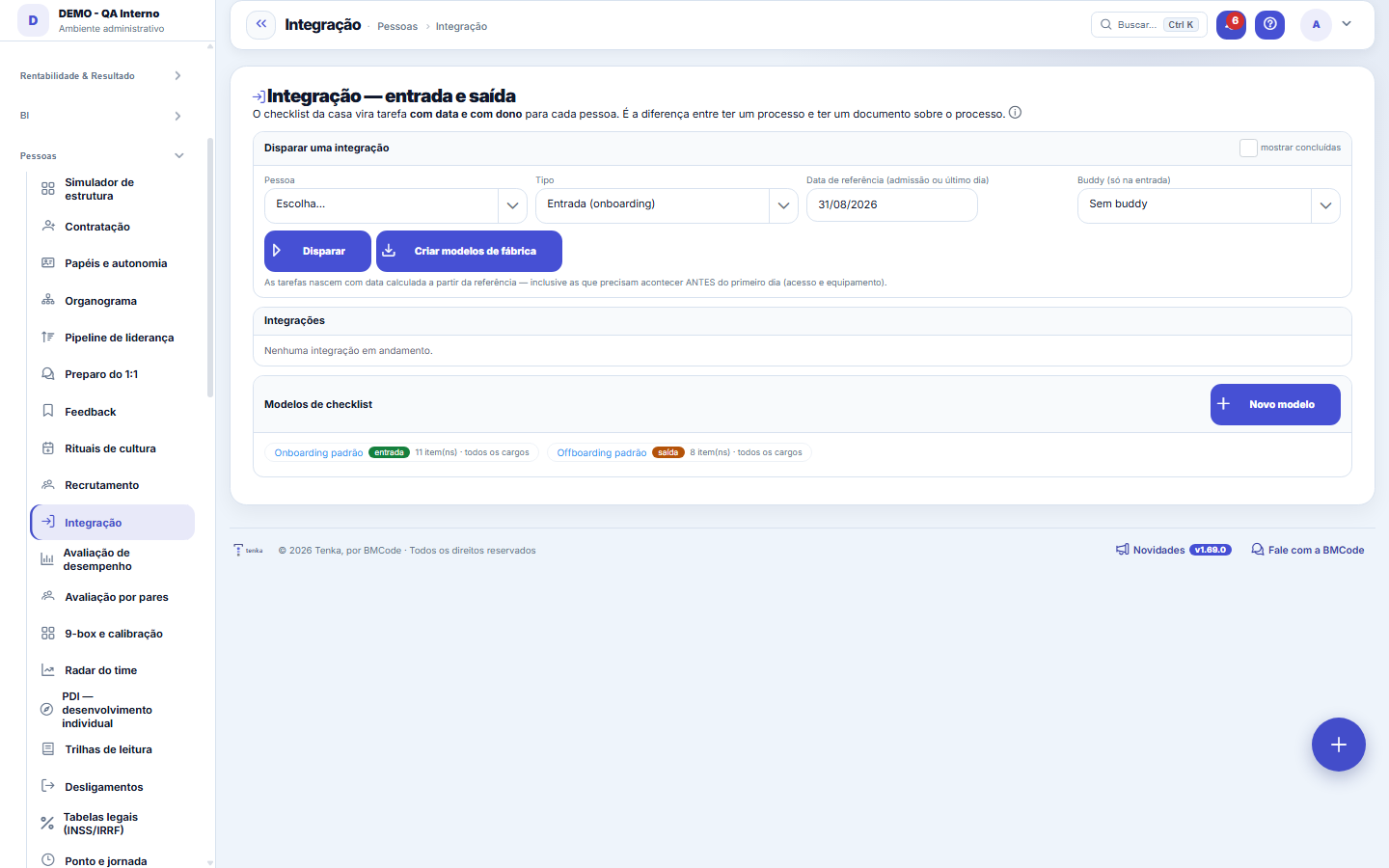
What you find on this screen
A portrait of the screen, read from the screen itself — it changes when the screen changes.
Available actions
TriggerCreate factory templatesComplete integrationNew modelSaveCancelNew item
Form fields
PessoaQuem está sendo integrado.
TipoSe é entrada na empresa, mudança de área ou saída.
ModeloRoteiro de etapas usado nesta integração.
Data de referênciaData que ancora as etapas: normalmente o primeiro dia da pessoa.
PadrinhoColega que acompanha a pessoa nos primeiros dias.
SituaçãoEm que ponto a integração está.
ObservaçãoCombinados e ajustes desta integração em particular.
Start here
What it's for
Trigger the onboarding of those who join and the offboarding of those who leave, with dates calculated from the hire date (or the last day) and tracking of what is still pending.
Rules
A relative deadline is what makes it work
Each item in the template says "how many days after the reference date" — including negative numbers, for what needs to be ready BEFORE the first day (access and equipment). That is what allows the same checklist to serve every hire, and it is what makes the 30/60/90-day markers come with a date instead of becoming a reminder that nobody sets.
Execution COPIES the template
Changing the standard checklist afterward does not rewrite what was agreed with someone who already went through it. Onboarding is a record of the moment — and that record is exactly what the audit asks for when it questions whether access was revoked.
A departure with an open item is a risk, not a pending task
Unrevoked access is finding #1 in vendor audits, and the reason is almost always the same: the termination was arranged by message and there was no checklist. That is why the screen refuses to complete an offboarding with a mandatory item still open.
Frequently asked questions
The buddy costs nothing and solves a lot
It is the person the newcomer can ask what they are too embarrassed to ask the manager. Among the onboarding items, it is the one with the best cost-to-effect ratio.
Was this article helpful?
In the same module: People and development24
9-box and calibrationThe matrix that crosses performance with potential, and the room where managers compare their standards with …Performance reviewThe reading of a work PERIOD, not of the person: how they delivered (competencies, with evidence), how much t…Peer reviewWhere whoever works alongside the person answers — on the same scale as the cycle, with evidence, anonymously…Climate & PulseAnonymous climate and eNPS surveys to listen to the team.New HiresThe people-inflow pipeline: from accepted offer to ACTIVE employee with a start date — feeding payroll, cost,…Company cultureThe honest portrait of how the company actually works — derived from an anonymous 16-statement diagnostic, on…TerminationsThe organized exit: final settlement, dates, and contract closure — with immediate effect on payroll, cost, a…FeedbackRecord, in half a minute, what happened, what the person did, and the effect of it — to become a ready-made a…
Tenka Academy
Explore the AcademyStep-by-step learning paths for your industry, inside the platform.