

Evaluation cycles
The container for everything: which period is being evaluated, within what window it is filled out, which scale applies, and how much the "how" weighs against the "how much."
The screen
The real screen, in the theme you picked above.
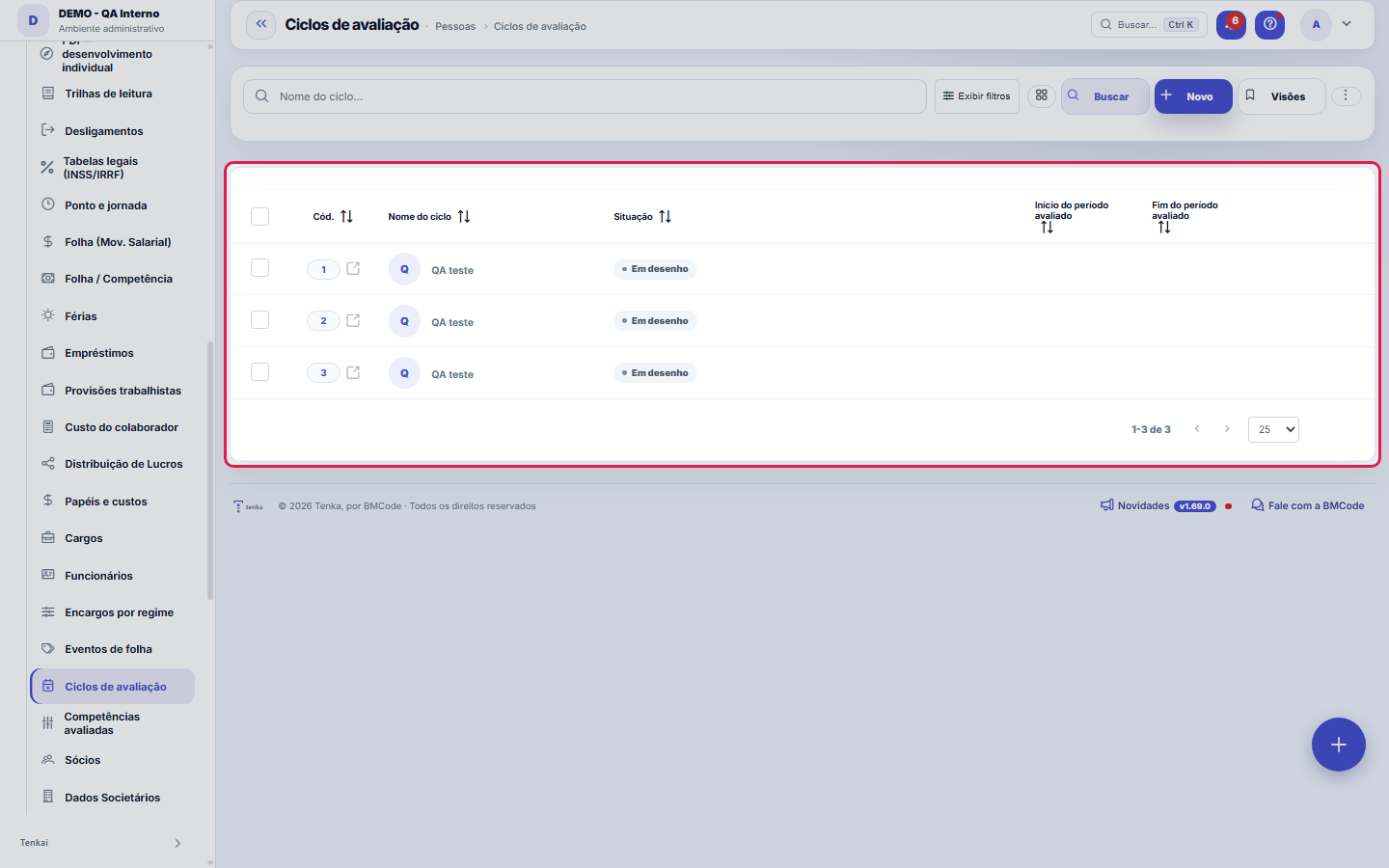
What you find on this screen
A portrait of the screen, read from the screen itself — it changes when the screen changes.
Form fields
Nome do ciclo*Como as pessoas vão reconhecer este ciclo (ex.: "Avaliação 2026 · 2º semestre"). Aparece no topo da ficha de todo mundo.
SituaçãoEm desenho = a régua ainda pode mudar e ninguém avalia. Avaliações abertas = a régua está congelada e as pessoas preenchem. Em calibração = notas fec…
Início do período avaliadoO primeiro dia do intervalo de trabalho sobre o qual se conversa. Não confunda com a data em que as pessoas preenchem: são coisas diferentes e é comu…
Fim do período avaliadoO último dia avaliado. Também é a data usada para saber quem estava no quadro e qual era a remuneração vigente.
Abertura do preenchimentoQuando as pessoas podem começar a responder. Serve para combinar o prazo com o time — a trava de fato é a situação do ciclo.
Prazo do preenchimentoPrazo combinado para as avaliações estarem preenchidas, antes da sessão de calibração.
Escala das notas (1 a N)As notas vão de 1 até este número. 5 é o padrão. Escala muito curta não separa ninguém; escala muito longa dá a ilusão de precisão que a avaliação nã…
Peso das competências (o COMO)Quanto o COMO a pessoa entregou vale na nota final de desempenho. Zerar este peso premia quem entrega resultado atropelando todo mundo no caminho.
Peso das metas (o QUANTO)Quanto o resultado das metas/OKR vale na nota final. Os dois pesos não precisam somar 100: o cálculo é proporcional entre eles.
Pedir autoavaliaçãoQuando ligado, a pessoa se avalia na mesma régua antes da conversa. A diferença entre as duas leituras costuma ser o assunto mais útil da devolutiva.
Habilitar avaliação por paresO 360 leve. Ligado, cada avaliado recebe pares convidados na tela "Avaliação por pares", onde eles respondem a mesma régua de forma anônima e de uma …
Usar matriz 9-boxLiga o cruzamento desempenho x potencial. Desligado, o ciclo continua funcionando só com nota e devolutiva.
Nome do eixo horizontalComo a sua empresa chama o eixo do que já foi entregue. Padrão: Desempenho.
Nome do eixo verticalComo a sua empresa chama o eixo da aposta sobre escopo maior. Padrão: Potencial.
Trimestre OKRNo formato AAAA-Tn (ex.: 2026-T3). É a ponte com metas: a ficha mostra os check-ins daquele trimestre para a nota de metas ter lastro em vez de ser c…
DescriçãoPara que serve este ciclo, em uma ou duas linhas.
Instruções para quem avaliaO que você quer que gestores e colaboradores leiam antes de dar a primeira nota. Ex.: "avalie o período inteiro, não a última semana".
Mínimo de pares para revelarO piso de anonimato. Enquanto menos pares do que este número tiverem respondido, NINGUÉM vê a leitura dos pares — nem o avaliado, nem o gestor, nem o…
Peso da nota dos pares (%)Quanto a média dos pares vale dentro da nota de competência; o restante fica com a leitura do gestor. Começa em 0 de propósito: em 0 os pares INFORMA…
Start here
Why nothing exists outside a cycle
Because an evaluation without a declared period stops being a reading of a work interval and becomes an opinion about the person. The cycle is what lets you say "in the first half, with this scope and this yardstick" — and it is what makes two cycles comparable.
O que esta tela responde
The preparation of the cycle: which period will be evaluated, on what scale, with what weight between competencies and goals, and in which window people can fill in. It is the foundation — nothing is evaluated here.
How to
Where the work really happens
Evaluating is on the "Performance review" screen; calibrating is in the "9-box"; the peer reading is in "Peer review". This registry lives under Registries because it is preparation, and that is why it does not appear in the day's work axis.
Rules
São DUAS datas diferentes — e é aqui que se erra
The evaluated period is the work interval being read. The fill-in window is when managers and people write. They almost never coincide: usually January–June is evaluated during July.
And there is an important subtlety: the window dates lock nothing. They serve to agree the deadline with the team. What opens and closes the fill-in is the cycle status — while it is in "Evaluations open" or "In calibration", the system accepts scores, even with the deadline passed.
The end of the evaluated period is also the reference date: it defines who was on the headcount and which salary was in effect. If blank, the system uses today.
As quatro situações, e o que cada uma significa para o time
In design — the yardstick can still change; nobody is evaluating.
Evaluations open — people are filling in and the yardstick is frozen.
In calibration — scores closed; managers are comparing yardsticks in the same room.
Closed — cycle closed, the scores have become history.
The status is not decoration: it is what tells the team what is expected of them this week, and it is the only real lock in the process.
What this screen answers
Changing the scale or weight after someone has already answered makes scores given on different yardsticks coexist in the same cycle — and the average stops meaning anything. If you really need to change, open a new cycle.
Os pesos são a política da empresa, escrita em número
The weight of competencies ("how it was delivered") against that of goals ("how much was delivered") says, in numbers, what kind of company you are. The default 60/40 is a middle ground: more weight on goals rewards results at any cost; more weight on competencies rewards the way of working even when the result did not come.
The two do not need to add up to 100: the calculation is proportional, so 60/40, 6/4 and 3/2 give exactly the same score. What the system rejects is both at zero — without weight, the performance score has nowhere to come from.
There is no right answer; there is a declared answer. What cannot happen is the company saying one thing in its speech and another in the weights.
A escala é o vocabulário do ciclo
By default, scores from 1 to 5. Even scales (1 to 4, 1 to 6) remove the middle and force the evaluator to take sides; odd scales leave the middle available — which is honest when the person really is in the middle and is evasion when the manager does not want to have the conversation.
Whatever it is, the 9-box cuts follow: low, medium and high are always the thirds of the chosen scale. A value lower than 2 is corrected to 5 when saving, because a one-point scale separates nothing.
The quarter field (YYYY-Qn) is the bridge to goals/OKR: it is what makes the period's check-ins appear as backing in the record. A half-yearly cycle usually points to the closing quarter.
Régua aberta não se muda no meio do caminho
While the cycle is in design, change it as you like. Once it leaves design, the system refuses to alter the yardstick — changing scale, weights or competencies with evaluation in progress would make the scores already given measure one thing and the next ones another, and there is no fixing it afterwards.
In practice, the "Open for filling in" button is the point of no return. If you really need to change, the honest path is to close it and open a new cycle.
In practice, the "Open for filling in" button is the point of no return. If you really need to change, the honest path is to close it and open a new cycle.
A visão salva guarda busca, filtros, colunas e ordenação
When you save a view with the Views button, it stores four things: the search text, the applied filters, which columns appear (and in what order) and which column the list is sorted by. Applying the view restores everything at once — including resetting the sort and the page you were on, so the result is exactly what the view describes. Views saved before this version remain valid: whatever they didn't store simply doesn't change when applied.
O erro de preenchimento aparece no campo, ao sair dele
Nas fichas, sair de um campo já dispara a conferência do que dá para conferir na hora: campo obrigatório deixado em branco e e-mail mal formado. O aviso aparece embaixo do campo e desaparece quando você começa a corrigir. Campo numérico não precisa de aviso: ele simplesmente não aceita letra enquanto você digita. Isso é conforto, não a validação final: ao salvar, o sistema confere tudo de novo do lado do servidor.
Frequently asked questions
Ligo autoavaliação? E avaliação por pares?
Self-evaluation: almost always yes. It costs little and produces the gap between what the person thinks and what the manager thinks — the best feedback script there is.
Peers (light 360): the field is in the registry, but peer score collection does not have a screen yet in this version — turn it on only when it exists. And, when it does, remember that 360 requires a mature team: without established trust, peer evaluation becomes anonymous retaliation or convenient praise, and in both cases it is worse data than no data.
Peers (light 360): the field is in the registry, but peer score collection does not have a screen yet in this version — turn it on only when it exists. And, when it does, remember that 360 requires a mature team: without established trust, peer evaluation becomes anonymous retaliation or convenient praise, and in both cases it is worse data than no data.
Quem entra no ciclo quando eu clico em "Gerar avaliações"?
The entire active headcount on the reference date — including the board and the managers themselves. Each evaluation is created already knowing who evaluates: the immediate superior registered in the employee record.
Anyone without a registered superior is marked as "no manager defined", and that person's record opens only for them or for whoever administers the cycle. If many people appear like this, the fix is in the org chart.
The button is safe to repeat: running it again after a hire only adds whoever is missing.
Como descobrir quem mudou um campo desta ficha?
Open the record and look at the Timeline on the right: it shows each change as "from one value to another", with the person and the date. When there are many changes, use the two filters at the top of the timeline — one by field, the other by person. The search runs in the database, so old changes show up just the same. You can also ask Tenkai: "who changed contract 482?".
Connected screens
Define a régua emCompetências avaliadasAs competências pertencem ao ciclo — a régua é escrita antes da primeira nota.Preenche emAvaliação de desempenhoÉ onde as avaliações do quadro são geradas e respondidas.Calibra em9-box e calibraçãoA sala existe dentro do ciclo e compara só as pessoas dele.
Was this article helpful?
In the same module: People7
PositionsThe company's positions: title, seniority, and range — organizes the headcount and the org chart.Evaluated competenciesThe cycle's standard: what will be evaluated, how much each item weighs, and — the field that makes the diffe…Corporate ownership dataWho the partners are, with what stake, and what that means for profit distribution and obligations.Payroll charges by employment typeThe percentages that turn salary into COST: charge components by employment type (INSS, FGTS, 13th salary, va…Payroll eventsThe payroll entry types: earnings and deductions, fixed or variable.EmployeesThe people behind the operation: data, position, employment type (CLT/independent contractor), salary, and ca…Partners (shareholders)The ownership structure: who the partners are, each one's stake, and the base data for profit distribution.
Tenka Academy
Explore the AcademyStep-by-step learning paths for your industry, inside the platform.