

Evaluated competencies
The cycle's standard: what will be evaluated, how much each item weighs, and — the field that makes the difference — how a low score and a high score are recognized.
The screen
The real screen, in the theme you picked above.
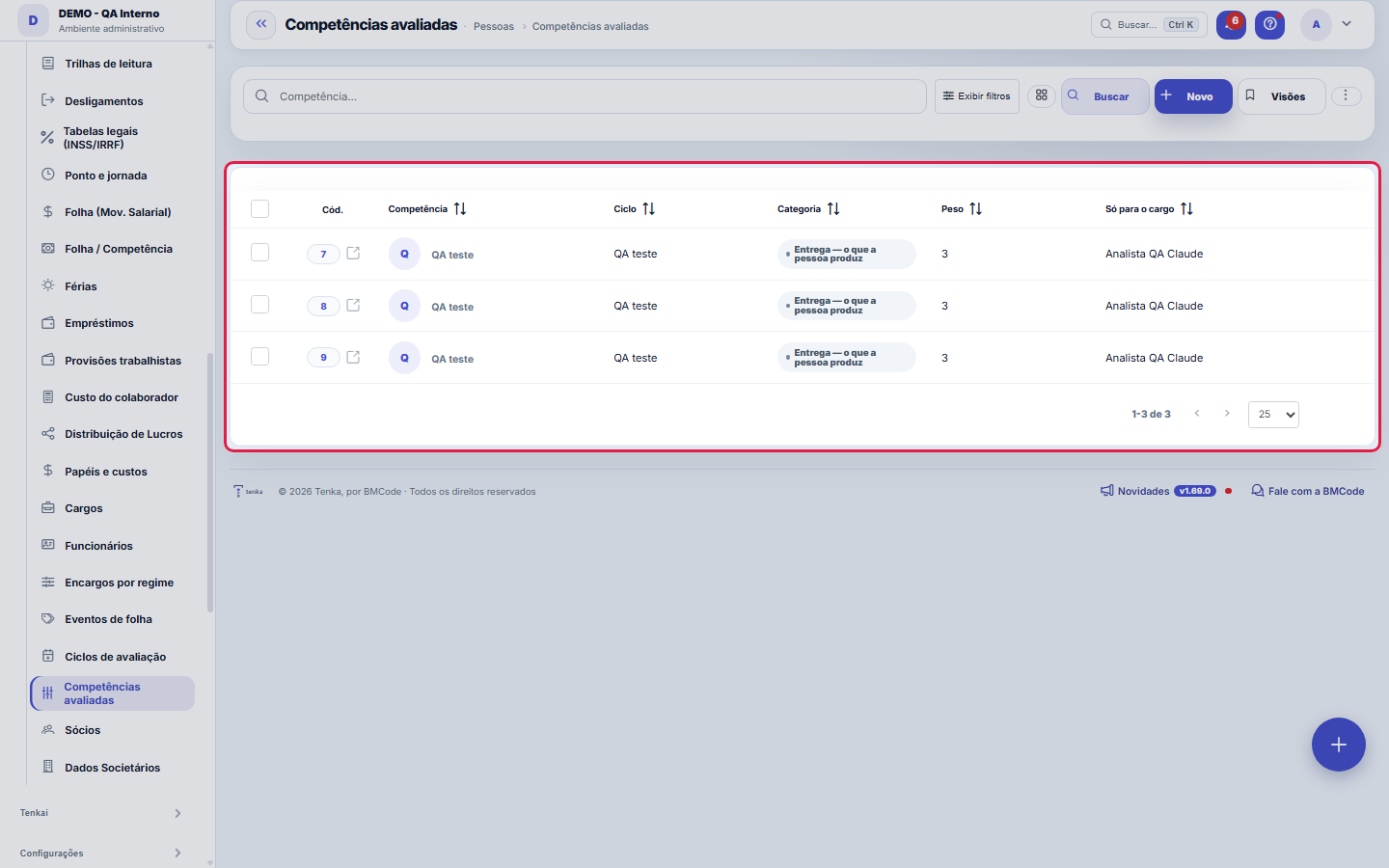
What you find on this screen
A portrait of the screen, read from the screen itself — it changes when the screen changes.
Form fields
Competência*O que exatamente se avalia. Escreva como comportamento observável ("cumpre o combinado no prazo"), não como qualidade abstrata ("é comprometido") — n…
Ciclo*A que ciclo esta competência pertence. A régua é sempre de um ciclo: ela pode mudar de um período para o outro sem reescrever a história do anterior.
CategoriaAgrupa as competências para leitura. Uma régua só de Entrega mede resultado sem olhar como ele foi obtido; só de Comportamento mede simpatia.
PesoQuanto esta competência pesa na média das competências (1 a 5). Peso alto em tudo é o mesmo que peso nenhum: escolha o que realmente diferencia.
OrdemPosição na ficha de avaliação. Deixe vazio para ordenar por nome.
Só para o cargoDeixe vazio para valer para todo mundo do ciclo. Preencha quando a competência só faz sentido em um cargo — cobrar liderança de quem não lidera ningu…
DescriçãoO que a competência quer dizer, em uma ou duas linhas, na linguagem da sua empresa.
Como avaliar (a âncora)Descreva o que é a nota mínima e o que é a nota máxima. Ex.: "1 = atrasa sem avisar · 5 = antecipa o risco antes do prazo". É este campo que faz dois…
Start here
O campo mais importante é "como avaliar"
Almost everyone writes the competency name. What almost no one writes is the anchor: a sentence saying what you see when the score is low and what you see when it is high.
Without an anchor, two managers using the same 1-to-5 scale are measuring different things — and calibration will try to patch this at the end of the cycle, with everyone's memory already contaminated. Writing the anchor takes ten minutes per competency and is what separates an assessment from a lottery.
Bad anchor: "communication — communicates well".
Good anchor: "low: has to be chased to find out the progress; high: the customer and the team know about the risk before it becomes a problem".
Saving without the anchor is allowed, but the system warns you — on purpose.
O que esta tela responde
Lists the competencies that will be assessed in the cycle, with weight, category, order and the "how to assess" text for each one. This is where the cycle's yardstick is written before the first score: whoever assesses reads this list to know what a low score and a high score mean in each competency. A competency can be general or restricted to a job position (column "Only for the position"), and the list is the platform standard: search, column filters, views saved per user and export of the whole set to Excel, PDF or CSV.
How to
"Como avaliar" é o campo que faz a ferramenta funcionar
It is the most skipped field and the most important one. Without it, "Communication score 4" means one thing to one manager and another thing to the manager next door — and the whole cycle turns into noise comparable to nothing. Write the OBSERVABLE behavior for each score, not the adjective.
Adjetivo × comportamento observável
Bad: "score 4 = communicates well". Good: "score 4 = anticipates risk in writing before it becomes a problem, and the message is understood without needing a meeting". The second can be checked; the first cannot.
Rules
Peso é o que a empresa realmente cobra
The weight multiplies the score of that competency within the average. A competency with a high weight is one whose absence you would accept losing people over.
Beware of the long, flat list: ten competencies with the same weight prioritize nothing, tire the assessor and produce scores by inertia. Five to seven competencies, with different weights, is the size at which the assessor still thinks about each one.
A blank weight or one less than 1 is corrected to 3 on saving. The weight used in a score is frozen inside it: changing the weight in the next cycle does not rewrite old averages.
Competência geral × competência de cargo
A competency without a position applies to everyone in the cycle — it is what the company expects from any person. A competency with a position only appears for whoever holds that position, and it is where what is specific to the job comes in. Each person answers the general ones plus those of their position.
The category (delivery, behavior, technical, leadership) helps you see the imbalance: a yardstick with only "technical" produces specialists who cannot get along; a yardstick with only "behavior" produces nice people who do not deliver.
The category (delivery, behavior, technical, leadership) helps you see the imbalance: a yardstick with only "technical" produces specialists who cannot get along; a yardstick with only "behavior" produces nice people who do not deliver.
A régua se escreve ANTES da primeira nota
A criterion defined after knowing the answers is a yardstick drawn around the favorite — the same trap as in recruitment. That is why the system refuses to save a competency for a cycle that has already left the design phase.
Rewriting the yardstick in the next cycle is normal and healthy; what is protected is the past: the competency name is copied into each score already given, so a new yardstick does not change the meaning of an old score.
Rewriting the yardstick in the next cycle is normal and healthy; what is protected is the past: the competency name is copied into each score already given, so a new yardstick does not change the meaning of an old score.
A visão salva guarda busca, filtros, colunas e ordenação
When you save a view with the Views button, it stores four things: the search text, the applied filters, which columns appear (and in what order) and which column the list is sorted by. Applying the view restores everything at once — including resetting the sort and the page you were on, so the result is exactly what the view describes. Views saved before this version remain valid: whatever they didn't store simply doesn't change when applied.
O erro de preenchimento aparece no campo, ao sair dele
Nas fichas, sair de um campo já dispara a conferência do que dá para conferir na hora: campo obrigatório deixado em branco e e-mail mal formado. O aviso aparece embaixo do campo e desaparece quando você começa a corrigir. Campo numérico não precisa de aviso: ele simplesmente não aceita letra enquanto você digita. Isso é conforto, não a validação final: ao salvar, o sistema confere tudo de novo do lado do servidor.
Frequently asked questions
Dá para importar de planilha? E reaproveitar do ciclo passado?
You can import: the spreadsheet has the columns Competency, Description, How to assess and Weight, and the import does not duplicate a name that already exists within the same cycle.
Reusing is more than allowed, it is recommended: a stable competency is what makes two cycles comparable and lets you say "it improved". Changing the whole yardstick every semester is the most efficient way to never know whether someone has grown.
Reusing is more than allowed, it is recommended: a stable competency is what makes two cycles comparable and lets you say "it improved". Changing the whole yardstick every semester is the most efficient way to never know whether someone has grown.
Como descobrir quem mudou um campo desta ficha?
Open the record and look at the Timeline on the right: it shows each change as "from one value to another", with the person and the date. When there are many changes, use the two filters at the top of the timeline — one by field, the other by person. The search runs in the database, so old changes show up just the same. You can also ask Tenkai: "who changed contract 482?".
Connected screens
Pertence aCiclos de avaliaçãoCada competência é de um ciclo — a régua vive dentro do período.Pode ser específica deCargosCompetência com cargo só aparece para quem ocupa aquele cargo.É pontuada emAvaliação de desempenhoCada competência vira uma nota com evidência na avaliação.
Was this article helpful?
In the same module: People7
PositionsThe company's positions: title, seniority, and range — organizes the headcount and the org chart.Evaluation cyclesThe container for everything: which period is being evaluated, within what window it is filled out, which sca…Corporate ownership dataWho the partners are, with what stake, and what that means for profit distribution and obligations.Payroll charges by employment typeThe percentages that turn salary into COST: charge components by employment type (INSS, FGTS, 13th salary, va…Payroll eventsThe payroll entry types: earnings and deductions, fixed or variable.EmployeesThe people behind the operation: data, position, employment type (CLT/independent contractor), salary, and ca…Partners (shareholders)The ownership structure: who the partners are, each one's stake, and the base data for profit distribution.
Tenka Academy
Explore the AcademyStep-by-step learning paths for your industry, inside the platform.