

IDP — Individual Development Plan
The written agreement between the person and their leader: what they will develop, in how much time, and how both will know it was developed. Tracked within the 1:1, with a snapshot of the percentage from each conversation.
The screen
The real screen, in the theme you picked above.
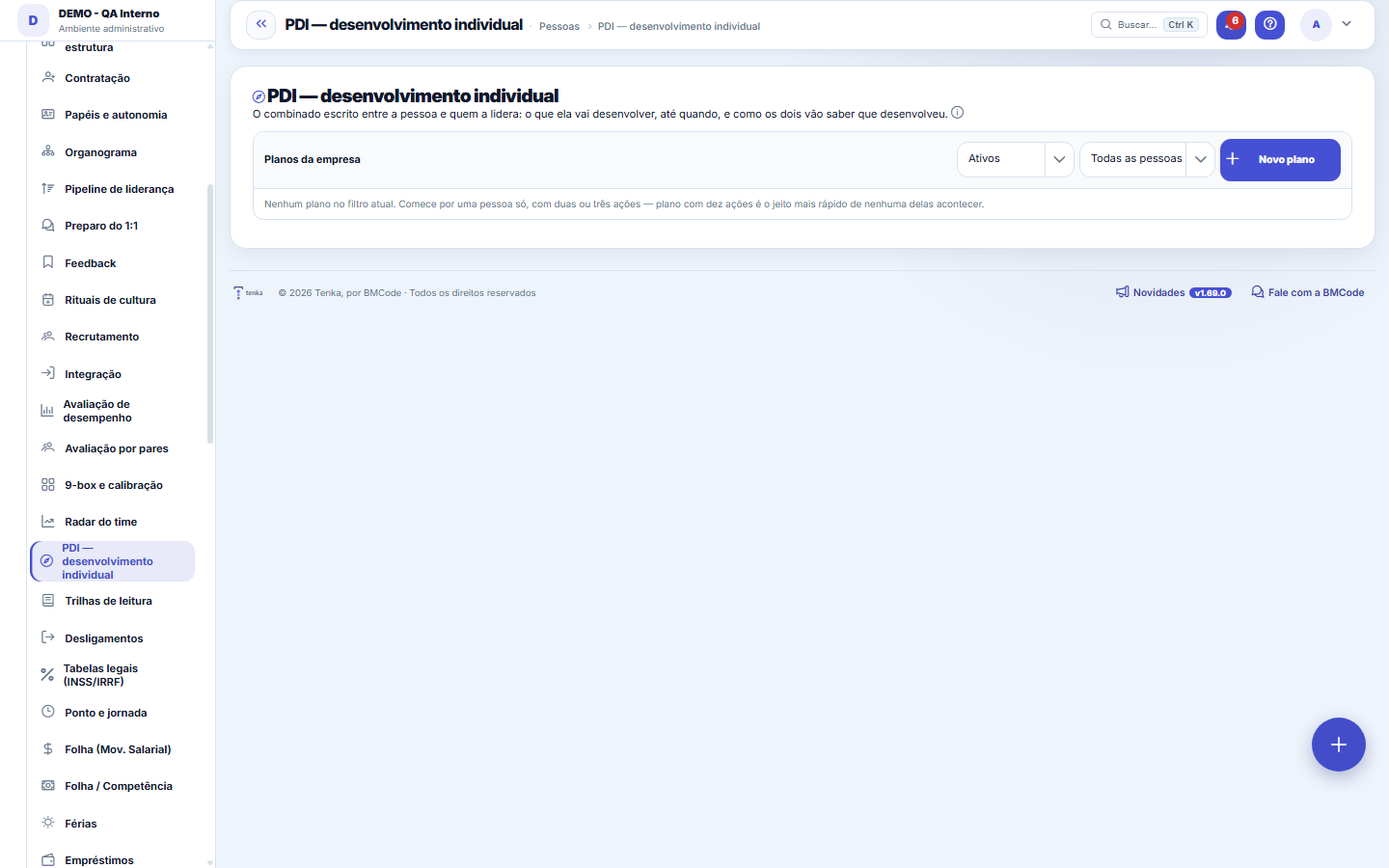
What you find on this screen
A portrait of the screen, read from the screen itself — it changes when the screen changes.
Available actions
New planSaveCancelActivateCompleteNew actionRecord 1:1Record
Form fields
PlanoNome do plano de desenvolvimento, do jeito que a pessoa e o gestor o chamam.
PessoaQuem está se desenvolvendo com este plano.
GestorQuem acompanha o plano e responde pelo resultado junto com a pessoa.
CompetênciaCompetência que o plano quer desenvolver. É o que liga o PDI à avaliação.
ObjetivoO que a pessoa vai conseguir fazer no fim do plano, em termos observáveis.
EvidênciaComo se vai provar que a competência evoluiu. Sem evidência, o plano fecha por opinião.
IndicadorIndicador da estratégia que este desenvolvimento ajuda a mover.
TrimestreCiclo em que o plano é cobrado.
InícioQuando o plano começou a valer.
PrazoData combinada para concluir. Plano sem prazo não vira ação nenhuma.
SituaçãoSe o plano está em rascunho, em andamento, concluído ou abandonado.
Start here
What it's for
Turn "you need to improve in X" into a verifiable agreement: an objective, evidence of arrival, actions with a deadline, and periodic follow-up that gets recorded. The person comes to know what is expected of them without having to ask the manager — which is the main reason people resign saying they "didn't see a future".
Rules
EVIDENCE is agreed upon at the start, never judged at the end
The field "how will both of you know she got there" is what separates an IDP from theater. Write what will be HAPPENING when the objective is reached — "runs the monthly meeting with the three largest clients alone, without prior review" — and not an adjective ("being more autonomous"). The screen refuses to activate a plan without evidence, on purpose: without it, the closing depends on the mood of the day, and that is how the person learns the plan was worthless.
A track action is NOT marked by hand
When the action is of the type "training track", it points to a track and progress comes from real advancement — item by item, acceptance by acceptance. The person is automatically enrolled when the action is saved. Trying to manually complete a track that is at 40% is refused, because it would erase the difference between doing and saying you did.
An IDP without 1:1s is a document, not development
Follow-up is not a stand-alone text field: it happens within a 1:1 meeting between manager and report (reusing that day's meeting if there already is one) and it saves a snapshot of that day's percentage. It's the snapshot that allows saying "it was at 20% on day 3, it's at 20% today" instead of "I think you haven't moved". Active plans without follow-up for more than 45 days appear flagged at the top of the screen.
Plano nascido de uma avaliação carrega a fonte de cada ação
When the plan comes from the feedback-session button, it records which evaluation it came from, and each action records which competency on the scale it came from and why — the score and the evidence that originated it are visible on the action. This serves two conversations: today's ("this isn't me picking on you, it's what was recorded in the cycle") and the next cycle's ("what we agreed last time, and what happened to that score"). An action typed by hand still exists normally, marked as manual.
Frequently asked questions
The most important field is "what's blocking progress"
It's what is almost never written down. An obstacle recorded three times in a row is not lack of effort on the person's part: it's a problem that only the person leading can remove — lack of protected time, lack of access, a competing priority. An IDP that only records progress becomes a report; one that records obstacles becomes management.
Was this article helpful?
In the same module: People and development24
9-box and calibrationThe matrix that crosses performance with potential, and the room where managers compare their standards with …Performance reviewThe reading of a work PERIOD, not of the person: how they delivered (competencies, with evidence), how much t…Peer reviewWhere whoever works alongside the person answers — on the same scale as the cycle, with evidence, anonymously…Climate & PulseAnonymous climate and eNPS surveys to listen to the team.New HiresThe people-inflow pipeline: from accepted offer to ACTIVE employee with a start date — feeding payroll, cost,…Company cultureThe honest portrait of how the company actually works — derived from an anonymous 16-statement diagnostic, on…TerminationsThe organized exit: final settlement, dates, and contract closure — with immediate effect on payroll, cost, a…FeedbackRecord, in half a minute, what happened, what the person did, and the effect of it — to become a ready-made a…
Tenka Academy
Explore the AcademyStep-by-step learning paths for your industry, inside the platform.