

Roles and autonomy
Job title is the employment link; role is the piece of work with purpose, responsibility and expectation. Next to each role lives the pair that is almost always missing: what the person can decide on their own.
The screen
The real screen, in the theme you picked above.
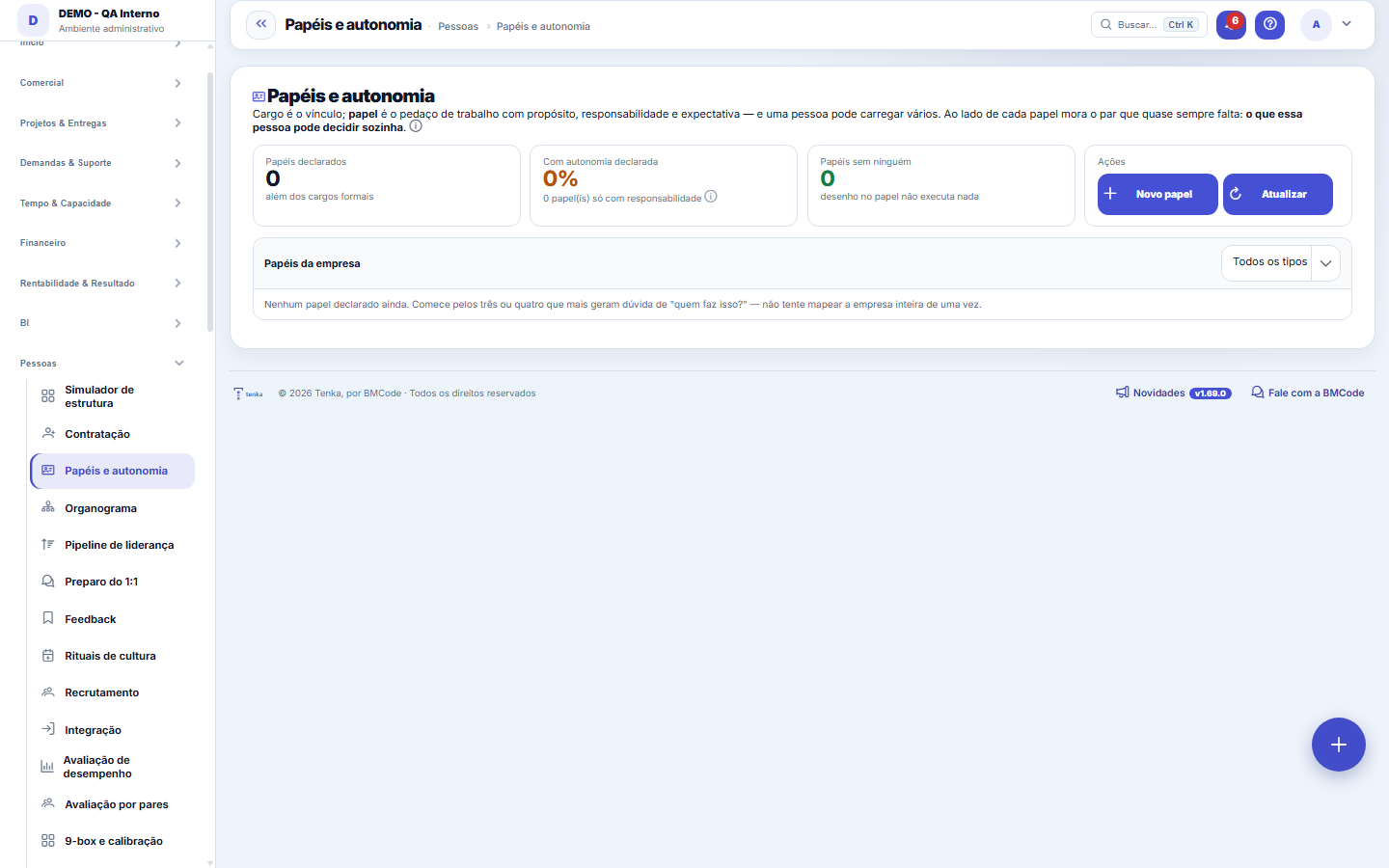
What you find on this screen
A portrait of the screen, read from the screen itself — it changes when the screen changes.
Available actions
New roleRefreshSaveCloseLink personCancelDeclare decision
Form fields
PapelNome do papel na organização. Papel é o que a pessoa faz, e não se confunde com o cargo da folha.
CódigoNúmero sequencial do papel por empresa.
TipoSe o papel é de liderança, de execução ou de suporte.
PropósitoPara que este papel existe, em uma frase. Papel sem propósito escrito vira acúmulo de tarefa.
ResponsabilidadesO que quem ocupa o papel decide e entrega sem precisar pedir permissão.
ExpectativasA régua combinada de desempenho. É o texto que a conversa de avaliação usa.
CargoCargo formal a que o papel se amarra na folha de pagamento.
AtivoPapel inativo não pode ser atribuído a mais ninguém; quem já ocupa continua registrado.
Start here
What it's for
State, in plain human language, what's expected of each role in the company — and how far the autonomy goes for whoever holds it. A person can have several roles, including outside their own position.
Rules
Why role and autonomy are on the same screen
Because kept apart they produce the most common flaw of growing companies: someone is accountable for everything and can decide nothing. Responsibility without autonomy produces an owner who can only be blamed; autonomy without an owner produces chaos. Here both things are declared together, side by side.
The autonomy ladder
Four steps, from freest to least: DECIDES AND ACTS (doesn't even need to notify) · DECIDES AND INFORMS AFTERWARD (mature delegation) · CONSULTS BEFOREHAND (the conversation is mandatory, but the decision is still theirs) · RECOMMENDS (someone else decides). Most day-to-day decisions should be in the first two steps — if almost everything is in the last two, the bottleneck is structural.
A ceiling without an escape route locks more than it unlocks
If you declare a limit ("up to R$5,000") and don't say who it goes to when it's exceeded, the person is left waiting to figure it out. The screen flags this case: every ceiling needs a destination.
Frequently asked questions
Somar mais de 100% não é problema de organização
It is a capacity problem. When the screen warns that someone has accumulated 260% of time in roles, the conversation is not about redrawing boxes — it is about what that person is going to stop doing.
Was this article helpful?
In the same module: People and development24
9-box and calibrationThe matrix that crosses performance with potential, and the room where managers compare their standards with …Performance reviewThe reading of a work PERIOD, not of the person: how they delivered (competencies, with evidence), how much t…Peer reviewWhere whoever works alongside the person answers — on the same scale as the cycle, with evidence, anonymously…Climate & PulseAnonymous climate and eNPS surveys to listen to the team.New HiresThe people-inflow pipeline: from accepted offer to ACTIVE employee with a start date — feeding payroll, cost,…Company cultureThe honest portrait of how the company actually works — derived from an anonymous 16-statement diagnostic, on…TerminationsThe organized exit: final settlement, dates, and contract closure — with immediate effect on payroll, cost, a…FeedbackRecord, in half a minute, what happened, what the person did, and the effect of it — to become a ready-made a…
Tenka Academy
Explore the AcademyStep-by-step learning paths for your industry, inside the platform.