

Leadership pipeline
What leadership rung each manager is on, what the next step is, and what needs to be let go of to take it — cross-checked against evidence of who actually leads someone in the org chart.
The screen
The real screen, in the theme you picked above.
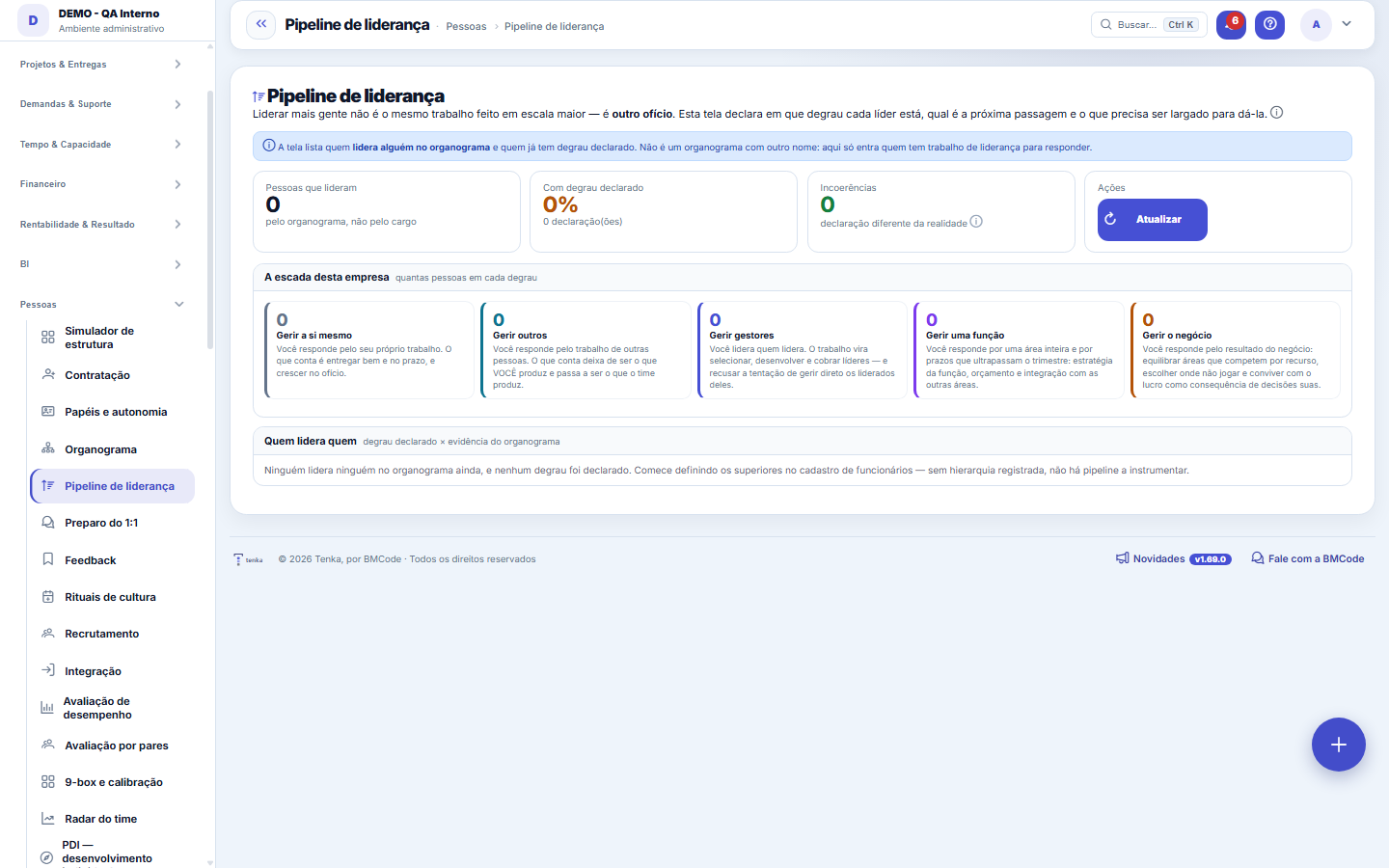
What you find on this screen
A portrait of the screen, read from the screen itself — it changes when the screen changes.
Available actions
RefreshSaveCancel
Form fields
PessoaQuem está sendo avaliado no pipeline de sucessão.
Nível atualNível de liderança que a pessoa exerce hoje.
Nível de destinoNível para o qual ela está sendo preparada. Sem destino declarado não existe pipeline, existe elogio.
ProntidãoQuando a pessoa estaria pronta para assumir: agora, em um ano, em dois.
Data da avaliaçãoQuando esta leitura foi feita. Avaliação velha não sustenta decisão de sucessão.
EvidênciaFatos observados que sustentam a prontidão declarada.
O que abandonarO que a pessoa precisa deixar de fazer para caber no nível seguinte.
ObservaçãoAnotações do gestor sobre o desenvolvimento combinado.
Start here
A ideia por trás: cada degrau é OUTRO ofício
The model says the leadership career is not a ladder of size, it is a sequence of changes of craft. At each passage, what made the person good at the previous rung starts to get in the way.
The five rungs: managing yourself (answers for your own work) → managing others (answers for other people's work) → managing managers (answers for those who lead) → managing a function (answers for an entire area, including competencies that are not your own) → managing the business (answers for the result, not the function).
No company needs all five. In a thirty-person business, the real ladder usually goes from the first to the third — and that is not a limitation, it is design.
Rules
O campo "o que abandonar" é o coração da ferramenta
Every passage requires letting go of something. Whoever moves up to "managing others" needs to let go of authorship of the task; whoever moves up to "managing managers" needs to let go of direct management of the task and start holding the leader accountable for their result — without fixing the work of that leader's team.
When this conversation does not happen, the promotion becomes accumulation: the person keeps doing the previous job and gets one more on top. Months later the company concludes that "she didn't work out as a leader", when in fact nobody agreed with her on what was changing.
When you choose the rung, the system suggests a default text for what to give up. It is a starting point — rewrite it with what is true in this company.
De onde vem a "evidência do organograma"
Two counts, both taken from the immediate superior field of the employee registry: how many people report directly to that person, and how many of those also lead people.
It is the crossing of these two numbers with the declared rung that produces the inconsistencies — for example, someone declared as "managing others" whose direct reports already lead people: in practice the passage to "managing managers" has already happened, and the company is the last to know.
The screen shows one inconsistency per person, the first one found. Once one is fixed, the next may appear.
If the screen is empty, the fix is not here: it is filling in the immediate superior in the employee registry. Without a registered hierarchy there is no pipeline to instrument.
Declarar o degrau é um ato, não uma classificação
The rung is not calculated or inferred: someone declares it, and from then on there is an agreement. Only the current rung is mandatory — destination, readiness, evidence and "what to let go of" can come later, and usually come from the conversation.
Readiness (not assessed, developing, ready within a year, ready now) is what feeds the succession block at the end of the screen. Marking someone "ready now" means publicly stating that the company would promote them if the position opened tomorrow — and it is exactly this discomfort that makes the information useful.
Readiness (not assessed, developing, ready within a year, ready now) is what feeds the succession block at the end of the screen. Marking someone "ready now" means publicly stating that the company would promote them if the position opened tomorrow — and it is exactly this discomfort that makes the information useful.
Existe um registro vigente por pessoa — não um histórico
Saving again overwrites that person's rung, destination, readiness and texts. The screen keeps the current snapshot, not the timeline.
In practice: if you want to compare "where they were in January" with today, record it in the evidence or in the 1:1 conversation — the pipeline will not remember for you.
In practice: if you want to compare "where they were in January" with today, record it in the evidence or in the 1:1 conversation — the pipeline will not remember for you.
Frequently asked questions
Who sees this screen
Only administration and management profiles. It is not a public org chart: it is the company's reading of who leads, who is ready and what is missing — information that, if misplaced, turns into hallway gossip.
Connected screens
Lê a hierarquia deFuncionáriosA evidência sai do campo "superior imediato" de cada funcionário.Vira conversa emPreparo do 1:1O degrau do liderado aparece no preparo do 1:1 de quem o lidera.Vira plano emPDI — desenvolvimento individualO que a pessoa precisa abandonar e desenvolver cabe num PDI com evidência e prazo.
Was this article helpful?
In the same module: People and development24
9-box and calibrationThe matrix that crosses performance with potential, and the room where managers compare their standards with …Performance reviewThe reading of a work PERIOD, not of the person: how they delivered (competencies, with evidence), how much t…Peer reviewWhere whoever works alongside the person answers — on the same scale as the cycle, with evidence, anonymously…Climate & PulseAnonymous climate and eNPS surveys to listen to the team.New HiresThe people-inflow pipeline: from accepted offer to ACTIVE employee with a start date — feeding payroll, cost,…Company cultureThe honest portrait of how the company actually works — derived from an anonymous 16-statement diagnostic, on…TerminationsThe organized exit: final settlement, dates, and contract closure — with immediate effect on payroll, cost, a…FeedbackRecord, in half a minute, what happened, what the person did, and the effect of it — to become a ready-made a…
Tenka Academy
Explore the AcademyStep-by-step learning paths for your industry, inside the platform.