

Culture rituals
The recurring meetings that keep alignment alive — with cadence, audience, an agenda anchored in values, and a timebox — and the real coverage: how many of the planned ones happened and left a trace.
The screen
The real screen, in the theme you picked above.
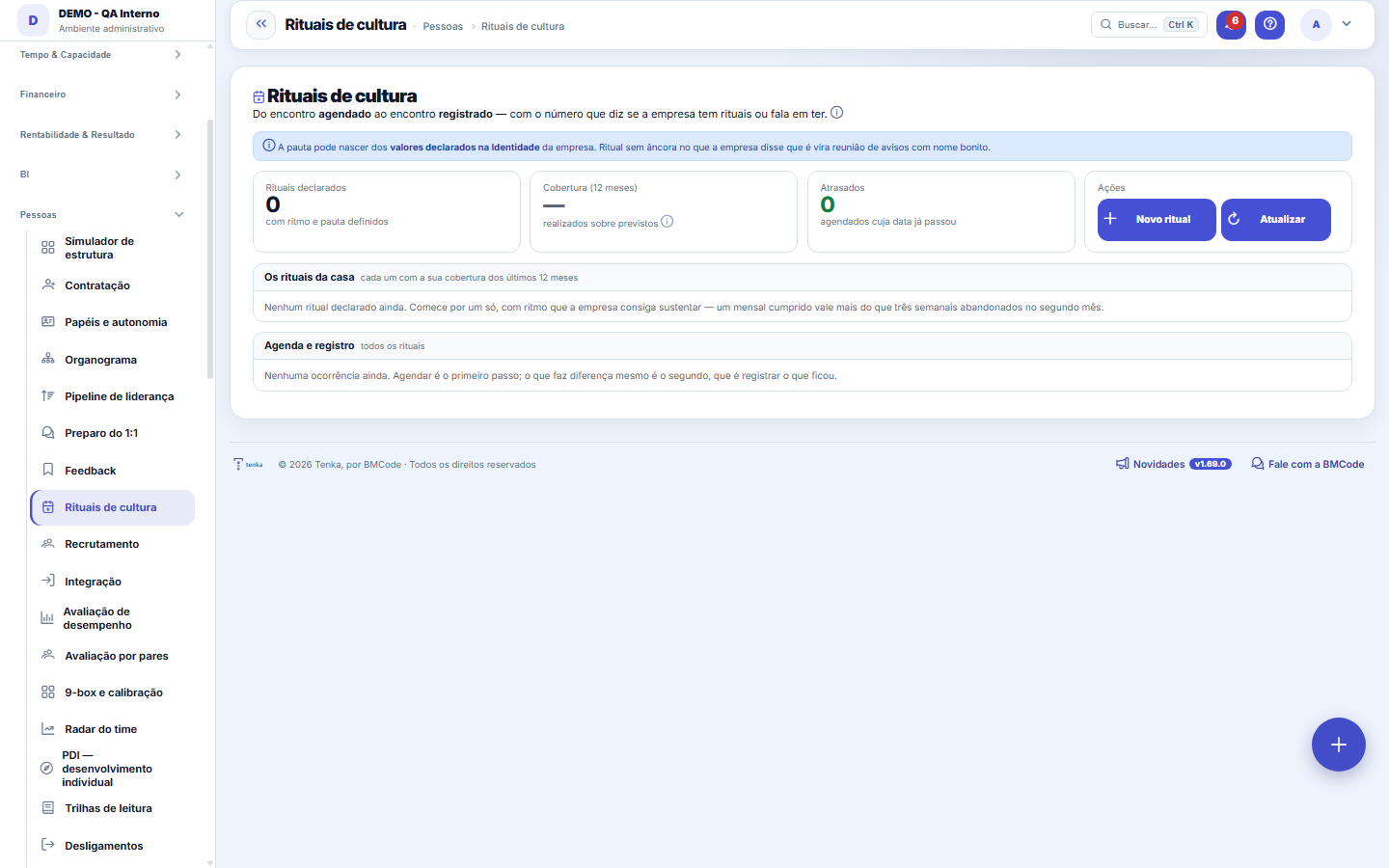
What you find on this screen
A portrait of the screen, read from the screen itself — it changes when the screen changes.
Available actions
New ritualRefreshSuggest agenda from the valuesSaveCancelScheduleOccurrencesView all
Form fields
RitualComo o ritual é chamado na agenda do time.
NºNúmero sequencial por empresa, para citar o ritual sem ambiguidade.
TipoQue função o ritual cumpre: alinhamento, reconhecimento, aprendizado, celebração.
RecorrênciaDe quanto em quanto tempo o ritual acontece. Ritual sem ritmo deixa de ser ritual.
EquipeTime que participa. Vazio significa ritual da empresa inteira.
ResponsávelQuem conduz e cobra a realização do ritual.
PautaRoteiro do encontro. Pauta escrita é o que impede o ritual de virar reunião solta.
Valores em focoQuais valores da empresa este ritual pretende reforçar na prática.
Duração (min)Tempo previsto do encontro. Serve para medir o custo de agenda do ritual.
AtivoRitual inativo sai da agenda, mas o histórico dos encontros já feitos permanece.
Start here
Por que ritual, e não comunicado
Culture isn't transmitted by announcement: a beautiful email changes what people know and doesn't change what they do. What changes behavior is repetition with an agenda — the same subject coming back, at the same rhythm, with concrete examples from the week.
A well-designed ritual has four things: rhythm (the date already exists, nobody decides whether it will happen), a clear audience, an agenda (otherwise it becomes an announcements meeting) and a timebox (otherwise it ends on the subject of whoever spoke last).
Start small: one monthly ritual kept is worth more than three weekly ones abandoned in the second month.
Rules
Modelo × rodada: duas coisas diferentes
The ritual is the template — name, rhythm, audience, default agenda, focus values, duration. The occurrence is each round: the planned date, who was invited, who showed up, that time's agenda and what came out of it.
When scheduling, the template agenda is copied into the round. Changing the default agenda later doesn't rewrite what was already agreed in previous meetings — and that is what allows the history to be read years later.
If the company has its Identity filled in, the suggest-agenda button builds three blocks using the declared values: where we saw the values happening, where we saw the opposite and what it cost us, and one thing to change before the next meeting — with an owner. It's the simplest agenda that works.
Realizado exige registro — não existe marcar e seguir
Marking a round as held without writing what came out of it is refused. The reason is straightforward: a meeting with no trail can't be told apart from a meeting that didn't happen, and that is how a company spends two years believing it has rituals.
The record is short on purpose — what was decided and who took on what. Nobody writes long minutes, and what isn't written isn't measured.
A round with a past date that is still scheduled appears flagged: either it happened and nobody noted it, or it didn't happen — and the two explanations deserve different conversations.
Como a cobertura é calculada — e o que ela NÃO diz
Coverage = rounds held ÷ rounds planned, over the last 12 months. Green from 80%, orange from 50%, red below.
Two details that change the reading:
• The denominator is the occurrences actually registered, not those the rhythm would require. A monthly ritual with a single round scheduled and held scores 100% over twelve months. Coverage measures fidelity to what was scheduled, not to the declared rhythm — to measure the rhythm, schedule the period's rounds all at once.
• A canceled round is left out of the count, it doesn't count as a failure. Canceling improves the number. Use cancellation for what really shouldn't have been scheduled, not to clean up the history.
A ritual with no rounds at all appears as "no occurrences in the period", not as 0% — absence of data is not a low score.
Frequently asked questions
Excluir um ritual apaga o histórico dele?
Deleting the ritual also sends its occurrences to the recycle bin, in cascade. If you just want to stop scheduling, deactivate instead of deleting: the history keeps telling the story, and past coverage remains readable.
Connected screens
Ancora a pauta emIdentidade da empresaOs valores declarados na Identidade viram a pauta sugerida do ritual.Não confundir comCerimônias do timeCerimônias são o rito do TIME sobre o trabalho (daily, retro); rituais são o rito da EMPRESA sobre a cultura.É medido junto deRadar do timeO efeito do ritual aparece no clima e no ambiente declarados pelo time.
Was this article helpful?
In the same module: People and development24
9-box and calibrationThe matrix that crosses performance with potential, and the room where managers compare their standards with …Performance reviewThe reading of a work PERIOD, not of the person: how they delivered (competencies, with evidence), how much t…Peer reviewWhere whoever works alongside the person answers — on the same scale as the cycle, with evidence, anonymously…Climate & PulseAnonymous climate and eNPS surveys to listen to the team.New HiresThe people-inflow pipeline: from accepted offer to ACTIVE employee with a start date — feeding payroll, cost,…Company cultureThe honest portrait of how the company actually works — derived from an anonymous 16-statement diagnostic, on…TerminationsThe organized exit: final settlement, dates, and contract closure — with immediate effect on payroll, cost, a…FeedbackRecord, in half a minute, what happened, what the person did, and the effect of it — to become a ready-made a…
Tenka Academy
Explore the AcademyStep-by-step learning paths for your industry, inside the platform.