
Team radar
Two anonymous readings: how people work with one another, and what environment leadership creates around them. Published only when no one can be identified.
The screen
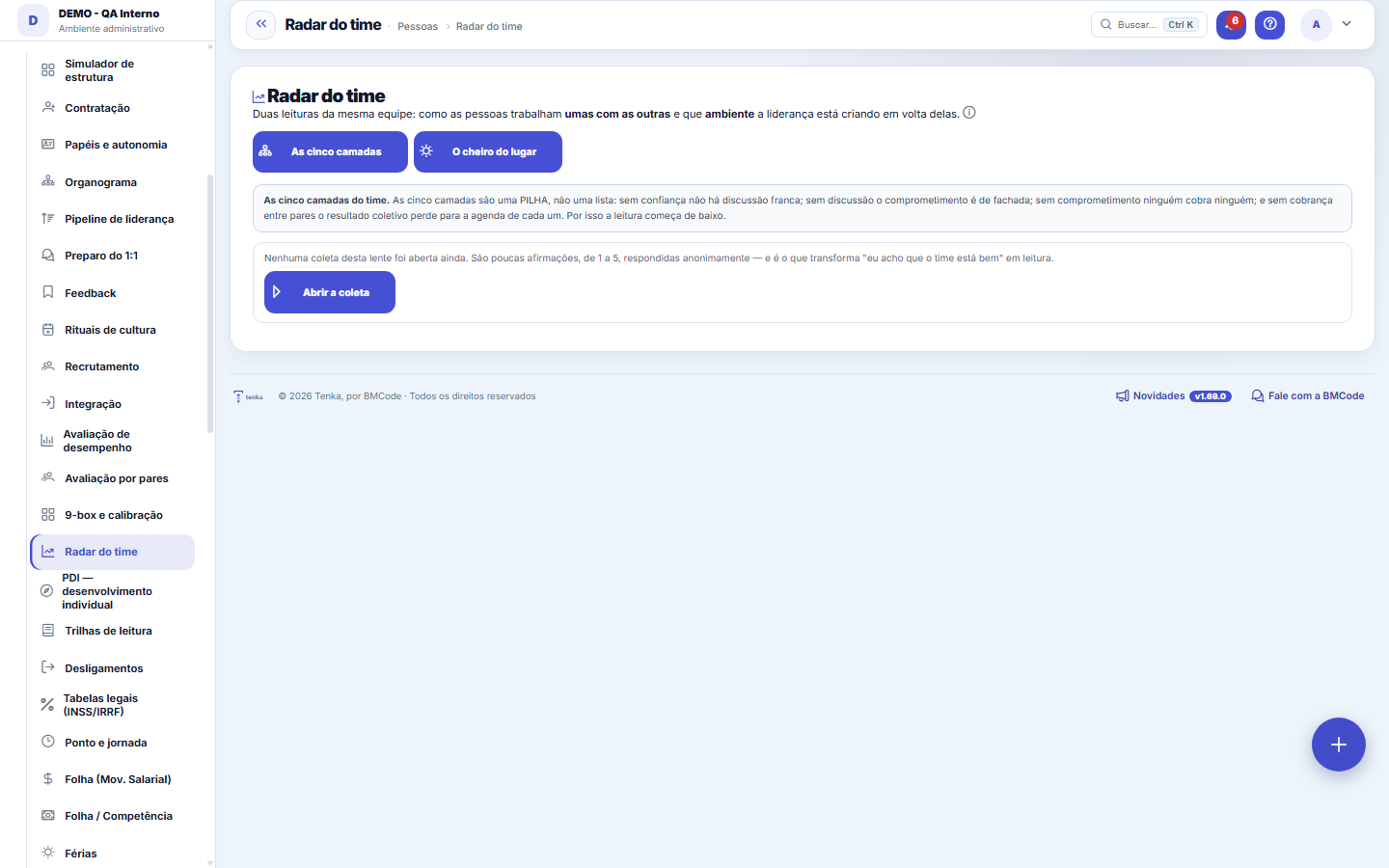
The real screen, in the theme you picked above.
What you find on this screen
A portrait of the screen, read from the screen itself — it changes when the screen changes.
Available actions
The five layersThe smell of the placeOpen the collectionSend my answers
Form fields
TítuloNome da rodada de clima, do jeito que o time viu no convite.
TipoQue aspecto do time está sendo ouvido nesta rodada.
AnônimaRodada anônima protege quem responde e é o que faz o time falar de gestor.
RecorrênciaFrequência da rodada. Comparar rodadas da mesma frequência é o que mostra se melhorou.
SituaçãoSe a rodada está em preparo, recebendo respostas ou fechada para leitura.
Start here
As cinco camadas — e por que a ordem importa
The first lens is a stack, not a list. Each layer only holds on top of the one below:
1 · Trust — being able to say "I got it wrong" or "I don't know" without it being used against you later. It's not liking your colleague; it's vulnerability at no cost.
2 · Productive conflict — disagreeing in public about the idea. Without trust, the team trades conflict for polite silence, and the decision comes out untested.
3 · Commitment — leaving the meeting with a decision everyone will stand behind, including those who disagreed. Without conflict there is no commitment: those who weren't heard don't commit, they obey.
4 · Peer accountability — colleagues holding colleagues to account when the agreement isn't moving. It is the most uncomfortable of the five layers; where only the boss holds people to account, the team has outsourced the yardstick to them.
5 · Attention to results — the team's result above the individual result.
That is why the screen points to the lowest layer that is fragile: tackling the upper ones before it is spending energy on the wrong floor of the building.
Rules
The second lens: the smell of the place
The other reading is not about the team, it is about the environment leadership creates, on four axes: stretch (how much is expected), discipline (agreements are kept), support (there is help when things get tight) and trust (the place is perceived as fair).
The value lies in the tensions between pairs, which the screen names when they appear:
• high stretch with low support — a lot is demanded and little help is given: it wears good people down in silence, and usually shows up as an unexpected resignation, not as a complaint;
• high support with low stretch — comfortable and undemanding: nobody suffers and nobody grows, and the best get bored;
• high discipline with low trust — firm demands in a place perceived as unfair: the team complies out of fear and bad news stops flowing up;
• high trust with low discipline — good atmosphere, slippery agreements: pleasant to live in and expensive to sustain, because those who deliver carry those who don't.
How to read the scores
Scale from 1 (strongly disagree) to 5 (strongly agree). The ranges: below 3.0 is fragile, from 3.0 to 3.8 is attention, 3.8 or more is healthy.
Next to the team's score appears the whole company's, as a backdrop: 3.4 in a place where the average is 4.1 is one conversation; 3.4 in a place where the average is 3.2 is another.
A layer with no answers at all appears as "—", never as zero. The absence is information and cannot disappear from the screen.
A leitura só aparece com 3 respondentes — e isso não é excesso de zelo
With two respondents, "the team's average" is someone's identifiable opinion. Publishing that breaks anonymity once and destroys the instrument forever: the next round would no longer get honest answers.
Teams below the cutoff appear named, without numbers — so you know they answered and still can't read anyone.
Two technical notes: whoever answers without stating a team falls into a group called "No team", which is also published if it reaches the minimum; and the number of respondents is estimated from the total answers divided by the number of questions — people who skip questions slightly affect that count.
Opening the collection creates a NEW round
Each click on "open collection" creates a new survey, and the screen starts reading the most recent one. The previous data remains in the database, but disappears from this screen.
Open one round per period (quarterly is usually the right rhythm) and let the response time run. Reopening by mistake in the middle of a collection resets the reading that was forming.
About rhythm: measuring every month is tiring and changes nothing — the layers move in months, not weeks. And measuring without giving the result back to the team is the fastest way to kill the next round.
Frequently asked questions
O sistema sabe quem respondeu o quê?
No. The answer is saved without the identifier of who answered; what stays with it is the team, to allow a per-team reading. The "already answered" control is done by a separate mark, which doesn't link the person to the content.
That is why the three-respondent cutoff is non-negotiable: it is the second layer of protection, so nobody is identified by elimination.
That is why the three-respondent cutoff is non-negotiable: it is the second layer of protection, so nobody is identified by elimination.
Can the team "do well" and the reading come out bad?
It can, and it's worth investigating before disagreeing. The two most common causes are recent: a change of team or leadership in the last few weeks, and an isolated low score in a small group pulling the average down. The right conversation is to take the result to the team and ask — the average doesn't solve anything, what you do with it does.
Connected screens
Usa a coleta deClima & PulseAs duas leituras são pesquisas de pulse com formulário próprio.É trabalhado emRituais de culturaCamada frágil vira pauta de ritual — leitura sem conversa não muda nada.Agrupa porEquipesA leitura é por equipe; renomear a equipe separa o histórico.
Was this article helpful?
In the same module: People and development24
9-box and calibrationThe matrix that crosses performance with potential, and the room where managers compare their standards with …Performance reviewThe reading of a work PERIOD, not of the person: how they delivered (competencies, with evidence), how much t…Peer reviewWhere whoever works alongside the person answers — on the same scale as the cycle, with evidence, anonymously…Climate & PulseAnonymous climate and eNPS surveys to listen to the team.New HiresThe people-inflow pipeline: from accepted offer to ACTIVE employee with a start date — feeding payroll, cost,…Company cultureThe honest portrait of how the company actually works — derived from an anonymous 16-statement diagnostic, on…TerminationsThe organized exit: final settlement, dates, and contract closure — with immediate effect on payroll, cost, a…FeedbackRecord, in half a minute, what happened, what the person did, and the effect of it — to become a ready-made a…
Tenka Academy
Explore the AcademyStep-by-step learning paths for your industry, inside the platform.