

Reading tracks
The wiki organized in sequence, by position or by role, with acceptance recorded on each page. A wiki without a track is a library: it has everything, and no one reads it.
The screen
The real screen, in the theme you picked above.
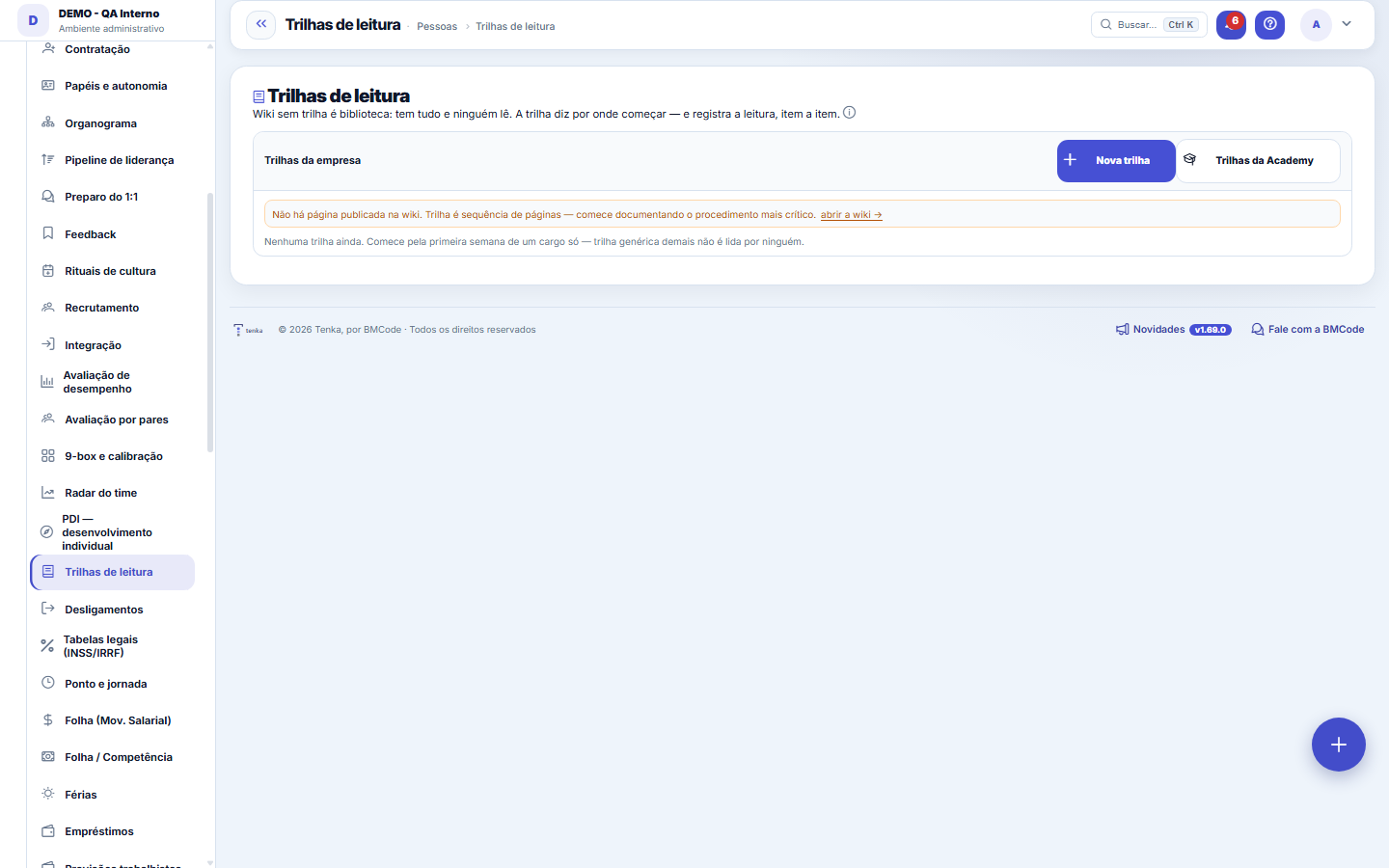
What you find on this screen
A portrait of the screen, read from the screen itself — it changes when the screen changes.
Available actions
New pathAcademy tracksSaveCancelAdd pageEnroll the target audienceAnswerOpen
The list shows
Area (job title)PeopleAverage progressCompletedOverdueAverage score
Form fields
NomeComo a trilha é chamada no convite que a pessoa recebe.
DescriçãoO que a pessoa vai saber fazer depois de concluir a trilha.
CargoCargo para quem esta trilha é destinada.
PapelPapel que a trilha prepara, quando o recorte não é o cargo.
ObrigatóriaTrilha obrigatória cobra conclusão e entra no indicador de conformidade do time.
Prazo (dias)Quantos dias a pessoa tem para concluir depois de receber a trilha.
AtivaTrilha inativa não é mais atribuída, mas quem já está fazendo continua.
Start here
What it's for
It organizes the wiki pages (as well as external videos, courses, and training) in the order they should be read, by position or by role, and records the acceptance of each item with date, time, and page version. It gives newcomers a starting point — the first week already scripted — and gives the company proof that the standard was communicated, with a verifiable code certificate when the track is completed.
How to
Quiz, certificate and hiring
On each item, the plus icon builds a quiz question (one option per line; the correct one is the line number, starting at 0). Learners answer through the question-mark icon and the score is stored on the enrollment. A finished path gets a certificate with a code. Anyone hired in the last 30 days is enrolled automatically in mandatory paths when this screen opens.
Rules
The order is the product
A track is a thought-out sequence, not a list of links. The "why read this" field is what separates "read this" from "read this because, without it, you'll get the first service call wrong" — and it's what makes the person open the page.
Acceptance is per item, on purpose
Accepting the whole track with one click is what happens with terms of use, and that's why nobody reads terms of use. Each page has its own "I read and understood", and the record keeps the date, time, origin, and the VERSION of the page that was read.
The record protects both sides
With the record, "nobody told me" becomes an objective conversation. Without it, sometimes the phrase is simply true — and the company has no way of knowing.
The track is not just the wiki
Besides the wiki page, an item can be an external link, a video, a document, or IN-PERSON training (which has no link at all — completion is self-declared). The reason is practical: restricting the track to the wiki forces the company to keep a second list outside the system, and it's always in that second list where progress dies. Each item can declare an estimated duration in minutes, and it's the sum of those that answers the only question the person really asks before starting: does this fit in my week?
Enrollment: what makes the percentage exist
Enrollment is the record that says who is taking the track, since when, and until when. Before it, there was always someone at 0% with no way to know whether they were behind schedule or whether the track wasn't even theirs. The "Enroll the target audience" button creates enrollment for whoever holds the track's role or position; it is idempotent — running it again does not duplicate anyone or reset those who already progressed. Whoever opens their own track is also enrolled on the spot. The deadline is counted from the start, with the number of days defined in the track; without a deadline there is no delay, only the absence of an agreement.
The percentage is derived, never typed in
It comes from the acceptances: mandatory items completed over mandatory items in the track. OPTIONAL items are not counted — if they were, nobody would reach 100% and the number would stop meaning anything. Nobody can edit the percentage anywhere in the system, and that is what keeps it as proof instead of a recorded opinion.
A new mandatory item REOPENS the track for those who already completed it
This is intentional, and it's the rule that surprises people the most. When the procedure changes and you add a mandatory page, whoever was already at 100% becomes pending on that item again. The alternative would be worse: the proof of communication would silently go stale, and the company would keep believing everyone knows the new version of a rule that nobody read.
Enrolment on hiring and on a change of role
When someone is registered, has their hiring completed or changes role, Tenka enrols them right away in the mandatory tracks that apply to them: the company-wide ones, those for their role and those for the duties they hold. Anyone already enrolled keeps what they completed. People who have left the company are not enrolled.
Frequently asked questions
Low adoption is almost never lack of interest
It's usually a track that's too long, too generic, or pointing to outdated pages. Start with the first week of ONE role, with few pages, and expand later.
Hours are self-declared, not timed
The person can report how many minutes they spent on the item they're completing; if left blank, the estimated duration applies. The system does NOT measure anyone's screen time — besides being surveillance, the number would be false (an open tab is not a read tab). What is stored serves the training hours that the company reports in audits, and it is honest precisely because it is self-declared.
Was this article helpful?
In the same module: People and development24
9-box and calibrationThe matrix that crosses performance with potential, and the room where managers compare their standards with …Performance reviewThe reading of a work PERIOD, not of the person: how they delivered (competencies, with evidence), how much t…Peer reviewWhere whoever works alongside the person answers — on the same scale as the cycle, with evidence, anonymously…Climate & PulseAnonymous climate and eNPS surveys to listen to the team.New HiresThe people-inflow pipeline: from accepted offer to ACTIVE employee with a start date — feeding payroll, cost,…Company cultureThe honest portrait of how the company actually works — derived from an anonymous 16-statement diagnostic, on…TerminationsThe organized exit: final settlement, dates, and contract closure — with immediate effect on payroll, cost, a…FeedbackRecord, in half a minute, what happened, what the person did, and the effect of it — to become a ready-made a…
Tenka Academy
Explore the AcademyStep-by-step learning paths for your industry, inside the platform.