

My week
The personal ten-minute ritual, once a week, that makes the rest of the method work: five steps, three written commitments, and what you're waiting on from others coming back on its own.
The screen
The real screen, in the theme you picked above.
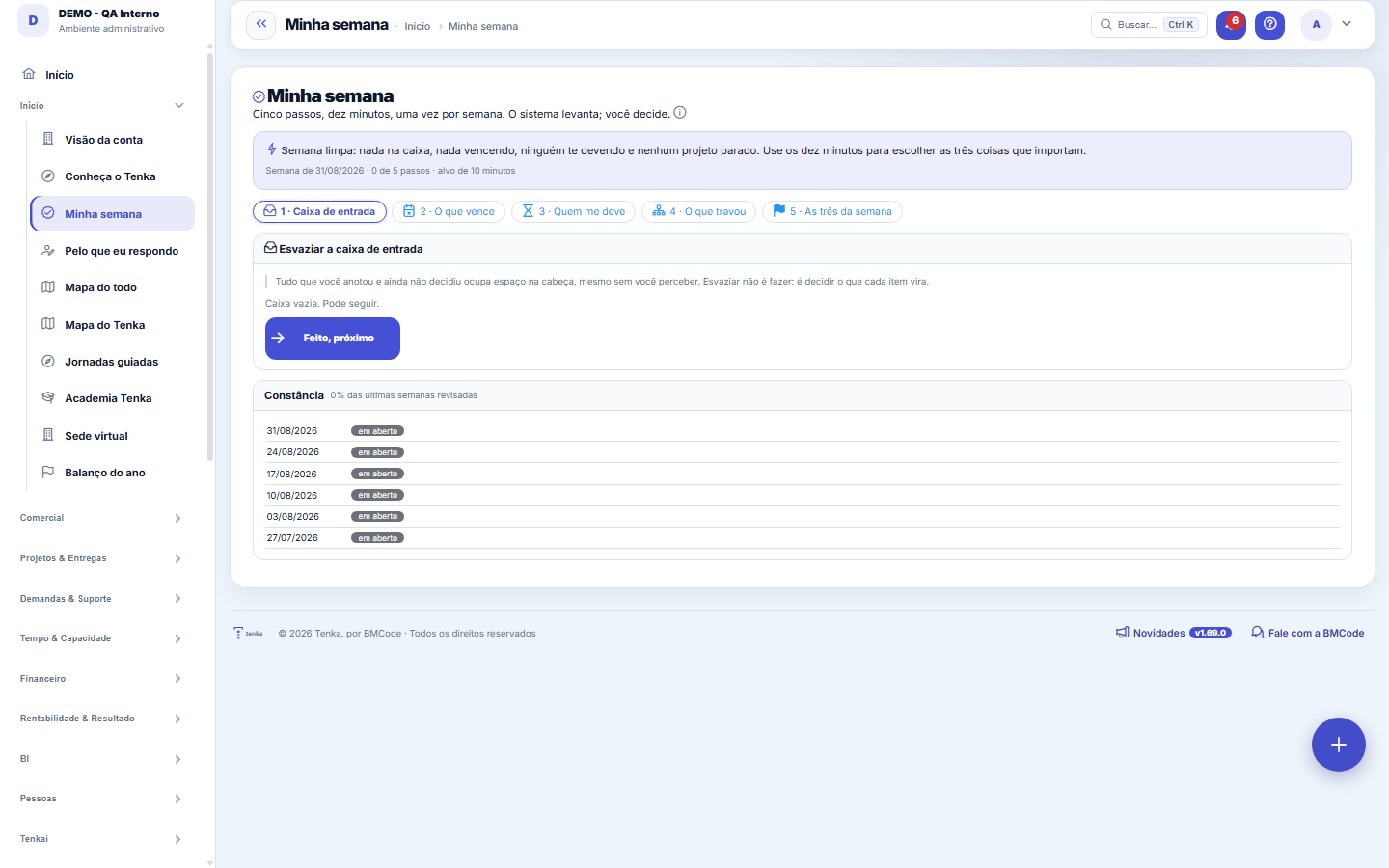
What you find on this screen
A portrait of the screen, read from the screen itself — it changes when the screen changes.
Available actions
Done, nextI received itAdd notePrepare draftComplete the reviewSave and continue later
Form fields
SemanaSegunda-feira da semana revisada. É a chave pela qual se compara uma semana com a outra.
Caixa de entradaMarcado quando a caixa foi zerada na revisão. Passo pulado é onde o compromisso se perde.
DemandasMarcado quando as demandas em aberto foram repassadas uma a uma.
AguardandoMarcado quando o que está na mão de terceiros foi cobrado.
ProjetosMarcado quando cada projeto ativo recebeu um próximo passo.
Top 3Marcado quando as três prioridades da semana foram escolhidas.
Prioridade 1A coisa mais importante da semana. Se só uma sair, é esta.
Prioridade 2A segunda coisa que precisa acontecer nesta semana.
Prioridade 3A terceira prioridade. Passar de três é não ter prioridade nenhuma.
Concluída emQuando a revisão foi fechada. Vazio significa revisão começada e abandonada.
DuraçãoQuanto tempo a revisão levou. Revisão de dois minutos costuma ser revisão que não aconteceu.
Start here
De onde vem a ideia — e por que ela costuma fracassar
The method behind it is GTD, and its centerpiece isn't the task list: it's the weekly review. It's what keeps the list trustworthy — and it's the first thing everyone abandons, because in the traditional version it takes hours.
This screen exists to fit in the gap between two meetings. It doesn't ask you to organize anything: it gathers the data, you look, decide and write down three commitments. If it regularly takes more than ten minutes, the problem is almost never you — it's too much accumulation between reviews, and the number in the footer is there precisely to show that.
Choose a fixed time (Friday afternoon or Monday morning) and protect it. A ritual that depends on remembering isn't a ritual.
What this screen answers
A ten-minute ritual in five steps: empty the inbox, look at what's due, chase whoever owes you, find what's stalled and choose the three things for the week. The system gathers the data; the decision is yours.
How to
What this screen answers
It's the percentage of the last eight weeks in which you completed the review. A week you never opened doesn't count against you. The ritual's effect comes from REPETITION: eight ten-minute reviews are worth more than one two-hour one.
Rules
What each of the five steps really looks at
1 · Inbox — just the count of what's open in the inbox; emptying it happens there.
2 · What's due — your open requests due within seven days, overdue ones included, most urgent first. Shows up to 12.
3 · Who owes me — what you noted as "waiting for", oldest to newest. No cap: this list is meant to bother you.
4 · What's stuck — projects where you're the manager and that have no open request. It's the classic sign of a project with no next action: nobody abandoned it, it's just that nobody decided what the next step is. Shows up to 12.
5 · The week's three — three free fields, yours.
Two cuts to keep in mind: steps 2 and 4 cut off at 12 items (the review is for choosing, not taking inventory), and step 4 doesn't see projects you take part in without being the manager.
What this screen answers
The duration of each review is recorded. If the ritual regularly goes past ten minutes, what failed was the screen's design — the number exists to hold the product accountable, not you.
A revisão termina em COMPROMISSO, não em leitura
You can't finish the review with the three fields empty: a review that doesn't end in a commitment is just reading a list. One is enough, but write at least one.
The format that works is what + by when. "Take care of the proposal" isn't a commitment; "send customer X's proposal by Wednesday" is. Three is the ceiling on purpose — whoever picks six hasn't picked anything.
Commitments are free text and don't automatically become requests. If one of them needs a deadline, an owner or follow-up, it deserves to become a real request — the review is the place to notice that, not to replace the board.
You can move between steps in any order and leave halfway: each step you check is saved immediately, and "save and continue later" returns to where you left off.
"Waiting" and the nudge: how it really works
When you note something you're waiting for, it starts coming back on its own. The ruler is the interval you set (default every 3 days, from 1 to 60): counted from the last reminder, or from the request if there hasn't been one yet.
The reminder arrives through the platform's bell. When the debtor is someone in-house and you point them out in the dedicated field, they get the notice too. Customers and suppliers never receive automatic chasers — chasing a third party by automation is a relationship decision, not a software one; you're the one who gets the nudge, so you can chase in the way the relationship calls for.
The routine runs once a day, handling one batch at a time and starting with whoever has gone longest without a reminder — in a large base, an item may be a day late, never left behind forever. Running twice on the same day doesn't generate a repeated notice.
Each row's age gets a label: recent (up to 2 days), "worth a nudge" (3 to 7), "past due" (8 to 21) and "probably forgotten" (over 21). The bell on each row turns that item's reminder on and off.
What this screen answers
Nobody reads what you write here — not your manager, not HR, not the platform administrator. It's a design decision: a review that someone else can read stops being honest in the first bad week, and a dishonest review isn't useful even to the person who writes it.
A duração conta TEMPO ATIVO — deixar a aba aberta não infla o número
Time is added up in segments: at each action of yours (completing a step, saving, requesting the draft, touching "waiting for", completing the review) the interval since the previous action is added. An interval longer than 3 minutes adds nothing — during that stretch you were somewhere else.
In other words: opening the review, going to a meeting and coming back three hours later records the time you were actually on the screen, not the three hours. That's why the footer talks about "minutes on screen".
The number doesn't evaluate you: it audits the screen's design. If reviews regularly go past ten minutes, either the screen failed or the interval between reviews is too long — and for that reading to stay useful it has to measure work, not calendar time.
There's also no way to reopen a review that's already completed. Whatever was left to do goes into next week, which is where it should be anyway.
O rascunho da IA é parecer sobre os SEUS itens
It receives exactly what's on the screen — the inbox count, the requests coming due, what you're waiting for with each item's age, the stalled projects — and returns an honest sentence about the week, up to three candidate commitments (each saying which concrete item it came from) and what can be let go.
It's instructed not to invent an item that isn't on your list and to say when information is missing. And it doesn't fill in the three fields: it stays alongside, and you copy whatever is useful.
If AI isn't active, the draft doesn't appear and nothing else changes — the review works perfectly without it. It just saves you the first draft.
Esta tela é sua, e de mais ninguém
The review is strictly personal: there is no manager, HR or platform administrator view. Not even the superuser reads what you write here.
It's a design decision, not an oversight: a review that someone else can read stops being honest in the first bad week — and a dishonest review is useless, even to the person who writes it.
It's a design decision, not an oversight: a review that someone else can read stops being honest in the first bad week — and a dishonest review is useless, even to the person who writes it.
Frequently asked questions
O que é "constância" e o que ela significa?
It's the percentage of the last eight weeks in which you completed the review. A week you never opened doesn't count against you — only weeks in which there was some review are included.
It's the screen's most honest indicator: the ritual's effect comes from repetition, not from the depth of a single review. Eight ten-minute reviews are worth much more than one two-hour review.
It's the screen's most honest indicator: the ritual's effect comes from repetition, not from the depth of a single review. Eight ten-minute reviews are worth much more than one two-hour review.
Connected screens
Esvazia emCaixa de entradaO passo 1 conta o que está aberto; o tratamento acontece na caixa de entrada.Lê as demandas deDemandasO que vence nos próximos sete dias sai das suas demandas em aberto.Lê os projetos deProjetosO passo 4 procura projetos seus sem nenhuma demanda aberta.Combina comPelo que eu respondoO que é meu e o que é de outro — a outra metade da mesma pergunta.
Was this article helpful?
In the same module: Today's work21
ConversationsThe conversation hub: reply to portal customers, talk to colleagues (internal chat), and in groups. Everythin…Base de conhecimentoOs artigos que respondem antes de o chamado existir — e o número que mostra quantos chamados isso evitou.InboxYour personal inbox to jot down anything without classifying it at the moment of capture.Team ceremoniesWhere the team's meetings are recorded — planning, daily, review and retrospective — with the agreed duration…ChamadosOs atendimentos de sustentação dos seus clientes, com o relógio do SLA, a previsão calculada e as ações da li…Ticket dashboardManagement view of the service desk: SLA, queue by status and type, workload by owner, and resolution time.TicketsDay-to-day operational cockpit: bugs, improvements, support, and tasks — with SLA, owner, contract consumptio…Company documentA certificate, policy, power of attorney or license with the validity at the center: status, notice to the pe…
Tenka Academy
Explore the AcademyStep-by-step learning paths for your industry, inside the platform.