

Working capital (Fleuriet)
The Fleuriet model views the balance sheet through the lens of cash: it separates what is operations, what is structure, and what is financial slack — and it anticipates the liquidity crisis (the scissor effect).
The screen
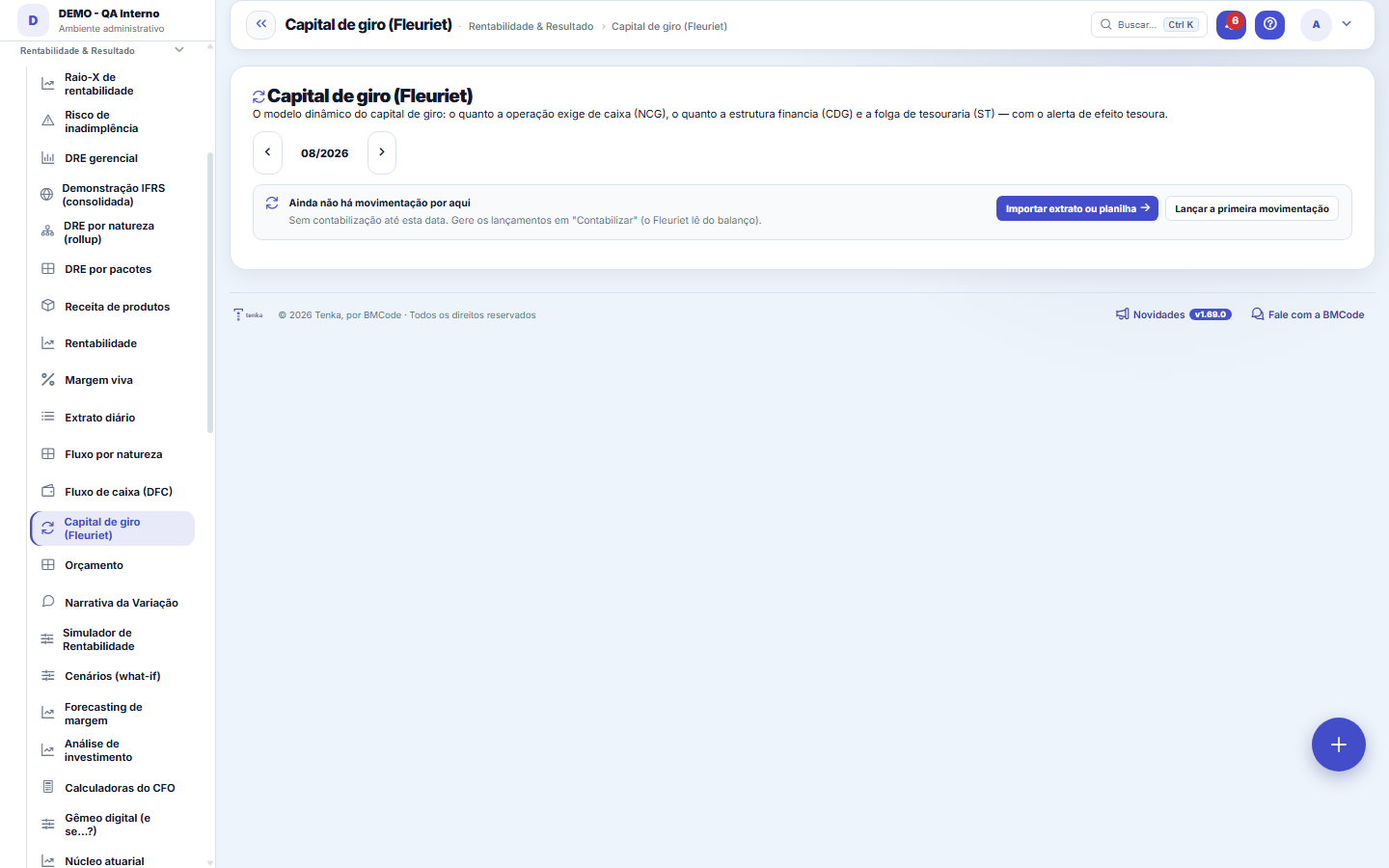
The real screen, in the theme you picked above.
What you find on this screen
A portrait of the screen, read from the screen itself — it changes when the screen changes.
Form fields
Situação de capital de giroTipologia de Fleuriet que classifica a estrutura de capital de giro do mês.
NCG — necessidade de capital de giroAtivo cíclico menos passivo cíclico: o caixa que a operação trava; negativo significa que a operação gera caixa.
CDG — capital de giroRecursos permanentes menos ativo não circulante: o financiamento de longo prazo disponível para o giro.
ST — saldo de tesourariaCDG menos NCG; positivo é folga financeira, negativo indica giro bancado por dívida de curto prazo.
Meses seguidos de pioraPor quantos meses consecutivos o saldo de tesouraria piorou, sinal de efeito tesoura.
Mês da sérieCompetência de cada ponto da série de NCG, CDG e ST.
Start here
Three measures
NCG (how much the operation locks up in cash), CDG (how much the long-term structure finances working capital) and ST (the treasury slack). Together they show whether the company is financing growth in a healthy way or with risk.
Rules
NCG — Working Capital Requirement
Cyclical assets (receivables, inventory, recoverable taxes) minus cyclical liabilities (suppliers, payroll, taxes payable). Positive = the operation consumes cash; negative = the operation GENERATES cash (you receive before you pay).
CDG — Working Capital
Permanent resources (equity + non-current liabilities) minus non-current assets. It's how much of the long term is left over to fund working capital. Positive is desirable.
ST — Treasury Balance
CDG minus NCG (equivalent to financial assets minus short-term financial liabilities). Positive = slack; negative = the company funds working capital with short-term debt — a warning sign.
Typology (Braga)
The combination of CDG, NCG and ST signs classifies the situation into 6 types, from "Excellent" (Type I) to "Very poor" (Type IV). Types IV to VI have negative working capital — risk.
Scissors effect
When NCG grows faster than CDG, the ST becomes increasingly negative — the two lines drift apart like an opening pair of scissors. If it persists for months, it's an imminent risk of running out of cash even while profitable. The panel alerts automatically.
Frequently asked questions
Where the numbers come from
From the accounting balance sheet (accounts classified as cyclical, erratic or permanent). It requires the period's accounting to be done; it's a management reading until the accountant validates the balance sheet.
Was this article helpful?
In the same module: Cash9
Financial AlertsThe proactive finance radar: rules watch margin, cash, budget, and fixed spend and alert BEFORE the problem g…Month's cashWhat I have, what I will receive, what I will pay and what I close the month with — and what is due this week.Cards and checksCard fees, receivables advance and the check portfolio — with the cost of each choice in plain sight.360 TowerWhere I am, where I'm going, what I promised, and how much I'm off — the owner's four questions on a single s…Extrato diárioO caixa dia a dia: quanto abriu, quanto entrou, quanto saiu e com quanto fechou — com a lista dos títulos por…Cash flow statementCash flow by the direct method, month by month: how much cash came in and out by activity, with runway, burn,…Flow by natureThe nature × day-of-month matrix — actual up to today, forecast from then on — and the bills due in the month.Help itemAnchor screen of the detail dictionary. Does not appear in the menu.
Tenka Academy
Explore the AcademyStep-by-step learning paths for your industry, inside the platform.