

Investment Analysis
Assesses whether a project/contract/purchase pays for the cost of capital and creates value. Discounts the projected cash flow by your business's WACC and delivers NPV, IRR, MIRR, discounted payback, and PI, with an objective verdict (IRR × WACC).
The screen
The real screen, in the theme you picked above.
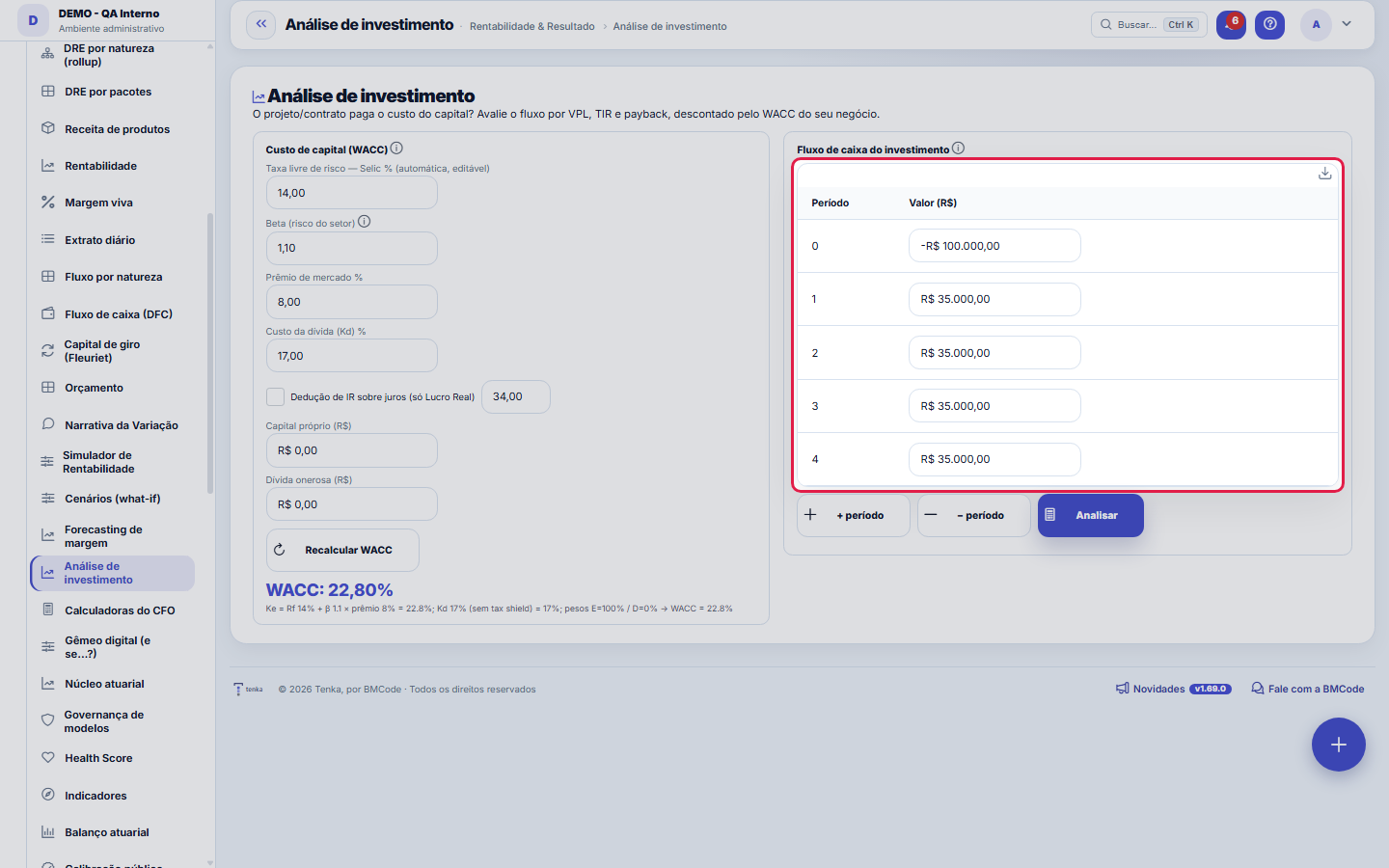
What you find on this screen
A portrait of the screen, read from the screen itself — it changes when the screen changes.
Available actions
Recalculate WACC+ period− periodAnalyze
The list shows
PeriodAmount
Form fields
WACCCusto médio ponderado de capital, ou seja o retorno mínimo que o projeto precisa entregar.
Taxa livre de riscoTaxa base sem risco usada no cálculo do custo de capital próprio.
Beta (risco do setor)Sensibilidade do setor ao risco de mercado, usada no custo do capital próprio.
Custo da dívida (Kd)Taxa média de juros paga pela empresa na dívida onerosa.
Capital próprioMontante de capital dos sócios usado na ponderação do WACC.
Dívida onerosaMontante de dívida com juros usado na ponderação do WACC.
Valor do períodoEntrada ou saída de caixa prevista em cada período do investimento.
VPL (ao WACC)Valor presente líquido do fluxo descontado ao WACC; positivo indica criação de valor.
TIRTaxa interna de retorno que zera o valor presente líquido do fluxo.
TIR modificadaTaxa interna de retorno recalculada reinvestindo os fluxos ao custo de capital.
Payback descontadoTempo necessário para recuperar o investimento considerando os fluxos a valor presente.
IBCÍndice benefício custo, ou seja quanto de valor presente o projeto devolve por real investido.
Start here
What this screen is for
Answers an owner's question: "is it worth putting money here?". You enter the investment and the expected returns over time; the screen brings that future money to today's value using the WACC (the cost of your capital) and tells you whether value is left over. Use it before closing a large contract, hiring a squad, buying equipment or starting a project.
Impact and related screens
The decision here connects with: the Regime simulator (the tax shield changes with the regime), Scenarios (what-if on revenue/cost), the Cash Flow Statement (the investment affects cash and runway) and Profitability (the project's real return once executed). Good practice: decided to invest here → record the effect in the Budget and follow it in the Cash Flow Statement.
How to
Button: Recalculate WACC
Recalculates the WACC from the fields above and shows the big number highlighted. Do this whenever you change the beta, premium, debt or equity — the WACC is what discounts the flow in the next block.
Rules
Block 1 — Cost of capital (WACC)
The WACC is the yardstick: an investment only creates value if it yields ABOVE it. It is the weighted average between the cost of equity (Ke) and the cost of debt (Kd), by the weight of each. Formula: WACC = Ke × (Equity ÷ (Equity+Debt)) + Kd_net × (Debt ÷ (Equity+Debt)).
Field: Risk-free rate (Selic %)
This is the "risk-free" yield (the Selic rate). It comes AUTOMATICALLY from the Central Bank and is editable. IMPORTANT: the value is fed by the BCB's daily collection job (BCB integration, super admin) — if the BCB is down, the screen uses the last collected value. It feeds the calculation of Ke (CAPM) as the base.
Field: Beta (sector risk)
Measures how much riskier than the market your sector is. 1.0 = equal to the market; software house/services usually sits at 1.0–1.3. It multiplies the market premium in the CAPM: the higher the beta, the higher the return demanded by the owner (Ke) and, therefore, the higher the WACC.
Field: Market premium %
How much the stock market yields ABOVE the risk-free rate, over the long run (typically 5–8%). Ke = Selic + Beta × Premium (CAPM model). It is the part that compensates for the risk of entrepreneurship instead of leaving the money in fixed income.
Field: Cost of debt (Kd) %
The average rate you pay banks for interest-bearing debt (loans/financing). It enters the WACC by the weight of the debt. Attention: in the calculation, the Kd used is NET of tax (see the IR field below).
Field: IR % (tax shield) — EXCEPTION by regime
Interest on debt is deductible from IR, so debt "costs less" (tax shield): Kd_net = Kd × (1 − IR). CRITICAL RULE: the deduction only applies under LUCRO REAL. Under Simples and Presumido there is NO deduction of interest, so the system ignores the tax shield (Kd_net = Kd) even if you fill in the IR. The regime is read from the company's configuration.
Fields: Equity (PL) and Interest-bearing debt
They define the WEIGHTS of the WACC. Equity = what the partners have invested; Interest-bearing debt = loans that pay interest (does not include suppliers/salaries payable). If you have no debt, WACC = Ke (100% equity). Today they are entered manually (they do not automatically pull from the accounting equity).
Block 2 — Project cash flow
One line per period. PERIOD 0 = today, usually the investment (a NEGATIVE value, the initial outflow). Periods 1, 2, 3… = the projected net returns (revenue − costs of that period). Use the same interval on all lines (all monthly OR all annual) and keep it consistent with the rate (annual WACC for an annual flow).
Result: NPV (at the WACC)
Net Present Value: the sum of the whole flow brought to today's value using the WACC. NPV above zero = the project pays for the cost of capital AND still leaves that much value in today's money → CREATES value. NPV below zero = it destroys value. It is the most reliable indicator for deciding.
Result: IRR and modified IRR
IRR = the "interest rate" the project yields (the rate that zeroes out the NPV). Decision rule: it creates value when the IRR exceeds the WACC. The MIRR (modified) is more realistic: it assumes returns are reinvested at the WACC itself (the plain IRR overestimates when there are high returns in the middle). EXCEPTION: if the flow has no outflow at all (no negative value) or does not change sign, the IRR does not exist/does not converge — the screen shows "—".
Result: Discounted payback and IBC
Discounted payback = how many periods it takes for the investment to pay for itself, ALREADY accounting for the time value of money (stricter than simple payback). BCR (Benefit-Cost Ratio) = R$ of present value generated per R$ invested; above 1 it creates value (e.g. 1.38 = each R$ 1 comes back as R$ 1.38 in today's money).
Verdict (IRR vs WACC)
The final band ties everything together: if the IRR beats the WACC (and the NPV is positive), the investment CREATES value; if the IRR falls below the WACC, it DESTROYS value — even if it looks profitable at first glance, it doesn't cover the cost of capital.
Exceções e limites
This screen is a decision SIMULATOR — it doesn't record any entry or contract. (1) The IRR may not exist for flows with no initial outflow or no sign change → "—", use the NPV. (2) If Equity+Debt = 0, the WACC can't be weighted; enter at least the equity. (3) The tax shield is ignored outside the Lucro Real (actual profit) regime (by law). (4) The Selic rate depends on the Central Bank job — if it's outdated, edit it manually.
Frequently asked questions
Frequently asked questions
Annual or monthly? Use the same interval in the flow and in the WACC (monthly flow → monthly WACC). • Cash or profit in the flow? Use each period's net CASH (inflows − outflows), not accounting profit. • Where does the Selic rate come from? From the Central Bank's daily job (it isn't typed in, but it can be adjusted). • Does the screen send notifications/e-mails? No — it's on-demand analysis; nothing is scheduled or notified from it.
Was this article helpful?
In the same module: Simulate before deciding16
Team journeyWho's most engaged: adoption by role, the week's scoreboard, and who needs a nudge.CFO CalculatorsThree everyday financial decisions solved on the spot: how to amortize a loan, compare rates on different bas…CenáriosTeste a decisão antes de tomá-la e veja o efeito no resultado e no caixa.Scenarios (what-if)Compare up to 3 futures side by side: hiring, losing a client, adjusting price — and see the effect on result…Comparar cenáriosCaminhos lado a lado, com o pior caso à mostra.Dossiê de investimentoO parecer que um comitê exigiria, em uma página.Margin ForecastingShows where your margin is heading: projects revenue, cost, and margin for the next 6 months based on the rea…Legal tablesThe INSS, IRRF, family-allowance brackets, and the ceiling that payroll uses in its calculation. They're vali…
Tenka Academy
Explore the AcademyStep-by-step learning paths for your industry, inside the platform.