

CFO Calculators
Three everyday financial decisions solved on the spot: how to amortize a loan, compare rates on different bases, and decide whether to prepay a payment.
The screen
The real screen, in the theme you picked above.
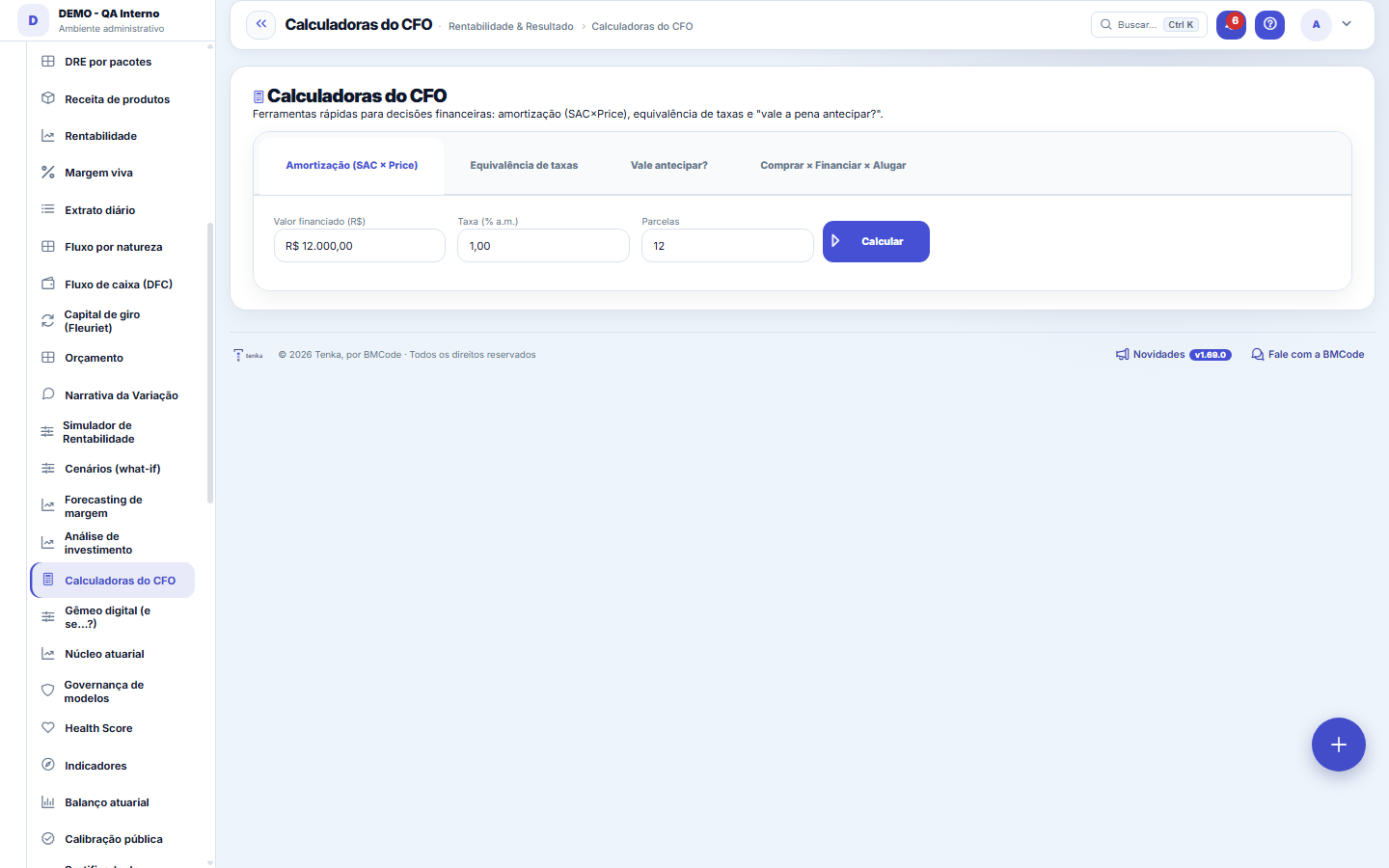
What you find on this screen
A portrait of the screen, read from the screen itself — it changes when the screen changes.
Tabs
Amortization (SAC × Price)Rate equivalenceIs it worth advancing?Buy × Finance × Lease
Available actions
CalculateConvertCompare
Form fields
Valor financiadoMontante financiado que será amortizado nos sistemas SAC e Price.
Taxa ao mêsJuro mensal aplicado ao financiamento simulado.
ParcelasQuantidade de prestações do financiamento simulado.
SAC: total de jurosTotal de juros pagos no sistema SAC, de prestação decrescente.
SAC: total pagoSoma de principal e juros desembolsada no sistema SAC.
Price: total de jurosTotal de juros pagos no sistema Price, de prestação fixa.
Price: prestaçãoValor fixo da prestação mensal no sistema Price.
Taxa equivalenteTaxa convertida do período de origem para o período de destino escolhido.
Taxa efetiva anualTaxa anual efetiva obtida da taxa nominal com o número de capitalizações informado.
Parcelas a valor presenteSoma das parcelas descontadas pelo custo de oportunidade até hoje.
Diferença em valor presenteGanho ou perda ao pagar à vista em vez de parcelar, medido em valor presente.
Custo em valor presenteCusto total de comprar, financiar ou alugar o ativo trazido a valor presente.
Rules
SAC vs. Price
SAC: you amortize a fixed amount per month; the interest (on the balance) decreases, so the installment starts higher and goes down — you pay LESS interest overall. Price: fixed installment from start to finish, easier to plan for, but you pay MORE interest.
Rate equivalence
Converts an effective rate between periods using compound interest: (1+i)^(n) − 1. E.g.: 2% per month equals ~26.8% per year (not 24%). It also converts a NOMINAL rate (e.g.: 12% p.a. with 12 compounding periods) into the real EFFECTIVE rate.
Is it worth prepaying?
Brings future installments to PRESENT VALUE using your opportunity cost (how much your money earns/costs). If the present value of the installments is greater than the cash price, paying in cash saves money.
Rate as decimal vs %
Enter rates as a percentage (e.g.: 2 for 2%). The calculator converts internally. The opportunity cost is the ruler that discounts the future — use the Selic rate or the cost of your working capital.
Frequently asked questions
What's still coming
The screen has already grown beyond its original description: besides SAC vs. Price, rate equivalence and "is it worth prepaying?", there's a fourth tab — Buy vs. Finance vs. Rent —, which compares the three ways of having an asset by present-value cost and highlights the recommended option. New calculators arrive with each platform version: follow the release notes to find out when a new calculation gets its own tab.
Was this article helpful?
In the same module: Simulate before deciding16
Investment AnalysisAssesses whether a project/contract/purchase pays for the cost of capital and creates value. Discounts the pr…Team journeyWho's most engaged: adoption by role, the week's scoreboard, and who needs a nudge.CenáriosTeste a decisão antes de tomá-la e veja o efeito no resultado e no caixa.Scenarios (what-if)Compare up to 3 futures side by side: hiring, losing a client, adjusting price — and see the effect on result…Comparar cenáriosCaminhos lado a lado, com o pior caso à mostra.Dossiê de investimentoO parecer que um comitê exigiria, em uma página.Margin ForecastingShows where your margin is heading: projects revenue, cost, and margin for the next 6 months based on the rea…Legal tablesThe INSS, IRRF, family-allowance brackets, and the ceiling that payroll uses in its calculation. They're vali…
Tenka Academy
Explore the AcademyStep-by-step learning paths for your industry, inside the platform.