

Network Templates
Install ready-made reports and publish your own.
The screen
The real screen, in the theme you picked above.
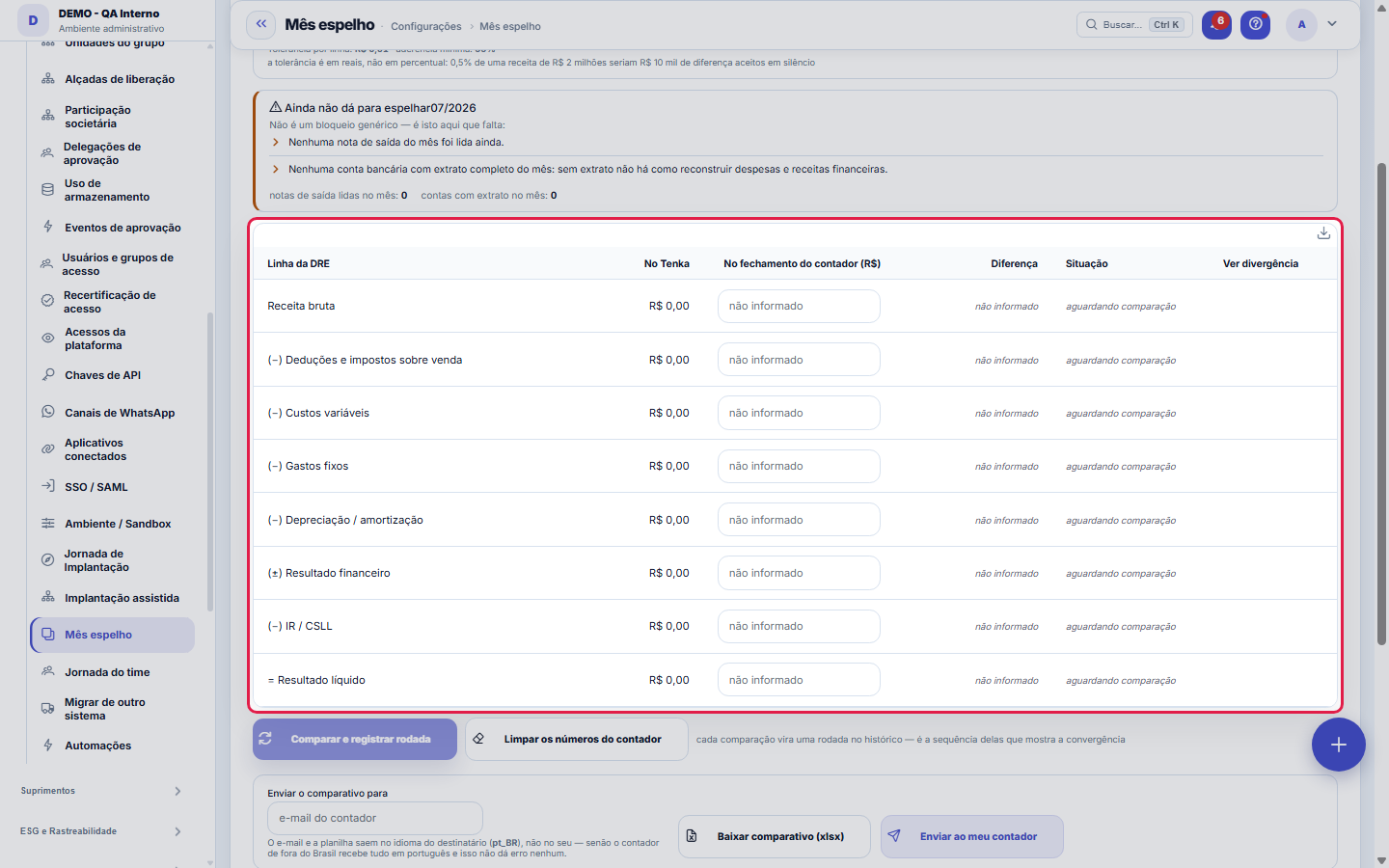
What you find on this screen
A portrait of the screen, read from the screen itself — it changes when the screen changes.
Available actions
See whyCompare and record roundReset the counter numbersDownload comparison (xlsx)Send to my accountant
The list shows
Income statement lineIn TenkaAt the meter closing (R$)DifferenceStatusView discrepancyPeriodDocumentCustomer / supplierDescriptionAccountAmount+6
Form fields
Competência a espelharMês fechado escolhido para comparar o Tenka com o fechamento do contador.
Notas de saída lidas no mêsQuantidade de notas de saída que o sistema leu na competência.
Contas com extrato no mêsQuantas contas bancárias têm extrato carregado na competência.
AderênciaFatia das linhas informadas pelo contador em que o Tenka dá o mesmo número.
Linhas batendoLinhas da DRE em que o valor do Tenka bate com o do contador dentro da tolerância.
Linhas para investigarLinhas cuja diferença passou da tolerância e precisam ser investigadas.
Linhas sem número do contadorLinhas em que o contador ainda não informou valor, e por isso não têm diferença.
Gate da rodadaSelo que diz se a rodada atingiu a aderência mínima e conquistou o gate.
No TenkaValor que o Tenka calcula para a linha da DRE na competência.
No fechamento do contadorValor informado pelo contador para a mesma linha da DRE.
DiferençaValor do Tenka menos o do contador; só existe quando o contador informou.
Situação da linhaClassificação da linha na comparação: bate, investigar ou pendente.
Start here
O que esta tela responde
Whether Tenka gives the SAME number your accountant closed. Switching systems usually requires posting everything twice for a whole month — and that is where many implementations die. Here the platform rebuilds a month that has already closed, with the documents you have already sent, and compares it line by line with the official close. Zero double work, and the answer is the same.
Ver por quê: de onde vem cada número
Every compared line has the "See why" button. It opens the postings that make up that value, one by one, with the sentence explaining why each one landed on that DRE line. It is what turns "it is wrong" into "it is wrong because of this": instead of knowing that fixed expenses are three thousand reais off, you see the postings and discover that one of them landed there because its nature has no accounting group.
How to
What this screen answers
The month you want to mirror. You can fill it in little by little: what you have already typed comes back filled in on your next visit, because the accountant almost never answers everything in the same conversation.
De onde veio o número do contador
It is recorded together with the run. Months later, when someone asks where that value came from, the answer is there: typed on screen, taken from the trial balance sent, or checked by the accountant themselves.
What this screen answers
Net revenue, contribution margin, EBITDA, EBIT and EBT are CALCULATIONS from the other lines. Asking the accountant for a subtotal is asking for the same number twice — and, worse, it would contaminate the result: five derived lines matching for free would push adherence up without proving any classification, which is exactly what this gate measures.
O histórico de rodadas é a prova que convence
Each comparison becomes a line in the history. What makes the customer flip the switch is not today's snapshot, it is the sequence: 40% in the first run, 78% in the second, 100% in the fourth. A comparison that overwrote the previous one would erase precisely that proof.
Download comparison (xlsx)
Generates the spreadsheet with two tabs: the DRE side by side and, for each line that still does not match, the postings that make it up with the explanation of each one. Only the divergent lines get detail — detailing all eight would turn the file into a statement of the month and bury the question that matters. Values go as numbers, not text: that way the Excel of whoever opens it applies their country's formatting instead of receiving the Brazilian mask frozen inside the file.
Rules
Só vale para um mês JÁ FECHADO
Mirroring the current month compares a half-finished month with a close that does not exist yet: everything would diverge and it would teach you to distrust the result. That is why the current month appears as pending, not as a bad comparison.
What this screen answers
This is the most important distinction on the screen. Zero is a number the accountant stated; empty is the absence of a statement. If empty became zero, the whole line would count as a divergence and the result would accuse the system of an error where data is simply missing. That is why there are three situations per line, not two: matches, investigate and pending.
A tolerância é em REAIS, não em percentual
The default is one cent, which covers rounding and nothing more. A percentage tolerance hides exactly the error that matters: half a percent of two million in revenue is ten thousand reais of difference accepted in silence. The value is configurable per company, because tolerance is a conversation between you and your accountant.
A aderência é por LINHA, não ponderada por valor
If the percentage were weighted by the size of each line, revenue would carry the result on its own and five wrong tax lines would go unnoticed. What is proven here is that the engine CLASSIFIES correctly, not that the total closes by chance.
O gate só fecha com a DRE inteira conferida
Even with 100% adherence, the gate is not achieved while there is a line without the accountant's number. Without this rule it would be enough to enter the two lines you already know match — the shortcut that would empty the whole validation.
A causa nº 1 de divergência é natureza sem grupo contábil
When a posting has a nature without an accounting group — or no nature at all —, the system treats it as OPERATIONAL by default. It is a reasonable default and a dangerous silence: the value enters the DRE on an assumption, and nothing warns you. That is why the detail begins the explanation of these postings by saying exactly that. Fixing the nature in its record usually makes the line match in the next run.
The detail sum MUST match the line
At the bottom of the detail appears the sum of the listed postings, and it has to equal the value in the "In Tenka" column. If it does not, the screen warns at the top, prominently. In that case the list serves as a clue and not as proof, and it is worth opening a ticket: a detail that does not add up is a platform defect, not a defect in your data.
Depreciação e subtotais não têm lançamento próprio
Depreciation does not come from a financial posting: it is calculated from the Fixed Assets register, dividing the asset's value by its useful life. A divergence there is almost always a useful life or acquisition date different from the one the accountant used. Net income, in turn, is a calculation from the other lines — when they match, it matches too. In both cases the detail explains the origin instead of showing an empty list.
O e-mail sai no idioma do CONTADOR, não no seu
The subject, the body and the entire spreadsheet — labels, headers and the explanations of each posting — go out in the recipient's language. The screen shows which one, next to the address, BEFORE you click. This exists because the opposite mistake produces no error at all: the email would be delivered, the queue would record success, and the accountant outside Brazil would simply not understand what they received. The language comes from the accountant's record; if they do not have one, the language configured for the account applies.
Frequently asked questions
What this screen answers
The difference is real and worth understanding before accepting. The most common causes are three: a document for the month that has not been read yet, a nature classified in another group of the cascade, or a legitimate difference in criteria between the management and accounting views (provision, tax accrual period). Fix what can be fixed and run again — each run is recorded.
A tela diz que ainda não dá para espelhar. Por quê?
It lists exactly what is missing, with numbers: how many of the month's outgoing invoices have been read and how many bank accounts have a statement for the period. Without documents, the rebuilt revenue is smaller and the divergence would be the DOCUMENT's, not the system's — and you would conclude that Tenka gets it wrong.
Where the system gets the accountant’s e-mail from
It first looks for a platform user with the Accountant profile linked to this company — that is the good path, because then the email is a real field and the person has a registered language. If none is found, it uses the firm's contact filled in under Settings › Tax regime; since the field there is free text (it can hold a phone number and a website), only what looks like an email address is accepted. In any case you can type another address on the spot, and the screen says where the pre-filled one came from.
Was this article helpful?
In the same module: First steps5
Campos do cliente (Studio)Crie campos que só a sua empresa precisa, sem esperar desenvolvimento. Eles aparecem numa aba própria da tela…Portfolio (prioritization)The order of projects by an explicit criterion, with the math shown.ValuationHow much the company is worth, with the calculation breakdown open.Migrar de outro sistemaEscolha o sistema de origem e o tipo de dado, suba o CSV exportado de lá e baixe o arquivo já no layout do Te…Migrate from previous systemProducts with grid and stock, customers, suppliers and open items, with preview and undo.
Tenka Academy
Explore the AcademyStep-by-step learning paths for your industry, inside the platform.