

Profitability X-ray
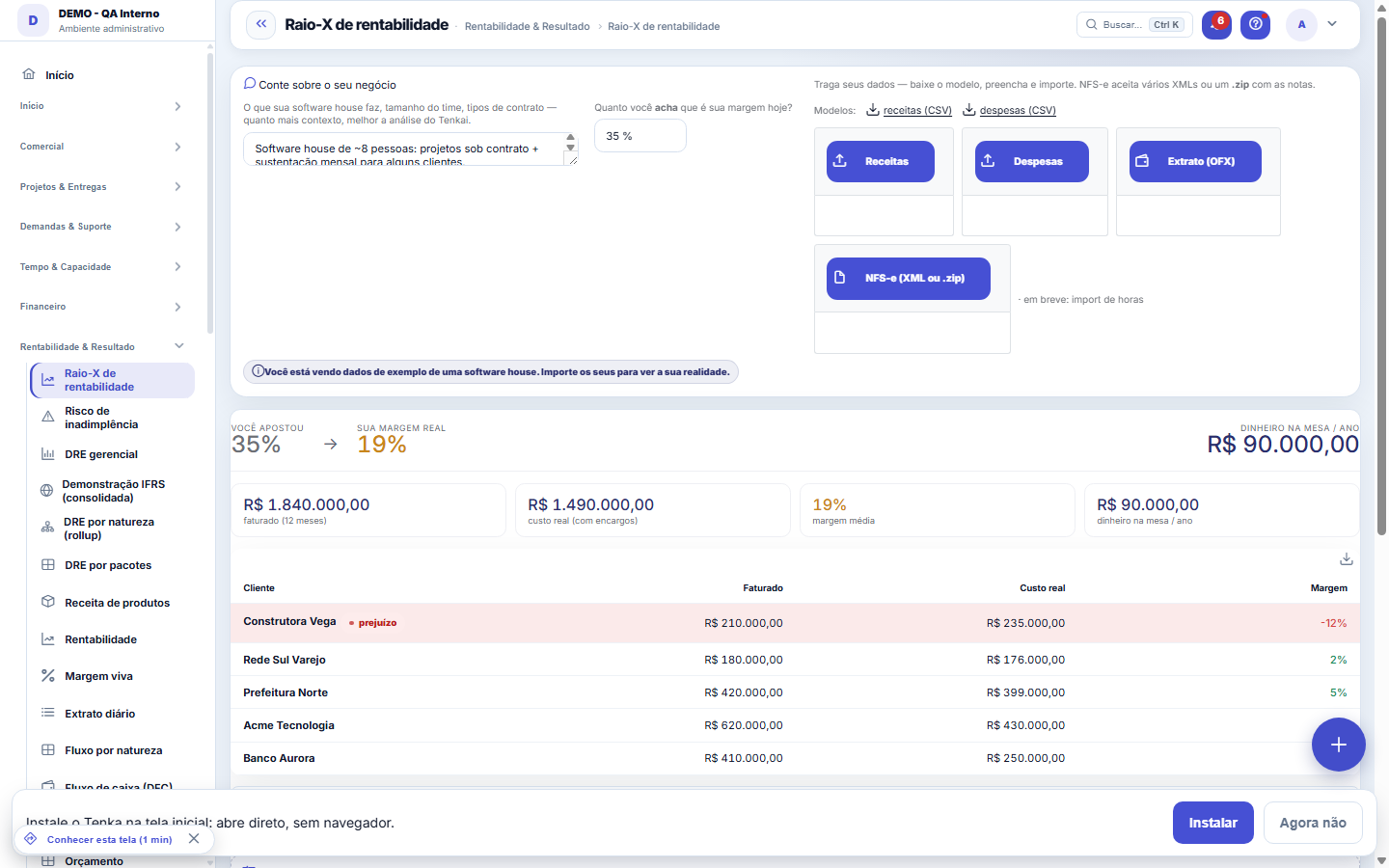
The entry diagnosis: what margin you think you have, what margin you actually have, which customers cause losses, and how much money is on the table — without needing to migrate anything.
The screen
The real screen, in the theme you picked above.
What you find on this screen
A portrait of the screen, read from the screen itself — it changes when the screen changes.
Form fields
Você apostouMargem que o dono acha que tem, informada por ele antes de ver o cálculo real.
Sua margem realMargem média calculada sobre o faturado e o custo real com encargos dos 12 meses.
Dinheiro na mesa por anoGanho anual estimado se os clientes no prejuízo forem corrigidos.
Faturado em 12 mesesReceita total dos últimos doze meses considerada no diagnóstico.
Custo real com encargosCusto total do período já incluindo encargos sobre a equipe.
Faturado do clienteQuanto aquele cliente faturou no período analisado.
Custo real do clienteCusto real alocado ao atendimento daquele cliente.
Margem do clienteMargem percentual do cliente; negativa indica prejuízo naquela conta.
Mediana de mercadoMargem mediana de referência do mercado usada para comparação.
Margem simulada sem prejuízoMargem média que a empresa teria se os clientes no prejuízo fossem levados ao ponto de equilíbrio.
Precisão do diagnósticoQuanto os dados importados sustentam o cálculo; quanto maior, mais confiável o número.
Impacto anual da açãoGanho anual estimado de cada ação sugerida no plano de recuperação.
Start here
A pergunta que quase ninguém consegue responder
"Which of your customers are profitable?" — most service companies answer with a feeling, not a number. The X-ray exists to replace the feeling with the math, with minimal effort: you guess your margin, import what you already have and see both side by side.
You can bring in a spreadsheet of revenue and expenses, a bank OFX statement and invoices in XML. None of this changes your database: until you activate, it is all simulation.
You can bring in a spreadsheet of revenue and expenses, a bank OFX statement and invoices in XML. None of this changes your database: until you activate, it is all simulation.
Rules
Como o custo chega até o cliente
Customer cost = their direct expense (what clearly belongs to that contract) + allocation of indirect expense, proportional to the revenue they represent.
It is the simplest allocation there is, and on purpose: sophisticated allocation requires data the company does not have yet, and the rough result already answers the question. The red line in the table is what matters — a customer that loses money is usually a surprise, and is usually the biggest.
One caution when importing OFX: every outflow on the statement becomes allocated indirect cost, including partner withdrawals and loan payments. If the reading looks too pessimistic, that is almost always why.
O que é "dinheiro na mesa"
It is not hidden profit or money to be received. It is the sum of the effect of the plan's actions: bringing loss-making customers to break-even and bringing those below a 15% margin up to 15%, considering the five biggest opportunities.
It is a target, not a promise: it measures the size of the conversation worth having with these customers — price adjustment, change of scope or termination.
The market comparison uses an estimated benchmark of 28% until there is enough of your own data. It is an order-of-magnitude yardstick, not a benchmark for your segment.
The screen opens with SAMPLE data
The first access shows a fictitious software house, so you can understand the reading before importing anything. Everything on the screen in that state is illustration.
That is why the system refuses to activate the account until you bring in your own data. Activating with the example inside would contaminate the database from day one.
That is why the system refuses to activate the account until you bring in your own data. Activating with the example inside would contaminate the database from day one.
Frequently asked questions
O raio-X diz que um cliente dá prejuízo, mas ele paga em dia. Como?
Pagar em dia é caixa; prejuízo é margem: o custo de atender (horas, frete, retrabalho, desconto) chega até o cliente e supera o que ele paga. A tela mostra como o custo chega e quanto dinheiro está "na mesa" — por preço ou por custo de servir.
Connected screens
Vira rotina emRentabilidadeDepois do diagnóstico, a margem por cliente passa a ser acompanhada continuamente.Aprofunda emDRE gerencialA visão de resultado por natureza e por centro.
Was this article helpful?
Tenka Academy
Explore the AcademyStep-by-step learning paths for your industry, inside the platform.