

Agent catalog
Where you turn digital employees on and off, and delegate tasks to them. Each agent has a scope and an AUTHORITY LIMIT: what it does on its own and what needs human approval. An agent with no defined authority limit acts automatically up to whatever its profile allows — set the ceiling before activ…
The screen
The real screen, in the theme you picked above.
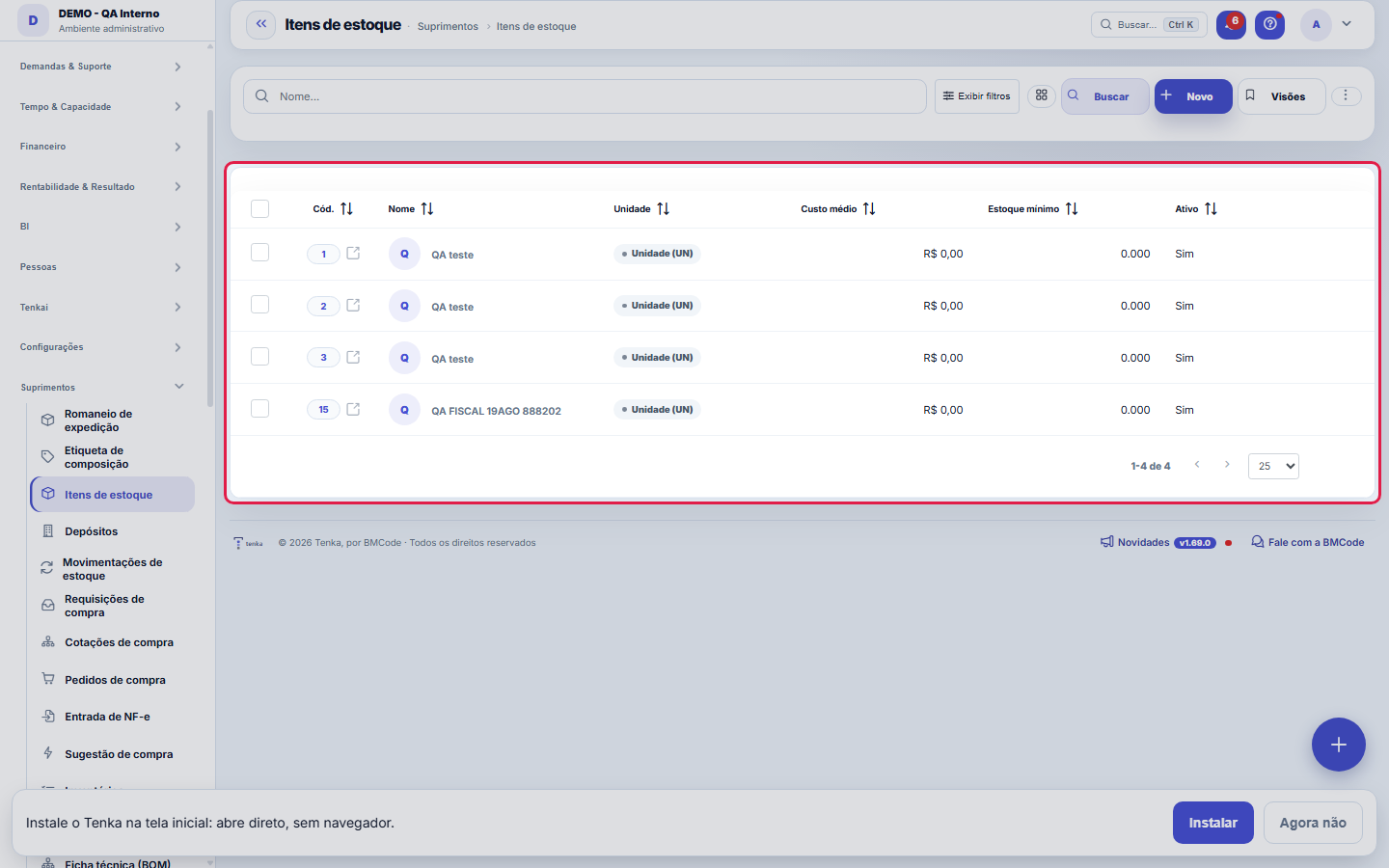
What you find on this screen
A portrait of the screen, read from the screen itself — it changes when the screen changes.
Form fields
Cód.Código sequencial interno do item, por empresa. É gerado automaticamente ao salvar.
Nome*Como o item é conhecido no dia a dia (ex.: "Parafuso sextavado M6"). Aparece em todas as listas e movimentações.
UnidadeA unidade em que este item é contado e movimentado (UN, KG, L, CX...). Escolha a que você usa no estoque, não a da nota.
DescriçãoDetalhe livre do item (especificação, marca, referência).
Grupo de produtosO grupo da peça. É por ele que o preço por peça de GRUPO se aplica (Preços por peça).
NCMCódigo NCM do item (classificação fiscal). Opcional — só entra em cena na nota fiscal.
GTIN / EANCódigo de barras do item (GTIN/EAN). Opcional.
Custo médioO custo médio ponderado atual, calculado pelas ENTRADAS. Só-leitura: é o sistema que mantém — a saída baixa por ele (CMV).
Estoque mínimoAbaixo deste saldo o item entra na lista de ruptura (precisa repor). Deixe 0 se não quer alerta.
Controla saldoLigado, o item movimenta saldo (entra/sai). Desligue para itens apenas cadastrais que você não controla fisicamente.
Controlado por loteLigado, o lote é obrigatório no rolo, na ordem de produção e na remessa para terceiro. Com OP, o rolo herda o lote de produção da OP.
AtivoItens inativos somem dos combos de movimentação, mas o histórico é preservado.
CFOPCódigo da operação na saída. Em branco, a NF-e sai com 5102 (venda de mercadoria de terceiros dentro do estado) — que é um chute razoável e continua …
CST/CSOSN do ICMSSituação tributária do ICMS. Depende do regime da empresa: CSOSN no Simples, CST fora dele.
Origem da mercadoria0 = nacional, 1 = importação direta, 2 = adquirida no mercado interno, e assim por diante. Vai no XML da nota.
Alíquota de ICMS (%)Alíquota de ICMS do item, quando ela não vem do regime.
Alíquota de IPI (%)Alíquota de IPI do item. Em branco quando não há IPI.
Classificação tributária (cClassTrib)O regime do item na LC 214/2025. É o que diz se ele é alíquota cheia, reduzida ou zero.
CST do IBS/CBSSituação tributária do IBS e da CBS, 3 dígitos. Em branco = os 3 primeiros dígitos da classificação tributária (o padrão da tabela oficial). Preencha…
Alíquota de IBS (%)Deixe EM BRANCO na maioria dos casos: em branco o item segue a tabela nacional do ano. Preencha só quando este item tem alíquota própria.
+ 6 more fields
Start here
O que entra aqui — e o que NAO entra
An item is what you store and count: equipment, part, consumable. It's for things that have quantity and leave stock. What you SELL as a service (hours, subscription, project) is not an item — it lives in Products and Services, and mixing the two is the most common mistake of beginners: the service starts showing up in inventory with a negative balance, because it never had a receipt.
How to
CFOP em branco não impede a nota — e é aí que mora o risco
Without a CFOP, the NF-e goes out with 5102 (sale of third-party goods within the state). It works for most sales and is wrong for several: transfers, shipments, returns, out-of-state sales. The invoice is accepted, and the discrepancy shows up in the tax cross-check months later.
Aba Unidades: o fator é o que torna a conversão possível
The same item can be bought in kilos, produced in meters and sold in pieces. The factor answers "how much is 1 of this unit worth in the item's primary unit" — if the item is in KG and 1 ROLL weighs 25 kg, the ROLL factor is 25. The converter just below lets you check before trusting it: type the quantity, choose from/to and see the result.
Aba Atributos têxteis: a ficha técnica que o cliente e o laboratório pedem
Yarn count (Ne), fabric weight (g/m²), width, composition, knit type and yarn process. Each one is validated by type: numeric ones require a number greater than zero. A key outside the catalog is accepted as free text, for what your operation calls by another name.
O fator de consumo da variação (por que GG não é igual a P)
Each variant is created with a consumption factor of 1 and can be adjusted. It says how much fabric that size consumes relative to the base — an XL uses more than an S, and ignoring that makes the material requirement come out wrong precisely in the sizes that weigh most on cost.
SPED item type
The type of SPED record 0200: 00 resale, 01 raw material, 02 packaging, 03 work in process, 04 finished product, 05 by-product, 06 intermediate, 07 use and consumption, 08 fixed asset, 09 service, 10 other inputs, 99 other. In Bloco K it decides what is produced, what is consumed and what enters the recorded inventory. Items in a bill of materials come already classified; check the others with your accountant.
Lot-controlled
When on, the lot becomes required wherever it is asked: closing rolls, opening a production order and shipping to a third party. With an order, the roll inherits the order’s production lot. Sales and dispatch, which don’t ask for a lot, stay the same.
Closed size grid, minimum and wholesale price
On the style: the grid multiple (2 means it sells in steps of 2 pieces), the minimum per style, and the wholesale price from N pieces. The register in wholesale mode (or fair mode) applies the wholesale price on its own by quantity; the store's minimum order is in the register settings. An order that arrives paid from Shopee, Shein or TikTok is retail and isn't subject to this rule.
Rules
What this screen answers
The "minimum stock" field is not decorative: it's the only thing the Purchase suggestion screen uses to know what is missing. An item without a minimum is never suggested — it drops out of replenishment without warning. The practical calculation is: average consumption during the replenishment period, plus a safety margin for supplier delays.
Alíquota de IBS/CBS em branco é o certo, não o esquecido
If you leave the item's tax rates empty, Tenka uses the year's national table — the 2026→2033 transition schedule that is already registered. Only fill them in when the item has its own rate declared by the accountant. Filling them in "just in case" freezes a number the law will change every year.
A redução é o campo que muda o imposto de verdade
A pharmacy that sells medicines with a 60% reduction and cosmetics at the full rate, calculating on total revenue, pays the wrong tax — and the number looks plausible, disappears into the month's total and doesn't look wrong on any screen. Filling in each item's reduction is what makes the calculation add up line by line: 60 for health, education and public transport; 30 for liberal professionals; 100 for the basic food basket.
Sem fator declarado, a conversão BLOQUEIA — e isso é proposital
If the unit has no factor, the system refuses the conversion and says which unit is missing. The alternative would be to assume 1, and then the number would come out equal to the original quantity: a quantity that LOOKS measured and isn't. This error doesn't show up as an error — it shows up weeks later, as stock that doesn't reconcile and nobody knows why.
A composição tem de somar exatamente 100%
A composition that adds up to 97% or 103% is refused on saving. It's the information that goes onto the label and to the customer, and a wrong sum there doesn't become a system error: it becomes a complaint, a return, and in some markets a fine. Checking now costs less than checking later.
Grid tab: generating the grid changes how the item moves across the WHOLE system
The grid creates one variant (one SKU) for each size and color combination. From the first active variant on, every movement of this item REQUIRES stating which variant moved — sale, production order, inventory, transfer and shipment to third parties. That's deliberate: a balance per SKU without a declared SKU is an invented number, and it's what the garment maker uses to decide what to buy and what to produce. If the item doesn't need a grid, don't generate one: it keeps moving without a SKU, as always.
A visão salva guarda busca, filtros, colunas e ordenação
When you save a view with the Views button, it stores four things: the search text, the applied filters, which columns appear (and in what order) and which column the list is sorted by. Applying the view restores everything at once — including resetting the sort and the page you were on, so the result is exactly what the view describes. Views saved before this version remain valid: whatever they didn't store simply doesn't change when applied.
O erro de preenchimento aparece no campo, ao sair dele
Nas fichas, sair de um campo já dispara a conferência do que dá para conferir na hora: campo obrigatório deixado em branco e e-mail mal formado. O aviso aparece embaixo do campo e desaparece quando você começa a corrigir. Campo numérico não precisa de aviso: ele simplesmente não aceita letra enquanto você digita. Isso é conforto, não a validação final: ao salvar, o sistema confere tudo de novo do lado do servidor.
Composition as on the label
In the textile attributes tab, write the composition the way it is on the label: "100% cotton", "96% cotton, 4% elastane", "cotton 60% / polyester 40%" or "70% viscose and 30% linen". Tenka stores it in the catalog format and still refuses compositions that don’t add up to 100% — a label that doesn’t add up breaks labeling rules.
Purchase and sale units
In the item record, Units tab, declare the packs you buy or sell in: box of 12 (CX12 = 12 UN), gallon (GALAO = 3.785 L), gram for an item in kilos (G = 0.001 KG). Each unit states whether it is for purchase, sale or both, may have its own price and the pack barcode, and may belong to one size/colour only — the size's unit overrides the item's. Stock always stays in the primary unit: buying 1 CX12 receives 12 UN. With no factor the operation is refused; the system never assumes 1.
Sales kit (kit composition)
Open the item and use the "Kit composition" tab: tick "This item is a kit" and add the components with the quantity per kit (a component with size and colour asks for the variant). The tab shows each component's cost, the kit cost — which becomes the item cost — and how many kits today's stock can assemble. The kit has no stock of its own: when it is sold, stock deducts the components. An item with a grid cannot become a kit, a kit cannot go inside another kit, and an item with its own stock must be zeroed before becoming a kit.
IBS/CBS tax status (CST) and tax classification
In the item's Tax reform group, the Tax classification (cClassTrib, 6 digits) states the item's regime: 000001 full taxation, 200xxx reduced rate, 410xxx immunity or non-incidence. The IBS/CBS CST is the first 3 digits of the classification: leave it blank to use that default and fill it in only if your accountant says otherwise. With IBS/CBS sending turned on, an NF-e does not go out with an item lacking a classification: the invoice stays pending and says which item to fix.
Garment passport with a verified seal and the document for each link
In the item Passport tab, the footprint shows as Verified when the fabric supplier provided the batch factor, or Estimated when it uses the average. Each link shows the document that proves the origin: the fabric inbound invoice, the cutting order and the subcontracting shipment. Register the batch factor in the same tab. The public page shows the same in the language of whoever scans the QR.
Footprint measured per piece: verified × estimated
In the product's passport tab, the footprint adds the spinning energy and the water, steam and energy of dyeing (or the denim indigo in weaving) measured in the group companies over the last 12 months, multiplied by the fabric in the technical sheet. Where there is a measurement the value is verified; where there is not, it comes from the stage reference and is estimated. Save to the passport keeps the values and they show in the label QR.
The product form in essentials mode
In the Essential profile, the product opens with name, type, unit, sale price and NCM code. "See complete" shows the other fields, and the choice is saved for you.
Size by market: men or women
For adult numeric sizes, the garment audience picks the table. MASCULINO (trousers and shorts by waist, 36 to 56): EU = BR + 8, US and UK = BR − 8 (BR 40 = EU 48 = US 32). FEMININO, ADULTO or no audience (34 to 54): EU = BR − 2, US = BR − 32, UK = BR − 28 (BR 40 = EU 38 = US 8 = UK 12). Letters (S, M, L) and kids’ sizes do not change with the audience. A size outside the tables gets no equivalent.
EU, US and UK sizes are a conversion reference
The Export (EU · US · UK) column of the size grid converts the Brazilian size with each market's usual chart. It is a conversion reference, not your garment's pattern: check with the customer (or their measurement chart) before producing and before printing the equivalent on the label.
A selection list may show only some of the items
In some records, the selection list of a field is filtered by the screen setup: in Loom production, for example, Article shows only knitted fabrics and Yarn consumed only yarns, according to the item's NCM code. If an item does not show where you expected, check in the item record the data that decides the filter (such as the NCM code). An item without that data filled in keeps showing, so it never disappears without warning.
Frequently asked questions
What is marking the item as "controlled" for?
A controlled item moves stock: every receipt and issue requires a record, and the balance has to match the movement statement. An uncontrolled item is a reference record — it appears in orders and quote requests, but doesn't generate a balance. Use uncontrolled for what you buy and consume on the spot (a maintenance service, freight), and controlled for everything that sits on the shelf.
Posso regerar a grade depois? E se eu ajustei um fator à mão?
You can, and it's safe: generation is idempotent. A combination that already exists is kept as it is, with whatever consumption factor you've adjusted — only the new combinations are created. Adding the color "Navy" to a grid that already has XS to XL creates only the missing pieces, without touching the rest.
As abas não aparecem enquanto eu cadastro um item novo
That's expected. Unit, attribute and variant are children of the item and need its code to exist. Save the item first; when you reopen it, the three tabs will be available.
Como descobrir quem mudou um campo desta ficha?
Open the record and look at the Timeline on the right: it shows each change as "from one value to another", with the person and the date. When there are many changes, use the two filters at the top of the timeline — one by field, the other by person. The search runs in the database, so old changes show up just the same. You can also ask Tenkai: "who changed contract 482?".
Is the passport ready for the EU delegated act?
The Ready for the EU textiles delegated act section shows each field the regulation will require (identification, composition, recycled content, who made the fabric, garment maker, subcontractor, footprint, repairability, recyclability and evidence) and what the passport already has. Missing counts only for mandatory fields; what the EU has not defined yet shows as to be defined. Download the map as a data file to send to the European customer.
Why was the order rejected by the size grid?
Because some style didn't close the grid (the quantity isn't a multiple of what you set), was below the per-style minimum, or the order was below the store's minimum. The rejection says which style and how much is missing. Someone with approval authority releases the order with their password; an order that arrives paid from Shopee, Shein or TikTok is retail and is never rejected by this rule.
Can I ask Tenkai which items have not sold in 90 days?
Yes. Ask "which items have had no sales for 90 days and still have stock?". Tenkai lists the items with stock on hand and no sale (order or till) in the period, with the date of the last sale. Without the word sale, the idle-items question keeps looking at any stock movement.
Does the item belong to the group or to each company?
The item belongs to the group: registered once, it shows for every company in the account, with the same code, the same sheet and the same composition. What belongs to each company is the stock: the balance, the average cost and the warehouse where the item is. So the spinning mill and the knitting mill talk about the same yarn, but each sees only its own balance. If an item should not show for another company in the group, mark the companies that see it in the Exclusive companies tab of the item record.
Was this article helpful?
In the same module: Supply and inventory18
Buy from the networkAnchor partner offers, orders to the supplier and the invoice that arrives by itself.Contagem programadaContar o estoque da loja sem fechar: programe por loja e por grupo de produto o dia da semana de cada contage…Year in reviewThe year in review on a single panel: the few numbers that tell the story of the company's fiscal year — cust…Enablement kitThe partner becomes qualified in a vertical without eating up a week of the team's time. Pick the vertical an…Process mining (the real flow)Discovering the REAL as-is flow from the history the operation has already recorded — with no tool log to imp…Sector benchmarkHow YOUR INDUSTRY performs, indicator by indicator (average collection period, average margin, average ticket…Etiqueta de composiçãoA etiqueta obrigatória do produto têxtil, conferida antes de virar PDF.Composition label (sheet)The Conmetro label for a textile product: country of origin, responsible party, CNPJ, care instructions and t…
Tenka Academy
Explore the AcademyStep-by-step learning paths for your industry, inside the platform.