

Demonstração IFRS (consolidada)
A demonstração statutory do grupo, com a régua honesta: conversão só com cotação real, mapa por rubrica revisável e a nota de heurística enquanto houver de-para não revisado.
The screen
The real screen, in the theme you picked above.
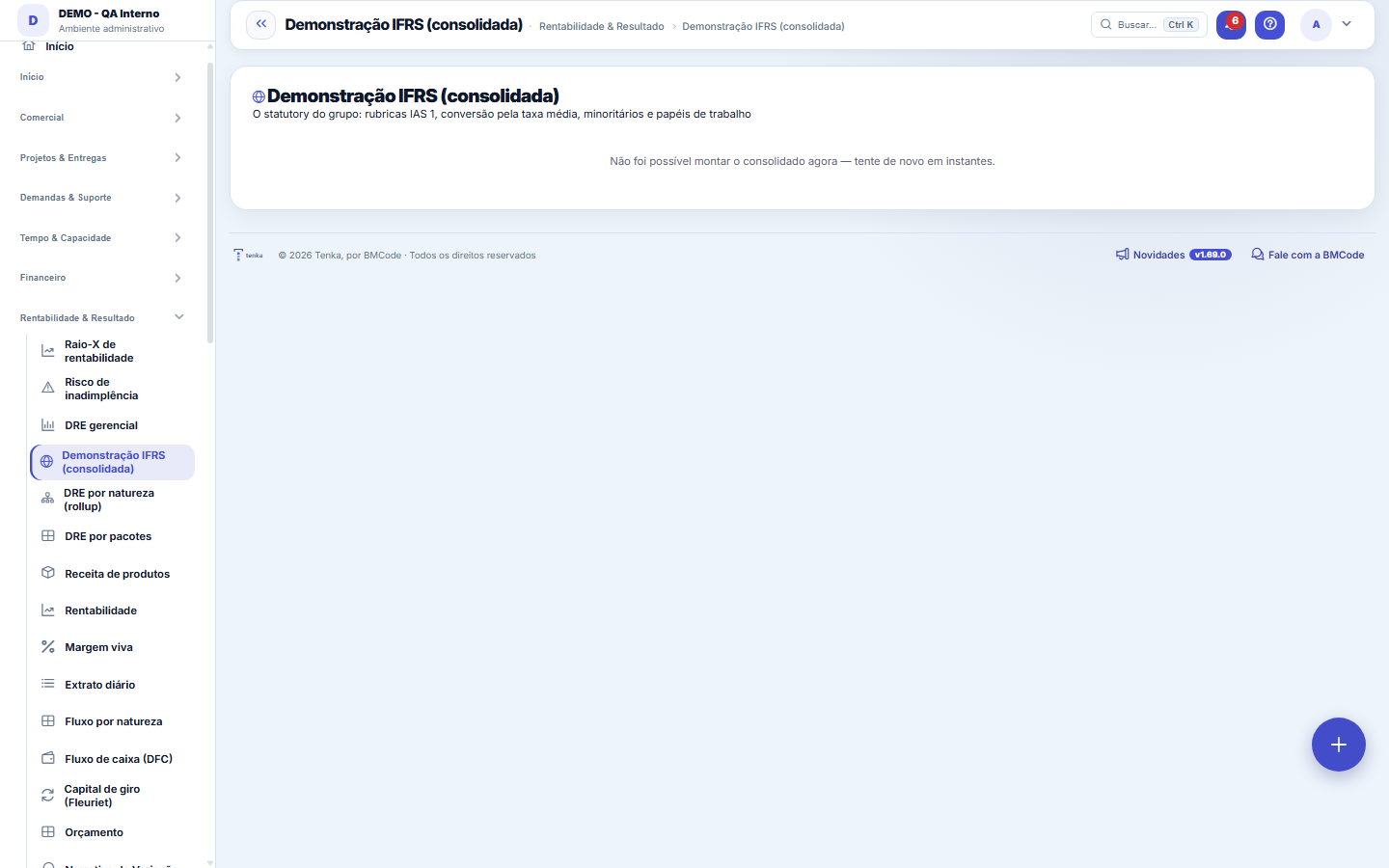
What you find on this screen
A portrait of the screen, read from the screen itself — it changes when the screen changes.
Available actions
Working papers
Form fields
Receita (Revenue)Receita consolidada do grupo nos últimos 12 meses, convertida pela taxa média.
Custo das vendasCusto das vendas consolidado do grupo no período.
Lucro brutoReceita menos custo das vendas do consolidado.
Despesas operacionaisDespesas operacionais consolidadas do grupo no período.
Resultado financeiroResultado financeiro consolidado: receitas menos custos financeiros.
Imposto sobre a rendaImposto sobre a renda reconhecido no consolidado do período.
Resultado de equivalência patrimonialResultado das investidas avaliadas por equivalência, proporcional à participação.
Participação de não controladoresParcela do resultado que pertence aos sócios minoritários das controladas.
Resultado atribuível aos controladoresResultado consolidado que sobra para os controladores, depois de minoritários.
Ativo totalSoma do ativo circulante e não circulante no balanço consolidado.
Patrimônio líquidoPatrimônio líquido consolidado do grupo na data de fechamento.
Reserva de conversão (CTA)Diferença gerada pelas três taxas de conversão do IAS 21, evidenciada como linha própria do PL.
How to
Participação e método vivem em tb_participacaosocietaria
An investee with no declared line consolidates FULLY at 100%. With an interest below 100%, the non-controlling interests' (NCI) result is shown separately. The EQUIVALENCIA (equity method) goes in as a single line: result × interest.
Papéis de trabalho com hash
The button exports company by company: currency, average rate used, method, interest, NCI and eliminations — with a SHA-256 of the content, the same contract as the auditor's package.
A reserva de conversão (CTA) é uma linha, não um ajuste
The CTA is the difference the three rates produce, and it appears as its own line within equity. It isn't a number made up to force the balance: it's the definition of the line. What the screen never does is dilute it into the other groups — if the CTA disappears inside equity, nobody can explain where the difference came from anymore.
Quando o balanço NÃO fecha, a tela diz
The seal below the balance sheet turns red and shows the difference. The two most common causes are a chart-of-accounts account with no type (asset/liability/equity) and an entry with no offsetting side. The working papers give the problem away: section 3 shows company by company, with the three rates and each one's CTA.
Rules
Sem cotação, a empresa BLOQUEIA — nunca taxa 1
A company whose currency differs from the functional one only enters the consolidation with a real rate for the period (average rate, IAS 21). Without a rate it appears flagged as blocked — because a consolidation with a made-up rate is worse than an incomplete consolidation that says so.
O mapa de rubricas é revisável — e a heurística se declara
The category→line mapping was seeded by heuristics (tb_ifrsmapa, origin HEURISTICA). As long as any entry passes through an unreviewed line, the statement carries the note that it is management-to-IFRS, not audited.
Por que TRÊS taxas de câmbio, e não uma
IAS 21 §39 requires assets and liabilities to be translated at the CLOSING DATE rate (the position exists on that date), the period's result at the AVERAGE rate (it was earned over the period) and pre-existing equity at the OPENING rate. Translating everything at the same rate makes the balance sheet balance by construction — and wipes out exactly the information the standard requires to be disclosed.
Sem cotação, a empresa fica FORA — nunca com taxa 1
If the closing or opening rate for a currency is missing, the company is blocked and flagged, instead of entering with an approximate rate. Approximating with the average would recognize exchange differences in the wrong place on the balance sheet, and no one would find out: the balance sheet would still balance.
Consolidated balance sheet without balances between group companies
In the IFRS statement, what one group company has to receive from another, and the other has to pay, is removed from consolidated current assets and liabilities. Only the part that matches on both sides is removed; the difference shows as a mismatch, so you can chase the missing entry. The detail by pair is in the working papers.
Frequently asked questions
Empresa por equivalência entra no balanço?
No, and that's on purpose (IAS 28): the investment goes in as ONE line in the investor's assets, not with the whole balance sheet added in. Adding up the balance sheet of an equity-method investee inflates the group's assets and liabilities — the classic consolidation mistake, which also leaves the balance sheet balancing.
Was this article helpful?
In the same module: What is left8
Value Creation (EVA)EVA answers the question the owner most wants to know: "does my business really create value?" Positive accou…Management P&LManagement income statement for the last 12 months: from revenue to profit, with contribution margin, EBITDA,…ConnectorsConnects Tenka to external systems (ERPs, banks, messaging). Each connector holds a credential and a scope; r…Income Statement by PackagesShows the year's actuals on the SAME tree you used to plan the budget: each package (IT, People, Sales...) su…Plan migration simulationWhat the account gains, what it loses, and how much it will pay — before switching.Product revenueConsolidated view of recurring revenue by product: MRR, active subscriptions, and trend — to see which produc…ProfitabilityThe crown jewel: billed × real cost × margin by customer, contract, project, and person — find out who genera…Value Added Statement (DVA)The DVA tells a social story of the result: how much wealth the company created and for whom it went. It's th…
Tenka Academy
Explore the AcademyStep-by-step learning paths for your industry, inside the platform.