

Workflow status
Anchor screen of the detail dictionary. Does not appear in the menu.
The screen
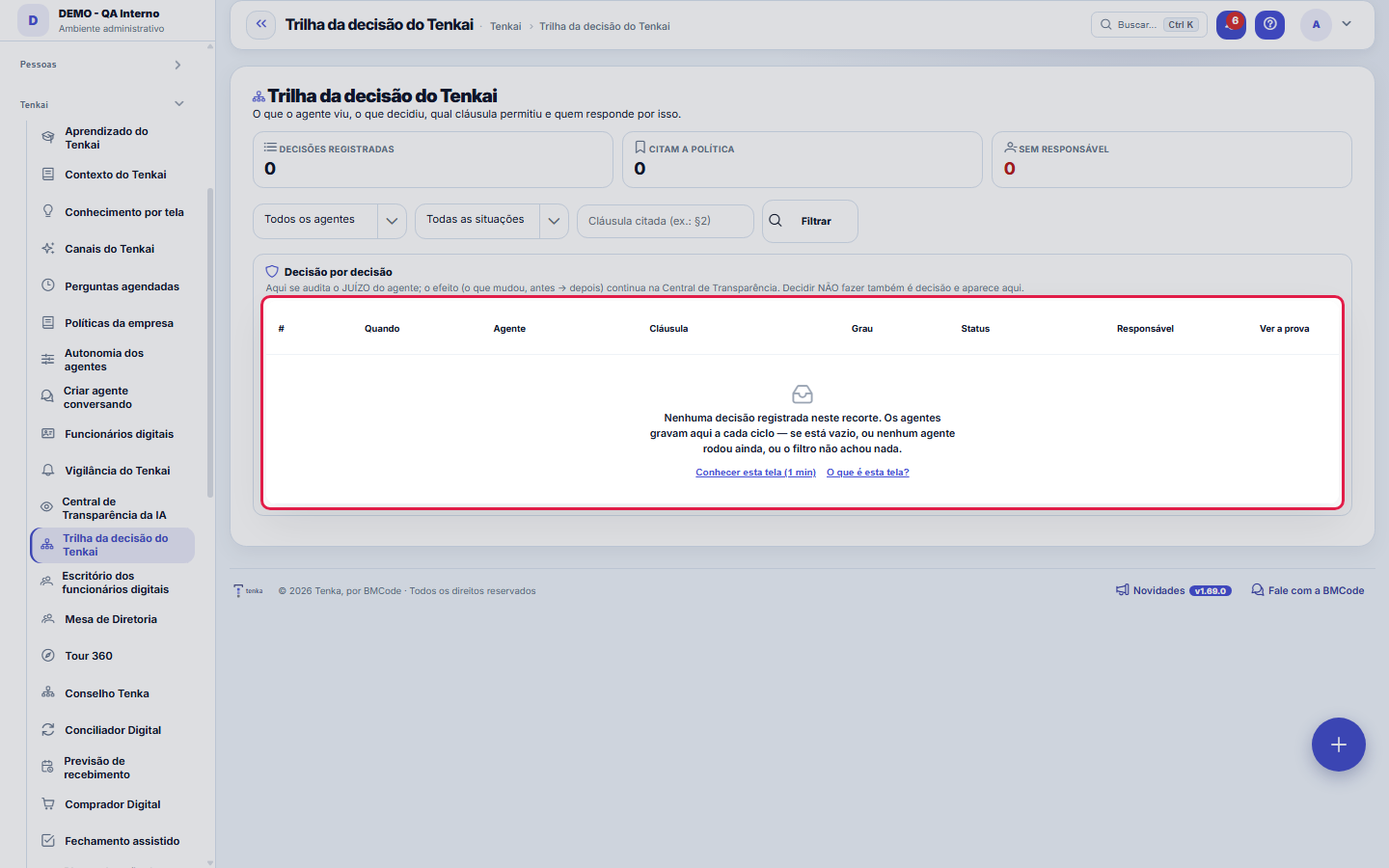
The real screen, in the theme you picked above.
What you find on this screen
A portrait of the screen, read from the screen itself — it changes when the screen changes.
Available actions
FiltrarRecusarRecord reversalAgent autonomy
The list shows
#WhenAgentWhat I decidedClauseLevelStatusOwnerSee the evidence
Form fields
EtapaEm que ponto da rotina o agente parou para decidir. É o passo da trilha.
AgenteQual funcionário digital tomou a decisão registrada nesta linha.
O que o agente viuOs dados que estavam na mesa no momento da decisão, no vocabulário de quem lê.
O que o agente decidiuA escolha feita, escrita em uma frase. É o que se confere quando alguém questiona.
AutonomiaSe o agente podia agir sozinho, precisava avisar ou dependia de aprovação.
SituaçãoSe a decisão foi executada, ficou pendente de aval ou acabou revertida.
Valor envolvidoQuanto dinheiro a decisão movimenta. É ele que define qual alçada precisa entrar.
MoedaMoeda do valor envolvido. Sem ela somar decisões de países diferentes dá número errado.
Cláusula citadaQual regra da política o agente invocou para justificar o que fez.
ProvaOnde ver o documento ou o registro que sustenta a decisão.
Decidida emData e hora da decisão. É a âncora para reconstituir a ordem dos fatos.
Revertida emQuando alguém desfez o que o agente fez. Vazio significa que segue de pé.
Motivo da reversãoPor que a decisão foi desfeita. É o campo que ensina o agente a não repetir.
How to
Filtrar por cláusula e exportar
The audit question is almost always by clause or by responsible person — both are filters here. The result comes out in CSV through the page's export button.
What the trail shows for a routine that acts
Each action step of a routine shows here with the status the policy gave it: Applied (done, with the system’s reply), Awaiting review (proposed and waiting for CONFIRM, with the code), Suggested (only noted what it would do) or Blocked by cap (over the day’s action limit). The execution summary adds up all four — proof, for the owner and the auditor, that the agent did only what it was allowed to.
Rules
O texto da cláusula fica congelado na decisão
The trail keeps the clause's code and also its text as it was on that day. Keeping only the link would answer tomorrow's question with tomorrow's rule, which is not the one that decided.
Toda decisão tem um humano responsável
The one responsible isn't whoever clicked — in an autonomous decision there is no click. It is the human configured on the Autonomy screen as responsible for that agent. An agent with no one responsible is an orphan decision, and the screen highlights it.
Decidir NÃO fazer também é decisão
The line "I decided not to collect because there was an open agreement" is as auditable as the one that acted. A trail that only records actions hides exactly the case where the agent failed to do what it should have.
A prova da decisão: o que é, e o que ela esconde de quem não pode ver valores
The evidence is what the agent READ before deciding — the facts, with the source of each one — plus the autonomy level of that step, the amount involved and the policy clause that applied. It is the answer to "based on what?", which is different from "what it did" (the step by step) and from "under which rule" (the policy). A run before September 2026 has no attached evidence, and the screen says so instead of showing an empty space. Whoever doesn't have the "View Values" permission gets the amount hidden: it is masked on the server, before it goes out — hiding it only on screen would leave the number accessible in other ways.
Frequently asked questions
A diferença entre esta tela e a Central de Transparência
The Center audits the NUMBER (the scoreboard, the calculation record) and what CHANGED. This one audits the DECISION: what the agent saw, what it decided, under which clause and who answers for it. One run usually contains many decisions.
Why the trail has more records than before
Because until September 2026 only two of the six engines that act on their own wrote to it. The Buyer, the Seller and the Process Analyst acted without recording decisions, and the Reconciler only recorded when someone undid something. As of this version all of them go through the same gate — autonomy level, written policy and record — including when the decision is to do NOTHING. That case is the most important of all: without it, "why did nobody collect this month?" had no answer anywhere.
O que é o passo a passo que aparece dentro da decisão
It is what the agent DID to reach that decision, in the order it did it, read from the record and not from the summary it wrote. The trail always answered "what it decided and under which rule"; what was missing was "what it did to get there", and that is the question of whoever is evaluating whether to move that agent up from confirm to execute. A run before September 2026 has no recorded steps, and the screen says so instead of showing an empty list — an empty list would read as "the agent did nothing", which is the opposite of the truth.
Was this article helpful?
In the same module: Digital employees23
Sprint developerAnchor screen of the detail dictionary (allocated devs). Does not appear in the menu.Workflow transitionAnchor screen of the detail dictionary. Does not appear in the menu.Caixa de entrada dos funcionários digitaisO que os agentes estão esperando de você, reunido num lugar só e separado por urgência.Accountant's cockpitThe accountant's dashboard: what's pending, what's due, and what needs approval, per company in the portfolio…My hiresThe marketplace transactions with the flow open: the ones I hired (I am the buyer) and the ones that hired me…Proprietary credit scoreThe credit risk of each drawee (customer) measured by the OBSERVED BEHAVIOR in your own operation — not a bur…Auditor package (SOC 2)The package handed to an auditor: the Segregation of Duties (SoD) matrix with the violations found — profiles…Agent builderFrom a request in Portuguese to the agent: interpret, review the powers one by one, rehearse without executin…
Tenka Academy
Explore the AcademyStep-by-step learning paths for your industry, inside the platform.