

Incidents
Where the platform opens, updates, and closes the incidents that appear on the public status page. An incident left open and forgotten needlessly alarms customers; updating and closing are as much a part of the incident as opening it.
The screen
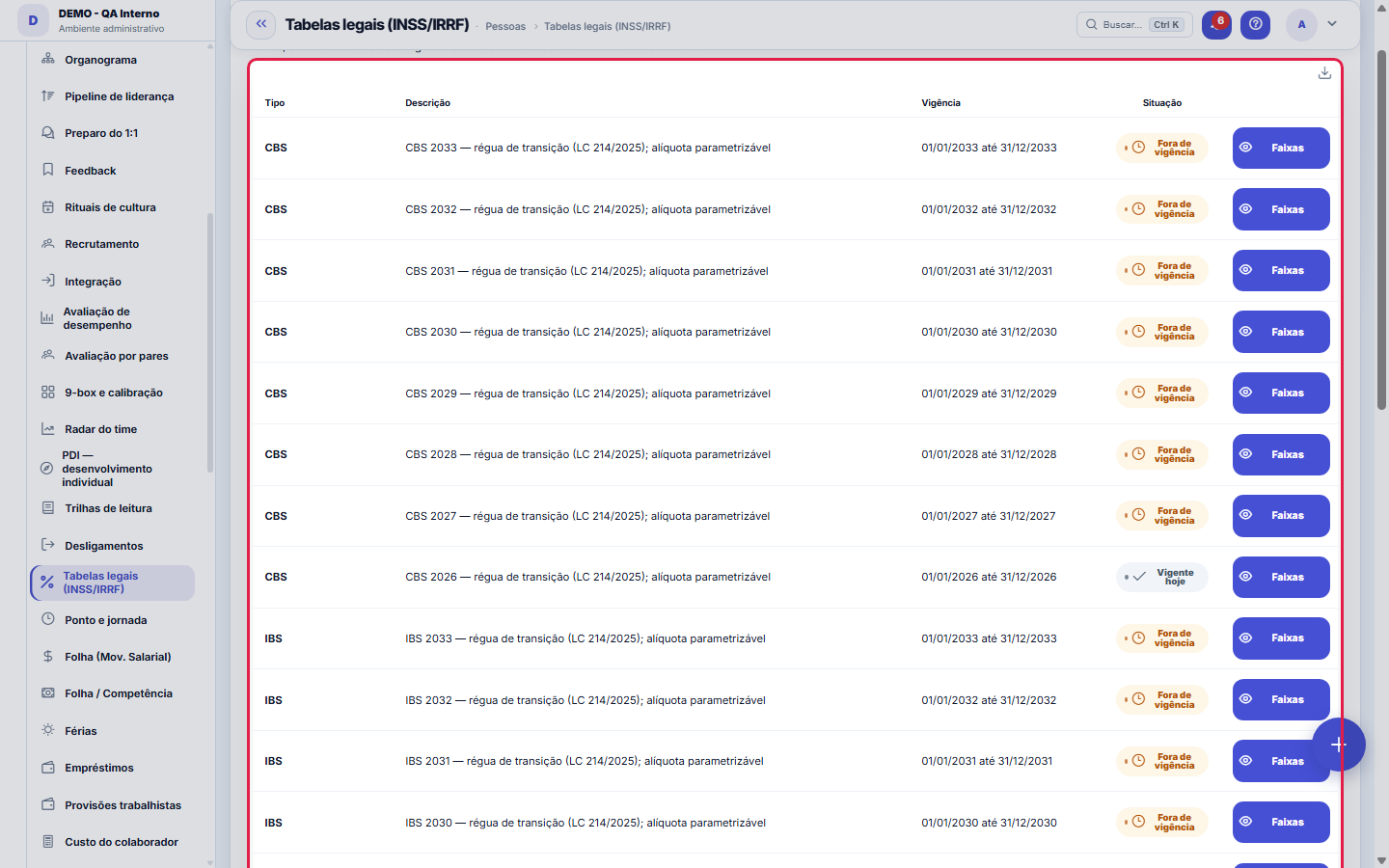
The real screen, in the theme you picked above.
What you find on this screen
A portrait of the screen, read from the screen itself — it changes when the screen changes.
Available actions
BracketsClose
The list shows
TypeDescriptionEffective periodStatus#JurisdictionFromToRateAmount to deductAmount
Form fields
VigênciaPeríodo de validade daquela tabela legal, com início e fim quando houver.
Situação da tabelaSe a tabela está vigente hoje ou fora de vigência.
Limite inferior da faixaValor inicial da faixa de cálculo.
Limite superior da faixaValor final da faixa de cálculo; vazio significa acima do topo.
AlíquotaPercentual aplicado sobre a base naquela faixa progressiva.
Parcela a deduzirValor subtraído do imposto calculado na faixa de IRRF.
Valor da faixaValor fixo da faixa, usado nas tabelas não progressivas.
Dedução por dependenteValor deduzido da base de IRRF por cada dependente.
Desconto simplificadoDesconto único alternativo do IRRF, aplicado quando é mais vantajoso.
Start here
What this screen answers
The INSS, IRRF, family allowance and ceiling brackets that payroll uses in the calculation. They are effective per period: running one month's payroll with another month's table gets the deduction wrong without flagging an error — check the effective date before closing.
O que esta tela faz
Legal tables versioned by effective date (INSS, IRRF, family allowance, ceiling and minimum wage) that feed the payroll calculation. Register a new effective version when an ordinance changes the brackets — payroll for previous months keeps adding up.
Rules
Income tax: dependent and simplified deduction
In the IRRF table, besides the brackets with rate and amount to deduct, two deductions apply: the per-dependent deduction (multiplied by the number of dependents registered for the employee) and the simplified discount — and the one most advantageous to the employee is always applied. Both values appear at the bottom of the brackets dialog for the selected effective version, opened by the row's "Brackets" button.
Where the royalty-abroad rate comes from
The withholding tax line for royalties paid abroad carries 15% under Provisional Measure 2,159-70/2001, art. 3, checked against the original publication by the Chamber of Deputies (the link is in the source column). The CIDE on remittances (10%) comes from Law 10,168/2000. A tax treaty with the licensor country can lower the withholding tax: enter the treaty rate in the company parameter. A licensor in a country on the Federal Revenue favored-taxation list pays 25% (Law 9,779/1999, art. 8): the list (IN RFB 1,037/2010) and the rate are on this screen, with the source.
The favored-taxation list and the rates for royalties abroad
The line "Countries and dependencies with favored taxation" holds the list of IN RFB 1,037/2010, art. 1, checked against the Federal Revenue consolidated text on 10/17/2026 (latest change: IN RFB 2,265/2025, which removed the United Arab Emirates). Open the brackets to see the 60 jurisdictions by item number. When the Federal Revenue changes the list, register a new validity: older statements keep the list of their period. Next to it are the 25% withholding tax for those jurisdictions (Law 9,779/1999, art. 8), PIS on imports at 1.65% and COFINS on imports at 7.6% on services from abroad (Law 10,865/2004, until 12/31/2026) and the exchange IOF at 3.5% (Decree 6,306/2007, art. 15-B), the last only as an estimate. Each line shows the source with the link and the date it was checked.
Frequently asked questions
Entrou tabela nova — a folha antiga muda?
No: the tables are versioned by effective date, and each payroll uses the table in force for its period. When an ordinance changes the brackets, a new effective version comes in with its start date — the previous one gets an end date and keeps covering the old months, which keep adding up. The "in force today" badge indicates which version applies now; the others remain as history you can consult in the brackets dialog.
Was this article helpful?
In the same module: Payroll and compensation10
Payroll periodA month's payroll: employees with earnings, deductions and net pay, the events and the contractor's service i…Convenções coletivasA convenção do sindicato com vigência, data-base, piso geral e por função, a garantia de quem ganha por peça,…Employee costThe X-ray of cost: gross salary × real cost with charges, side by side — "how much the margin lies" without t…Profit DistributionThe formal distribution of results among the partners: accrual period, amounts per partner, and automatic pos…Loans and advancesControl of what the company has advanced to the employee and how it is paid back: installments, outstanding b…Salary movementEach employee's compensation history: how much they used to earn, how much they now earn, when and why.Payroll by periodLightweight monthly payroll: events (salary, bonus, deductions) per person → generates the period's "payable"…VacationVacation scheduling and record-keeping: periods, status, and the effect on team capacity planning.
Tenka Academy
Explore the AcademyStep-by-step learning paths for your industry, inside the platform.