

Credit score
Classifies customers by default risk (A–D) to guide credit limits and collections. The score is a probability, not a sentence: a good payer can have a bad month. Use it to prioritize the collections workflow, not to deny a relationship.
The screen
The real screen, in the theme you picked above.
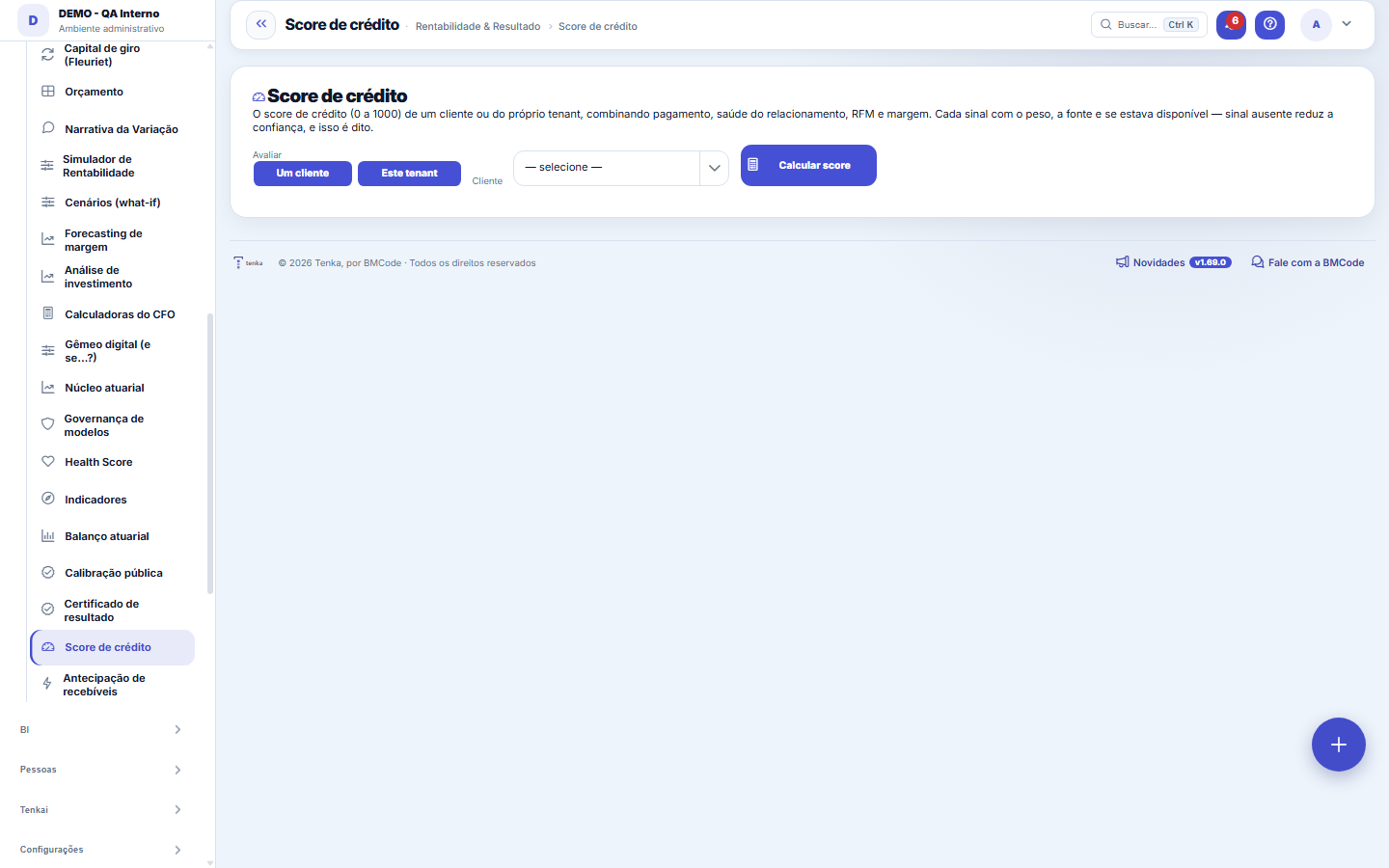
What you find on this screen
A portrait of the screen, read from the screen itself — it changes when the screen changes.
Available actions
Calculate scoreView the calculation trace JSON
The list shows
SignalSourceWeightScore (0-100)Calculation basis
Form fields
ClienteCliente avaliado. O score é dele, não do contrato.
ScoreNota de 0 a 1000 calculada a partir do histórico de pagamento e do relacionamento.
FaixaA letra que resume o score (A a E). É por ela que a alçada de crédito decide.
Limite sugeridoLimite que o cálculo recomenda. Sugestão, não decisão — quem libera é a alçada.
ConfiançaQuanto dos sinais estava disponível no cálculo. Confiança baixa é score com pouca base.
Tem dadosSem histórico não há score, e a tela diz isso em vez de mostrar zero.
Start here
O que esta tela responde
How good a customer's credit is, from 0 to 1000, using what already exists in your system: payment and delinquency history, relationship health, recency/frequency/value of purchases and margin. It gives the band (A to E) and a suggested credit limit.
How to
Confiança e limite sugerido: como ler
Confidence is the percentage of signals that were available in the calculation — a missing signal appears marked as "(missing)" in the record, does not score and pulls confidence down; a customer with little history tends to have low confidence before having high risk. The suggested limit is guidance: a reference derived from the score, not a credit approval — the decision is still yours. The calculation record (including the full JSON) shows the weight, source and score of each signal, precisely so you can disagree with good reason.
Rules
A memória de cálculo fica aberta
Each signal appears with the weight it had, the source it came from and whether it was available. It lets you disagree with good reason: you can see exactly which signal pulled the score down or held it up, instead of just receiving the number.
Cliente novo tem score baixo por FALTA de histórico, não por risco
When a signal does not exist, it is not guessed — the score's confidence drops and the screen says so. In practice, a newly registered customer with no payment history in the system tends to score low simply because there is nothing to measure. Read the confidence together with the score. And the limit is SUGGESTED: nothing here approves credit or blocks a sale — the decision is still yours.
Frequently asked questions
Posso mudar o score de um cliente à mão?
Não — o score é probabilidade calculada do histórico, com a memória de cálculo aberta. O que você decide é o LIMITE e a política de cobrança a partir dele. Cliente novo tem score baixo por falta de histórico; isso se corrige com pagamentos, não com edição.
Was this article helpful?
In the same module: Capital2
Tenka Academy
Explore the AcademyStep-by-step learning paths for your industry, inside the platform.